
November Lawn & Landscape Tips
The weather the last couple of days of October ushered in the feeling of fall.
Fall… Crisp jacket wearing mornings.
Fall… Pleasant short sleeve afternoons.
Fall… Red and yellow leaves brightening blue skies.
Fall… Warm season lawns gradually fading from summer green to winter browns.
Fall… Cool season lawns adding rich green hues to the landscape.
Fall… What a great time to be outside!
Fall... November… Less lawn and landscape tasks, right?
Well, yes. But, even though there are less, there are still very important tasks if your goal is to have your best lawn and landscape.
Lawn Fertilizer
Fescue and rye lawns need their second fall fertilizer application in late October through November. Fall is the best time of the year to fertilize cool season lawns. Bermuda lawns do not need any more fertilizer this year. A good lawn care program will fertilize cool season and warm season turf on a different schedule making sure they each receive fertilizer at the correct times of the season.
Learn More: Fall…Does My Lawn & Landscape Still Need Fertilizer? October 19, 2025
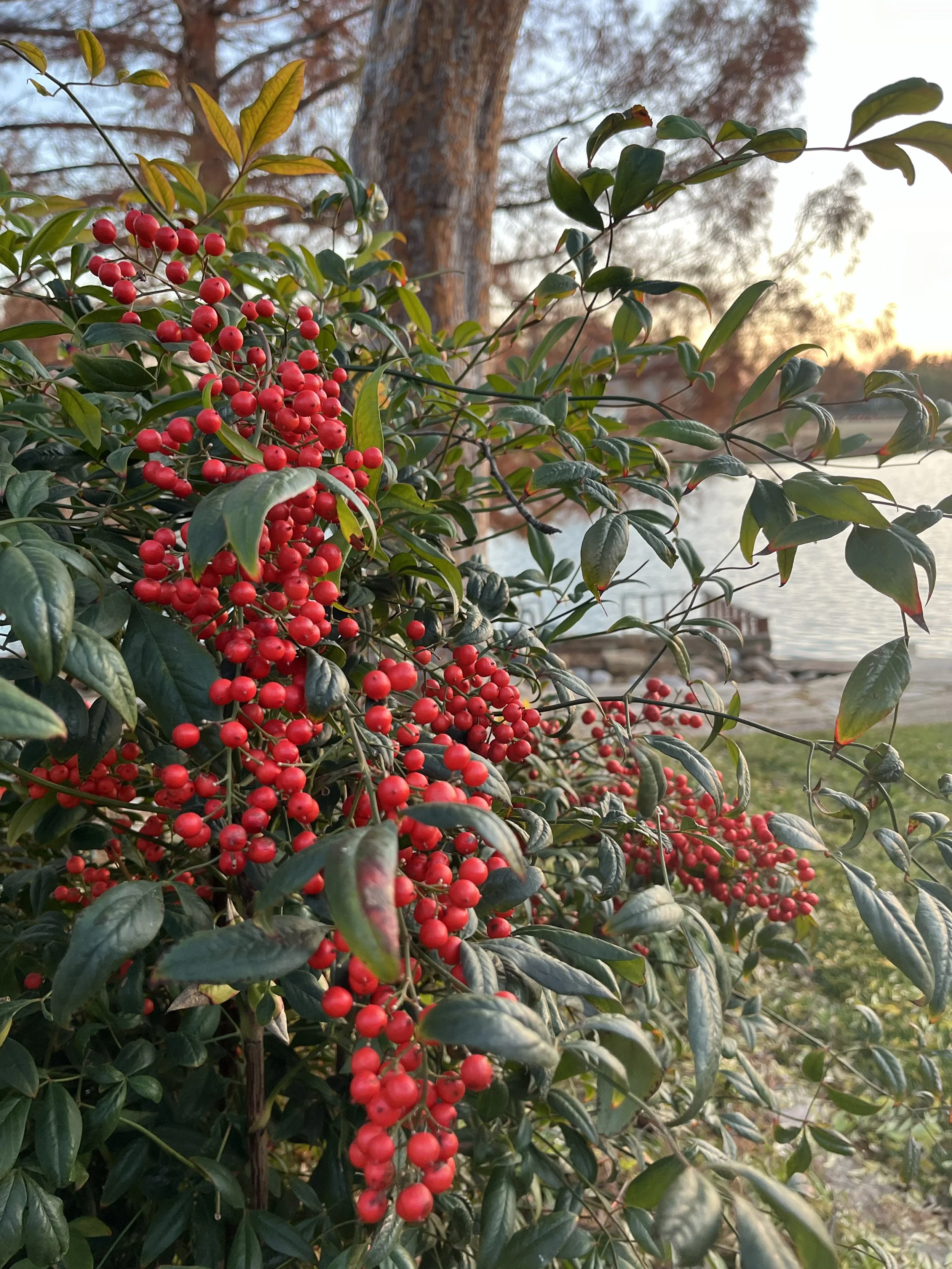
Plants that produce berries, such as nandina, add bright colors and interest to the fall and winter landscape.
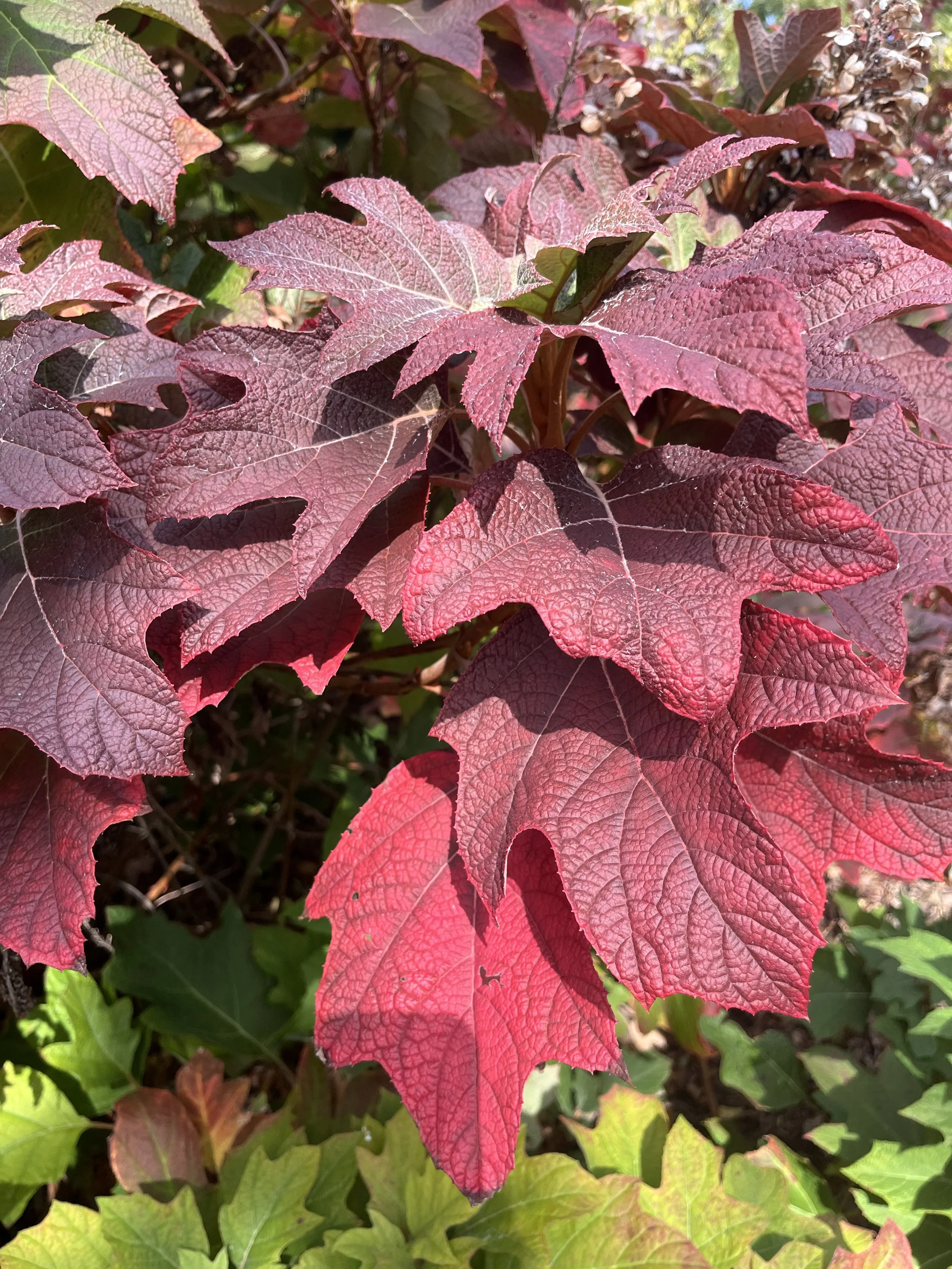
Oakleaf Hydrangea, know for their early summer blooms, also adds color to the fall landscape.
Weed Control
This month is a good time to control broadleaf weeds in your warm season and established cool season lawns. Dandelions and other broadleaf weeds are typically small at this point and easier to kill. If you overseeded your lawn with fescue or rye this fall, do not apply any weed control products until the new grass is well established and has been mowed a few times.
If you have not applied a pre-emergent to your lawn this fall, please do so as soon as possible. And if you applied a fall pre-emergent in August or September, a second pre-emergent should be applied between mid-October to early December for best prevention of winter weeds. A clean start next spring is the result of two timely fall applications.
Learn More: Why A Second Fall Pre-Emergent Is Important. October 12, 2025


Perennial Tip: If you have mums in pots this fall, don’t throw them away when they are finished. Instead, add them to your landscape. These mums, used as a perennial, where in pots last fall.

Pyracantha is another fall berrying plant. There are varieties with orange, yellow or red berries.

The blue berries of Hollywood Junipers add interest to the fall and winter landscape.

Poa Annua, one of the hardest to control winter annual weeds, is best prevented when a second fall pre-emergent is applied in late October to early December.
Fertilizing Trees and Shrubs
Once your area has received a freeze, it is time to apply a good balanced fertilizer to your trees and shrubs. Our soil temperatures remain above 40 degrees most of the winter and plant roots remain active. Because nitrogen leaches from the soil, it needs to be replaced. Our experience has found that a late fertilizer application to feed the roots will aid the health and beauty of your plants next spring.
Learn More: Fall…Does My Lawn & Landscape Still Need Fertilizer? October 19, 2025

Now is the perfect time to add pansies to your fall landscape.

The bright colors of summer loving annuals will be gone as soon as we receive a killing frost.
Seasonal Color Planting
If you have not removed your summer color and replaced them with pansies and kale, now is the time to do it. Soon, as nighttime temperatures continue to cool, any remaining summer color will be done for the season. Because soil temperatures stay warm through November, you still have time to plant pansies.
Learn More: Coming Soon To A Landscape Near You – Fall Seasonal Color! September 21, 2025

Spring Bulbs
November through early December is the best time to plant spring flowering bulbs such as daffodils, hyacinths, and tulips. I have never heard anyone in March say they wish they hadn’t planted bulbs last fall. But, every year I hear someone say how much they wish they would have taken the time to plant bulbs last fall.
Learn More: Plan Now. Plant Next Month. Enjoy Next Spring! October 26, 2025
Lawn Mowing
Warm season lawns, bermuda and zoysia, most likely have had their last mowing or will very soon. Do not scalp warm season turf to end the growing season. Cool season lawns, fescue and rye, will continue to grow and flourish. Continue to mow fescue and rye on a regular schedule. The best height to maintain your cool season lawn in the fall is 2.5” to 3”.

A common appearance of bermuda lawns is a spotty pattern after a heavy frost.
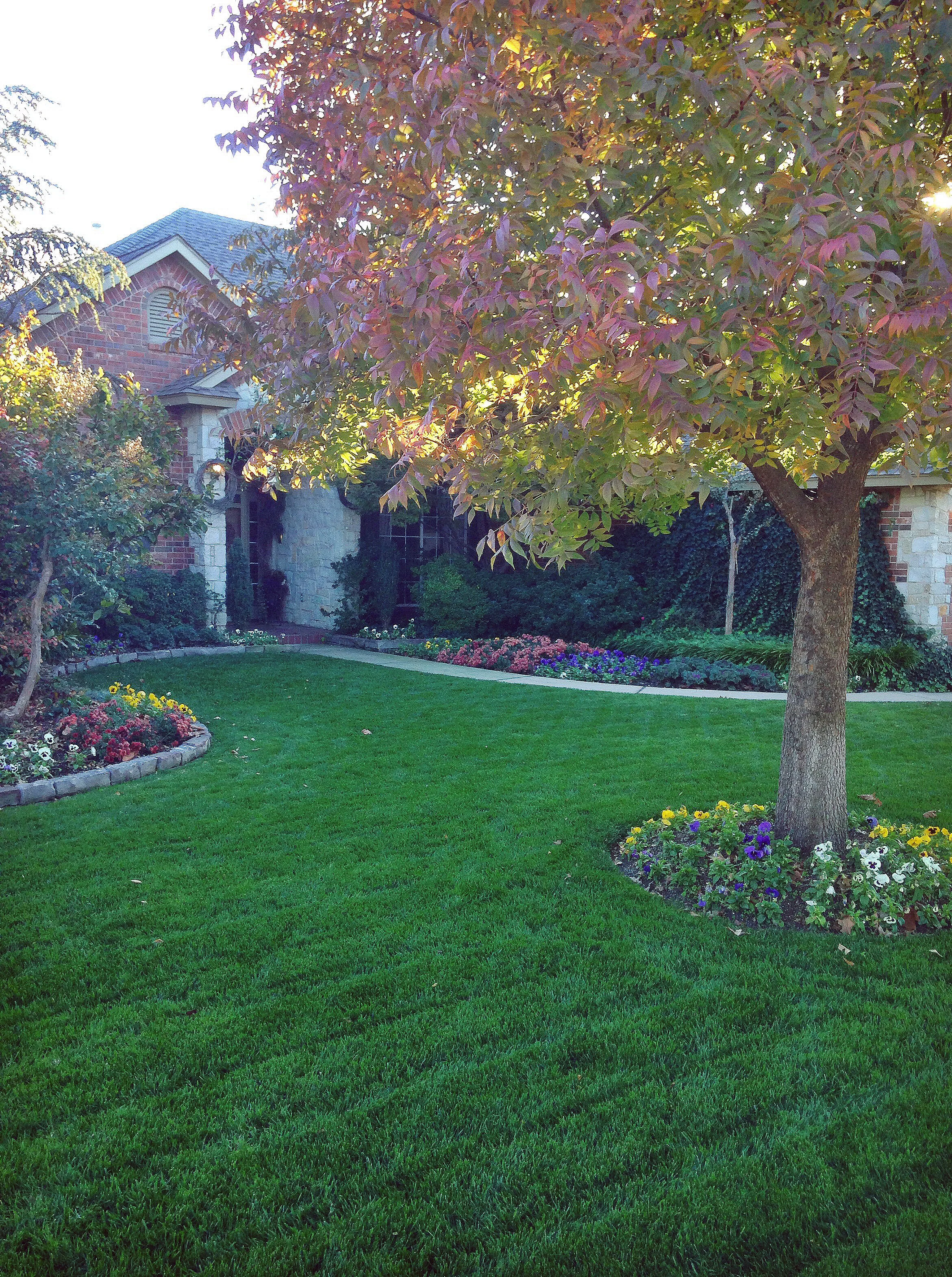

Autumn Blaze Maples have started adding dynamic reds to the landscape. It is one of the first maples to turn in the fall while the October Glory Maple is one of the last.


Ash trees add bright yellows to the early fall landscape.

Chinese Pistache is a medium sized tree with an oval round growth habit and spectacular fall color in shades of yellow, orange and red.
Leaf Removal
It is important to keep leaves cleaned up. Allowing them to decay on the lawn promotes fungus and disease. If you have a cool season lawn, it is critical to keep the leaves removed. Fescue and rye need light. Allowing leaves to remain on the lawn for extended periods of time will kill areas of your lawn. My favorite way to remove leaves from my fescue lawn is to mulch mow every 5-7 days. I find that mulching small amounts of leaves back into the lawn improves my soil structure. I only rake and bag leaves when leaf drop is too heavy to mulch mow.
Learn More: Leaf Clean-up Is A Matter Of Lawn Health. November 10, 2024

A great way to manage leaf clean up is to mulch mow the leaves every 4-5 days.

If you have a fescue lawn it is very important to remove leaves at least weekly. Fescue needs light and will fade away if leaves are allowed to accumulate on the grass.
Irrigation
Until we received a good rainfall last weekend, most of the metro area had gone over 50 days with only a couple of very small rainfalls. A good rainfall headed into November, one of our driest months, was much needed by your lawn and landscape.
Lack of moisture is a major cause of winter damage to trees and shrubs. Particularly, your evergreens need moisture even when the landscape is dormant.
With cooler temperatues and shorter days, you may not need to water as often. But it is too early to stop watering all together.
This time of year, I will either set my irrigation to run every 4 days or leave it on every other day and turn it off for a few days when we receive at least a ½” rainfall.
If your irrigation backflow device is located below ground, inside your garage/house, or has winter protection (heat tape, insulated bag, and cover) you do not need to winterize your system for the winter. Continue to use the system as needed on nice days throughout the winter.
If your system’s backflow is not protected from freezing temperatures, consider adding heat tape, an insulated bag and cover. This will allow you to protect your landscape investment by watering as needed this winter. You can also take it one step further and install a rain/freeze system that will shut the system off when it is too cold, or we have had rain.
Key Point – Most landscape winter damage occurs when the top few inches of soil are dry when temperatures are below freezing.
Learn More: Fall Irrigation Changes Coming Soon! October 5, 2025


Irrigation systems are required to have a backflow device installed to prevent irrigation water from re-entering the city water supply. Without freeze protection, your system needs to be shut down for the winter.

The traditional way to protect your backflow from freezing is to wrap it with heat tape and cover with an insulated bag and mock rock. With freeze protection you can continue to use your system as needed through the winter.


Autumn Blaze Maples, one of the first maples to turn in the fall, started adding bright reds to the landscape this week.
Seeding Fescue
The best time to overseed fescue is September through October. If you have not seeded this year and need to, even though we are into November, you can still have success seeding in early November. Remember the keys are good seed to soil contact and keeping the seed moist until it germinates. With cooler temperatures you can expect it to take a little longer to see results than the typical two weeks, and depending on temperatures in November and December, the results may not be fully seen until spring.
Learn More: Plan Now. The 4 Most Common Ways To Fail At Establishing Fescue. September 7, 2025
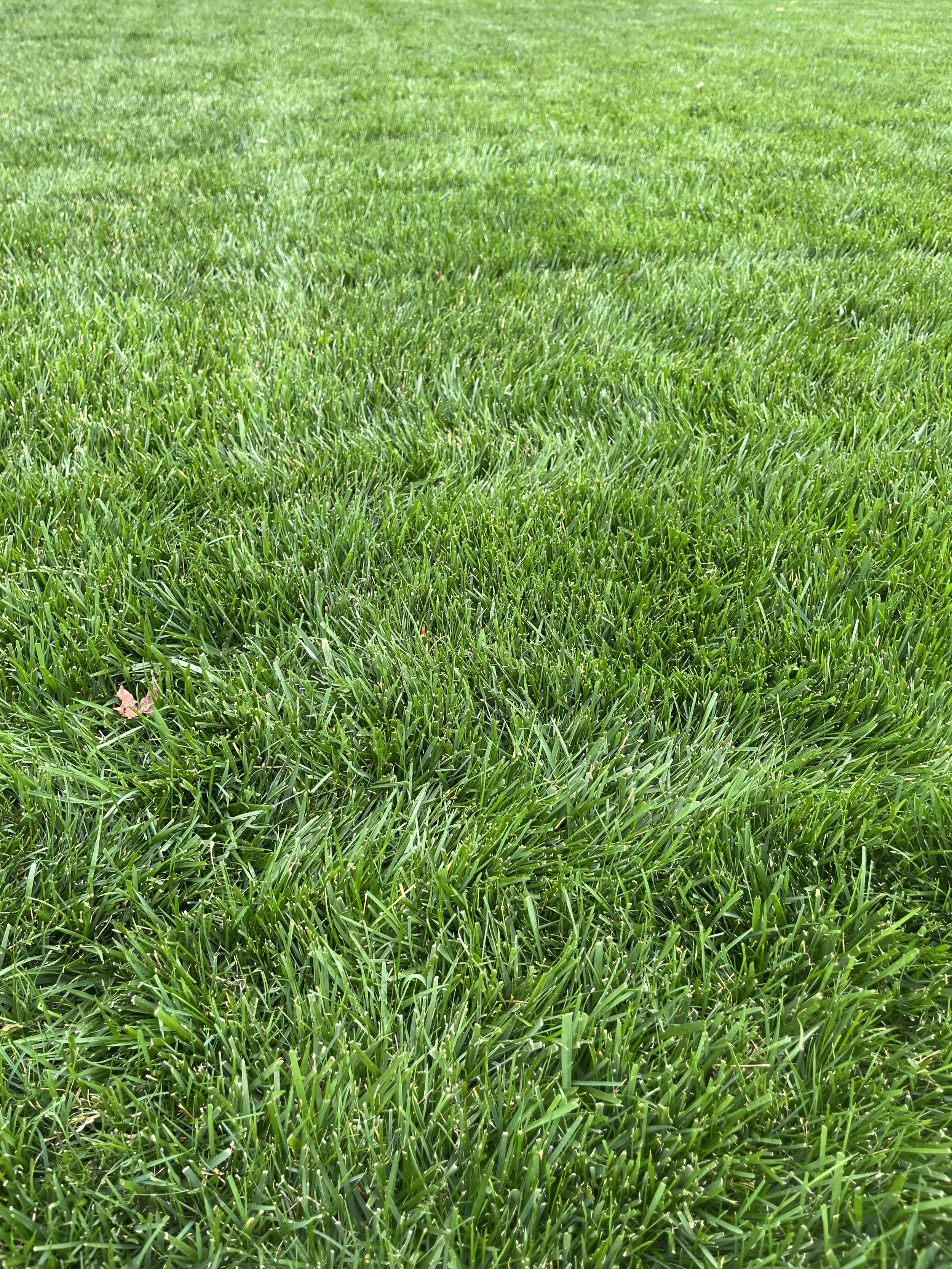
If you overseeded your lawn with fescue in September or October, keep the seed consistently moist, and followed up with a fertilizer application in the last month, your fescue is most likely looking its best headed into November. If you need to do any touch up seeding, with the extended warm soil temperatures, you still have time to add more seed.

If you didn’t prune the spent blooms off your reblooming hydrangeas after they faded, the dried out, spent blooms of late summer turn bright pinkish-red colors in the fall.

Autumn Sage is a perennial that is great for adding reds and pinks to your fall landscape.

One of the great colors of fall comes from an unexpected plant, an ornamental grass - Pink Muhly Grass.


Ginkgo trees will add a bright yellow to the landscape this month.

Chinese Pistache trees are starting to add yellows, oranges and reds to the landscape.

Sumac is a great midsized plant, perfect for planting under large trees, that will add splashes of color through the fall.

Oak trees will grace our environment with reds and browns before the end of November.
So, November doesn’t mean it is time to put up the lawn and landscape tools. Your lawn and landscape still need plenty of attention.
Your best lawn and landscape next spring is the result of how well you finish the season this fall.
If you have questions or need help, send us an email, or give us a call.
Lorne Hall
Hall | Stewart Lawn + Landscape
(405)367-3873
Plan now. Plant next month. Enjoy next spring!

Awe…much needed rainfall returns, and the feeling of fall is in the air!
But hold on, before our thoughts turn to all things fall, let’s leap forward and talk about one of my favorite things about spring!
What requires planning now, planting next month, but you don’t get to enjoy until next spring?
Spring Flowering Bulbs!
There may not be a better example of delayed gratification than spring blooming bulbs.
The wonderful blooms of tulips, daffodils, and hyacinth cannot be added to the landscape in the spring on a whim.
The most vibrant colors you will enjoy next spring require planning now and action next month to experience them next spring.

If you have problems with deer eating your flowers, plant daffodil bulbs. Daffodils contain a bitter substance that deer won’t eat.
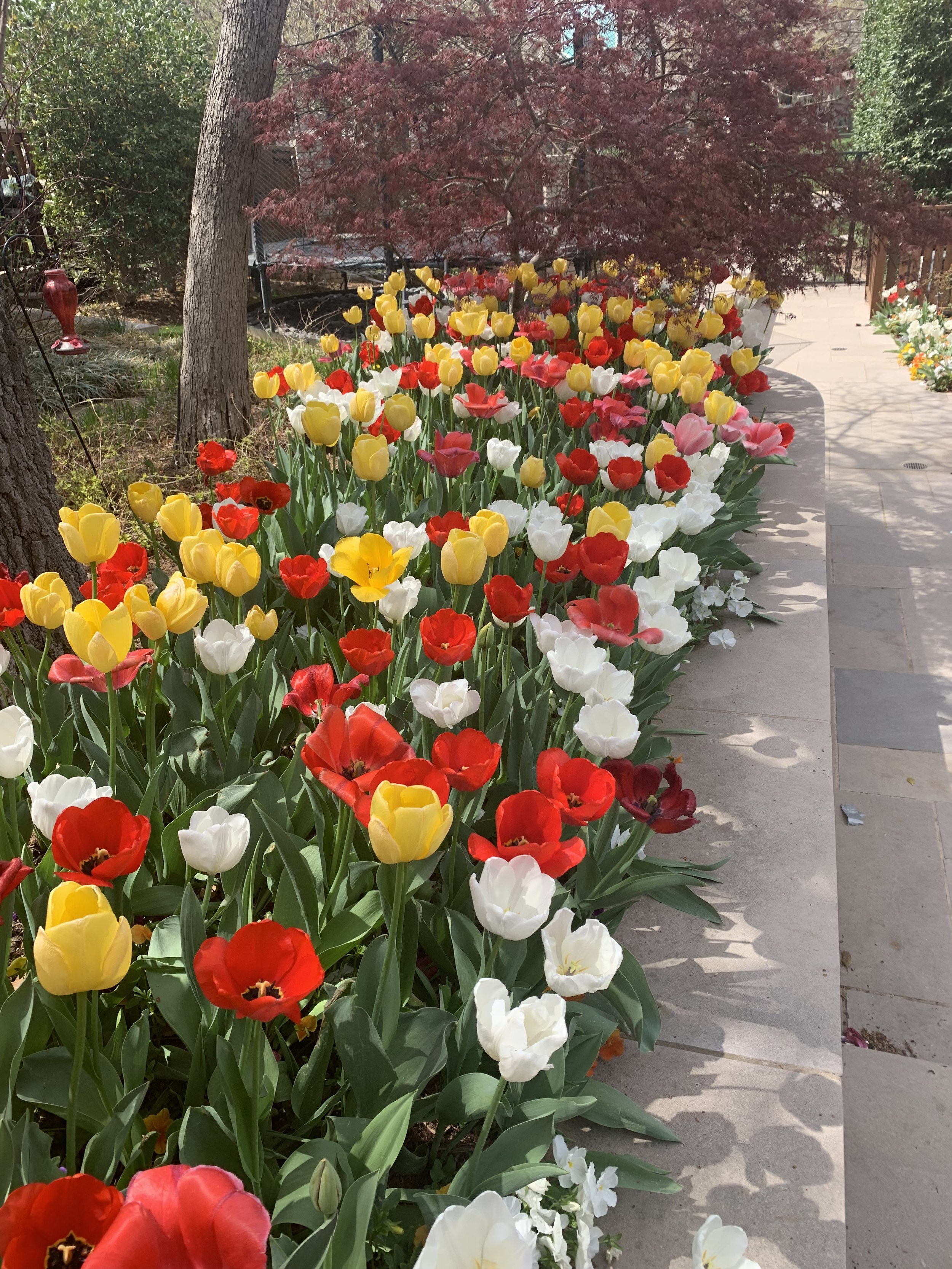


Tulips at the Myriad Gardens.
Let’s answer a few questions so you can have dynamic color next spring:
When to plant?
Spring blooming bulbs need to be planted from early November through mid-December. They are best planted after the first freeze, which in central Oklahoma is typically November 2nd. And, because spring bulbs require winter chilling for successful blooming, it is best to plant them within 6 to 8 weeks after the first freeze. Planting later may greatly diminish your success.
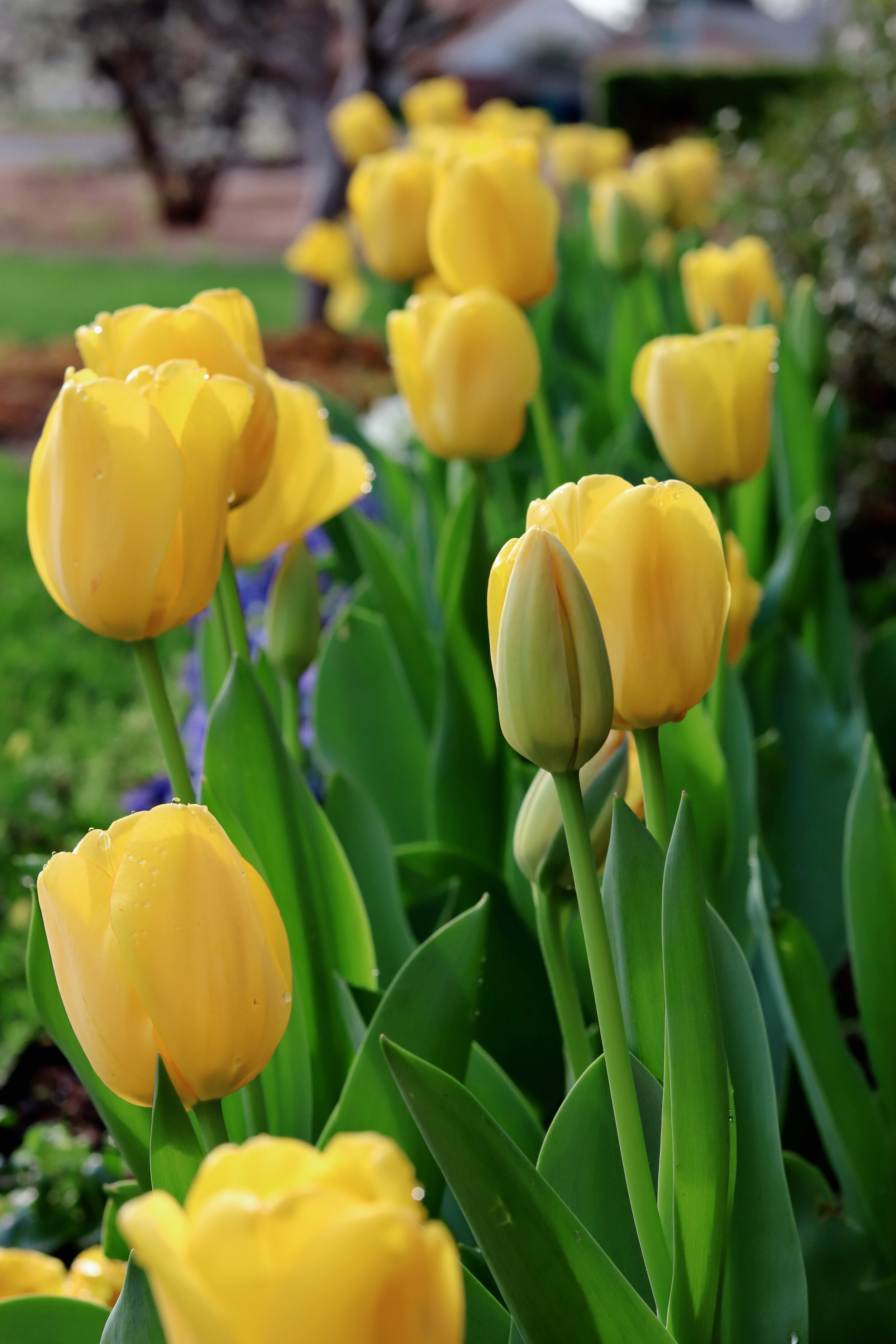


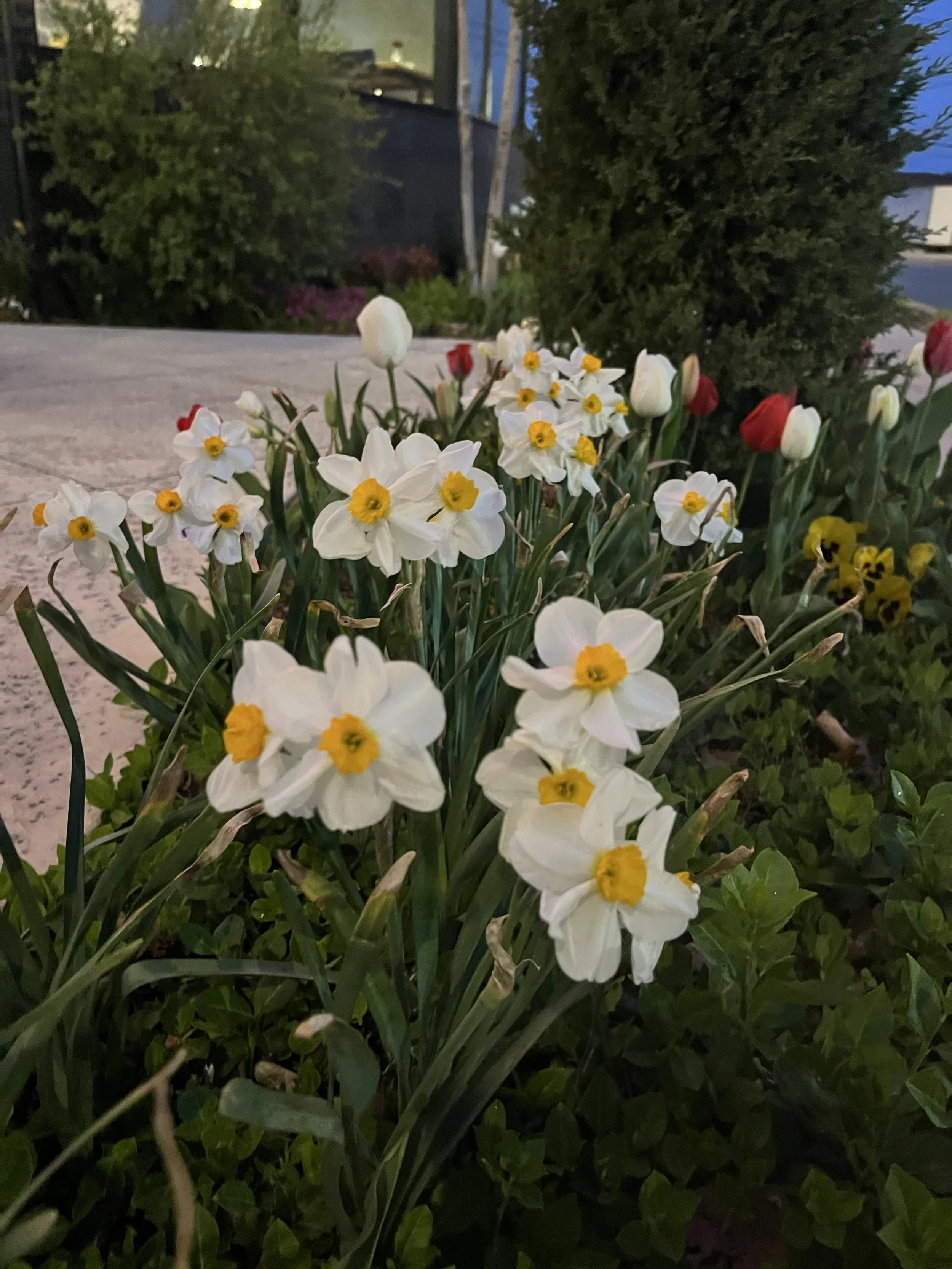
Daffodils are a spring blooming bulb that is very forgiving of our tight clay soils and are perennials in our area (meaning they will come back year after year).
Where to plant?
Bulbs require well drained, rich, organic soil. They do not perform well in the native, tight clay soils that dominate central Oklahoma. All spring blooming bulbs prefer full sun, but because they grow and bloom while trees are mostly dormant, you can have success planting under deciduous trees. Tulips perform best as far south as USDA Hardiness Zone 6. If you live in southern Oklahoma, daffodils and hyacinths are a better choice for spring blooming bulbs.

How to plant?
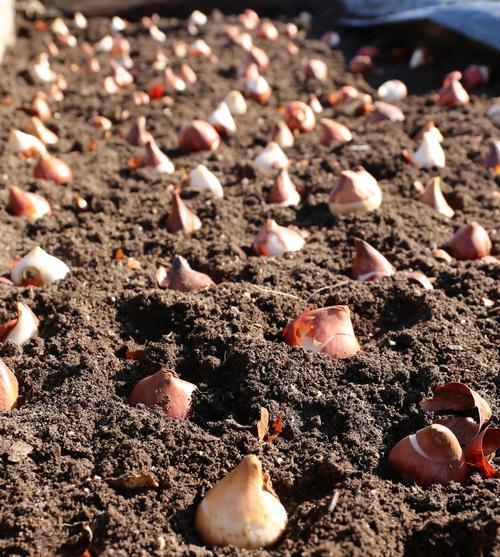
Bulbs should be planted at a depth of two times their height, or approximately 3-4”. Shallow planting exposes cool season bulbs to summer heat. Plant with the rounded end down and the pointed end up. Bulbs do not need to be fertilized when they are planted. But, if your soil is not rich in organic material, I recommend mixing in compost when planting.
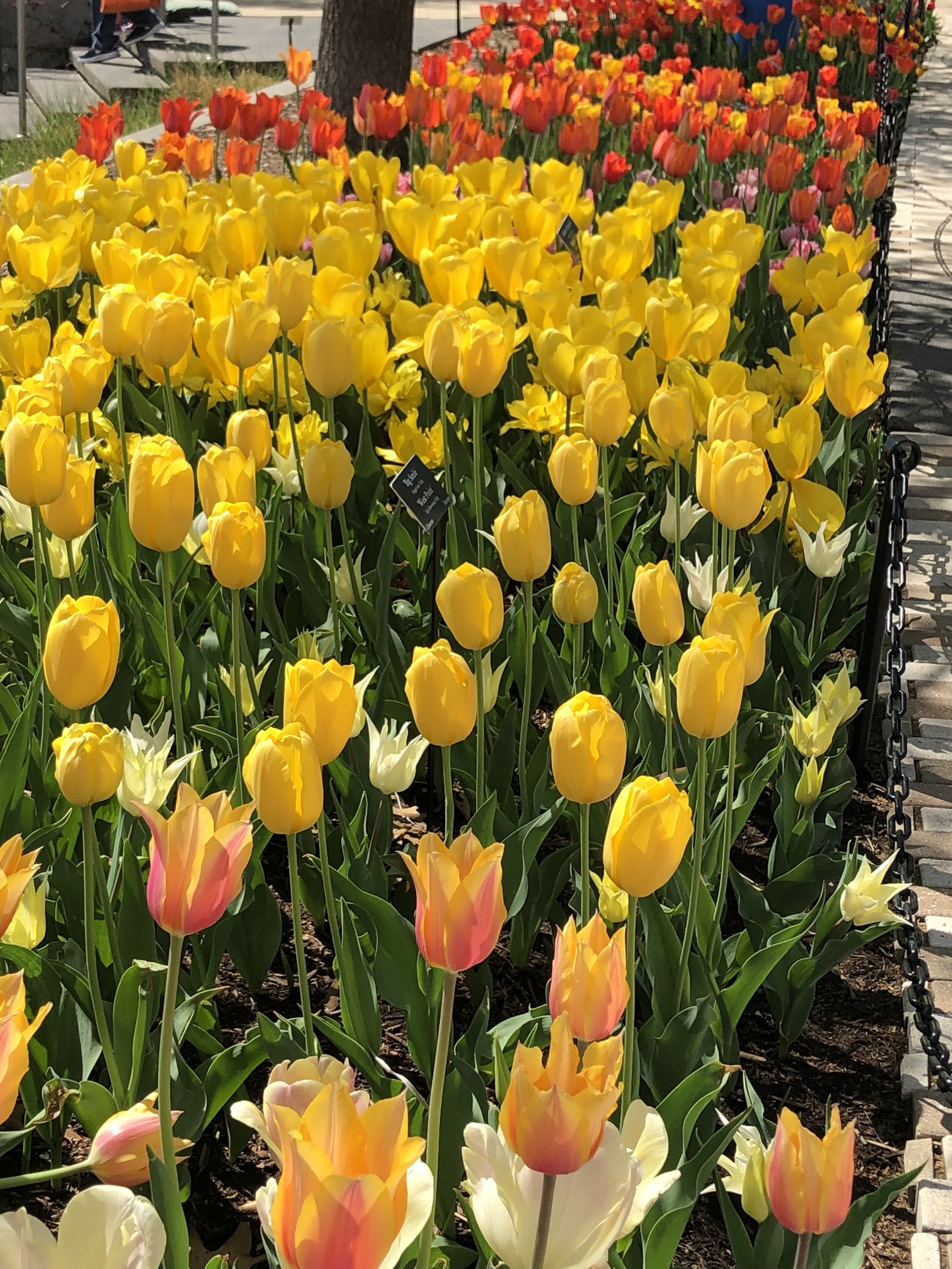
Tulip colors are nearly limitless. A great local show of tulip colors is the Myriad Gardens.

Spring bulbs have a dynamic impact when planted in mass.

Are spring blooming bulbs annuals or perennials?
Tulips in central Oklahoma are best used as an annual - meaning you will want to replant them every fall. You will have some repeat blooming the first year or two, but they diminish in results each year. If you don’t replant every fall, plan on replanting at least every two to three years. Our tight soils and warm summer soils are not ideal for bulbs to act as perennials. Daffodils and hyacinths are much more forgiving of our soils and can perform well as perennials. One key to improving the perennial nature of bulbs is to never plant over the bulbs. This creates problems for me as I typically use bulbs in my annual color areas. I treat tulips as annuals and replant each year.
Can I dig and store bulbs over the summer?
Yes. Lift the bulbs from the soil after the foliage has completely turned brown using a pitchfork. Dust off as much soil as possible. Store in a cool, dry place for the summer.
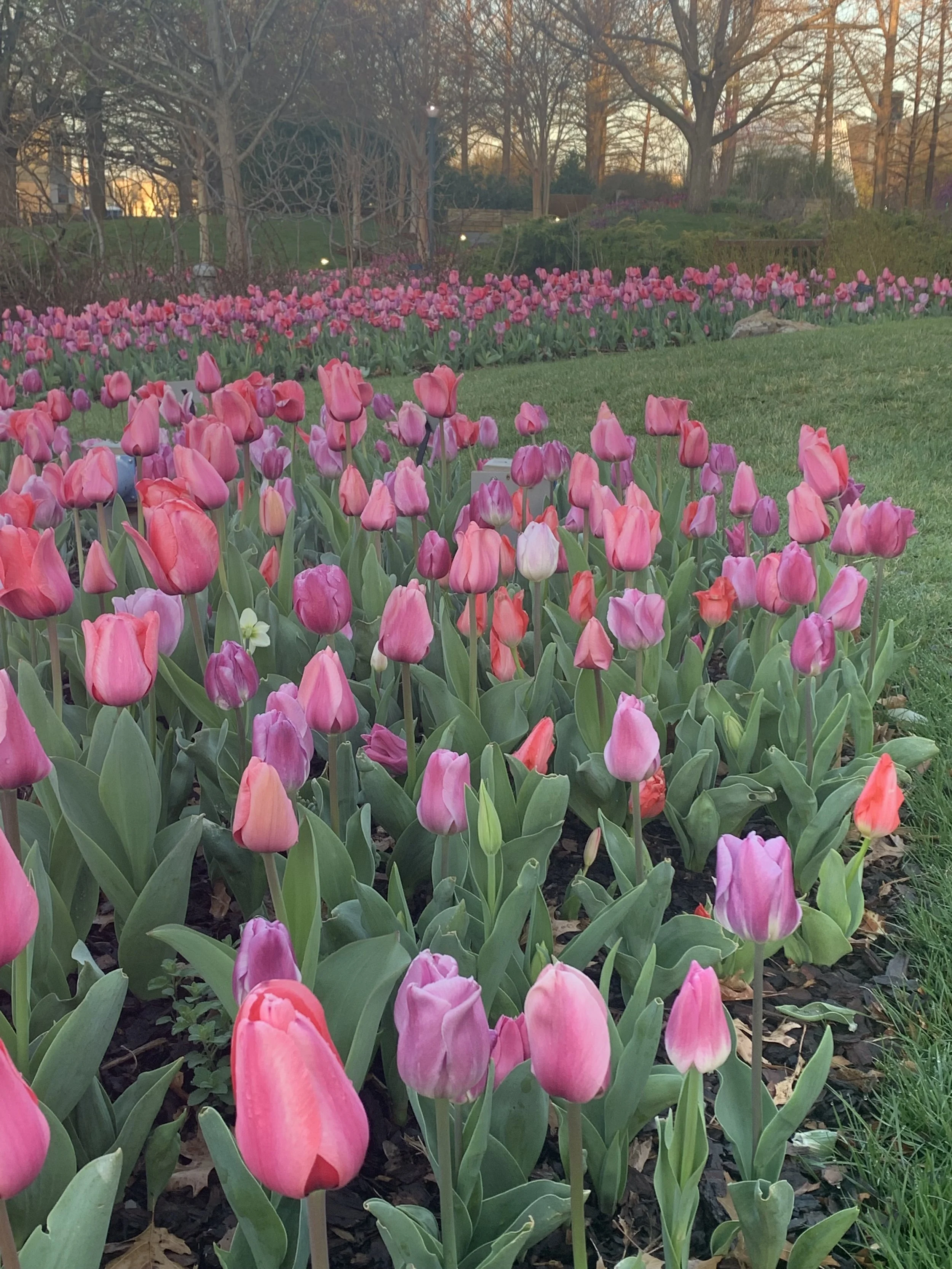
One of the best tulip displays every spring is the Myriad Gardens. Go ahead and set a reminder in your phone to take a tulip walk in March 2026.


Hyacinths are known for their adding a burst of purple, blue and pink tones to the late winter and early spring landscape.
When do they bloom?
Hyacinths will bloom first in late winter to early spring. Daffodils bloom next in early spring. Tulips come in three bloom periods – early, mid and late spring. Early spring tulips bloom the same time as daffodils. The danger with early spring bloomers is the chance their delicate pedals will be short lived due to a late freeze. Late blooming tulips also run the risk of a short bloom period because a few windy and warm days will put an early end to the show. I try to use mid-spring blooming varieties as much as possible, or if the area I am planting is large, I will plant tulips from each bloom period to extend the color show.


What colors are available?
Hyacinth comes in bluish-purple, white, buttery-yellow, soft blue and fuchsia. Daffodils are traditionally white and yellow, but you will find shades of orange, pink and cream. For tulips, the varieties and colors are nearly endless with new kinds arriving every year. I have tried many varieties and colors over the years, but I’m a traditionalist when it comes to tulips. It is really hard to beat a Darwin Hybrid tulip. Darwin Hybrids are mid-spring bloomers that come in many colors and are known for big blooms. They also are one of the best at returning in years two and three if you want to use them as a perennial.


Are bulbs deer and rodent proof?
If you have problems with deer munching on your flowers, consider planting daffodil bulbs. Daffodils are deer and rodent proof because they contain a bitter substance called lycorine that mammals won’t eat.
A great site to view all the colors of hyacinths, daffodils, and tulips is www.colorblends.com. Their website is an endless source for bulb information, planting tips and design ideas.
Start planning now.
Be ready to plant in November.
Enjoy next spring!
You will never regret planning ahead and planting spring flowering bulbs!
Lorne Hall
Hall|Stewart Lawn + Landscape
405.367.3873
Fall…Does My Lawn & Landscape Still Need Fertilizer?

Finally, a morning with the feeling of Fall in the air!
I’m ready for the feeling of fall to hang around, are you?
So, here’s the question we are often asked as temperatures cool, Does my lawn and landscape still need fertilizer?
Short answer: “Yes” and “No” and “No”
A little longer answer:
“Yes, the fertilizer season is over for warm season turf (bermuda & zoysia).”
“No, the fertilizer season is not over for fescue.”
And, no the fertilizer season is not over for trees and shrubs.”
Let’s explore the long answer on why fertilizing cool season turf and trees and shrubs is important this Fall.

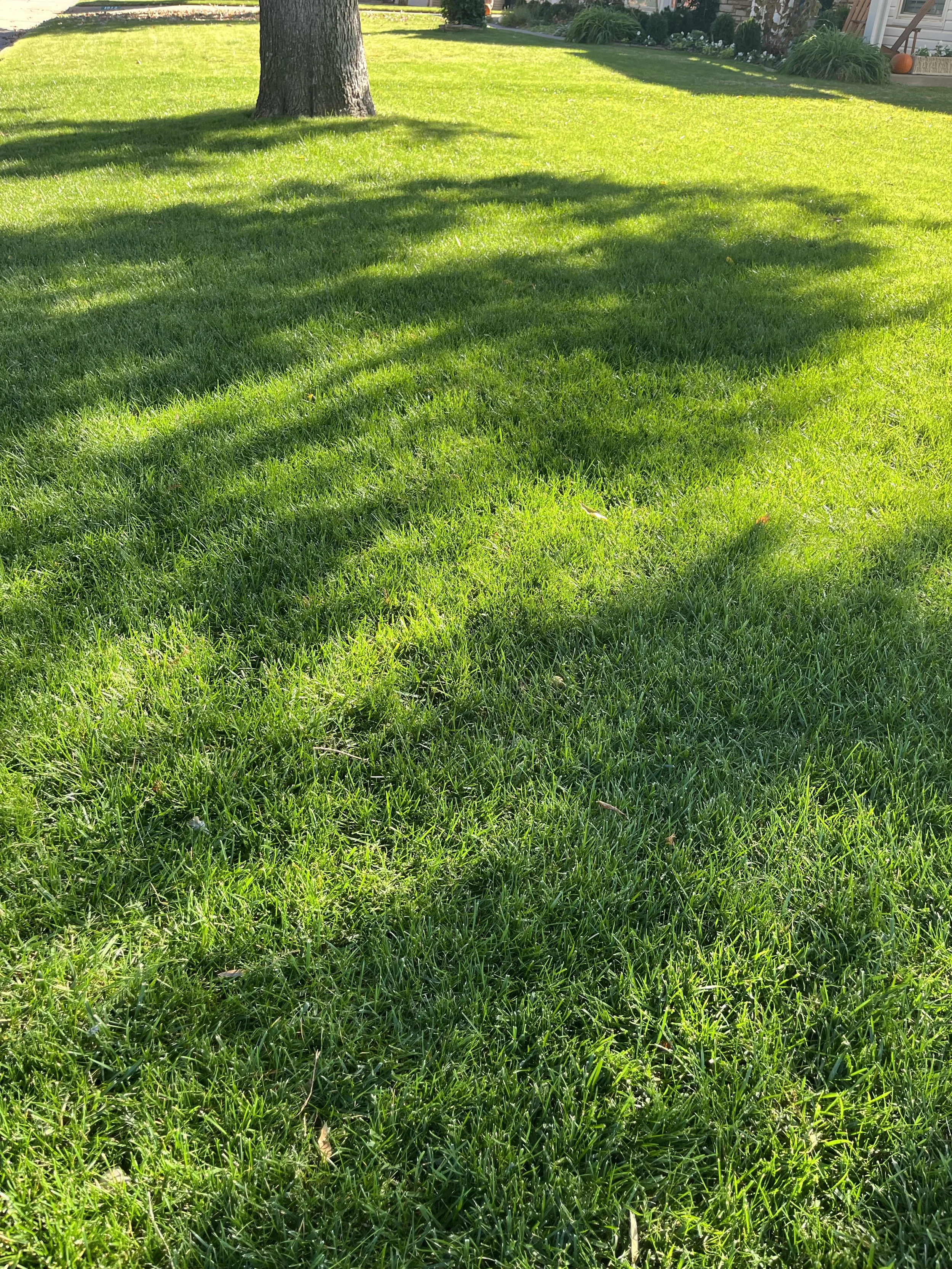
Fescue
Fall is the beginning of a new season for fescue lawns.
I’m sure you have noticed as afternoon temperatures became more moderate, fescue lawns started regaining color and growing.
For Fescue, Fall is the same as Spring is for bermuda.
A fertilizer application with a higher nitrogen fertilizer, the first number on the fertilizer bag, applied in the Fall as temperatures cool thickens fescue, encourages new growth and adds a deep rich color to the lawn.
Fall fertilizer applications on fescue will result in a healthier, thicker lawn. And don’t forget, a dense healthy lawn is the best defense against weeds.
Two fertilizer applications with at least 25% nitrogen in the fall, 4-6 weeks apart, is recommended for the best fescue lawn.
If you skip one or both of the fall fertilizer applications on your fescue turf, you are not setting yourself up to have your best lawn in 2026. Even if you are overseeding your fescue this fall, fall fertilizer is especially critical in the establishment of a healthy lawn. Don’t cut corners in the fall when it comes to fertilizing fescue.
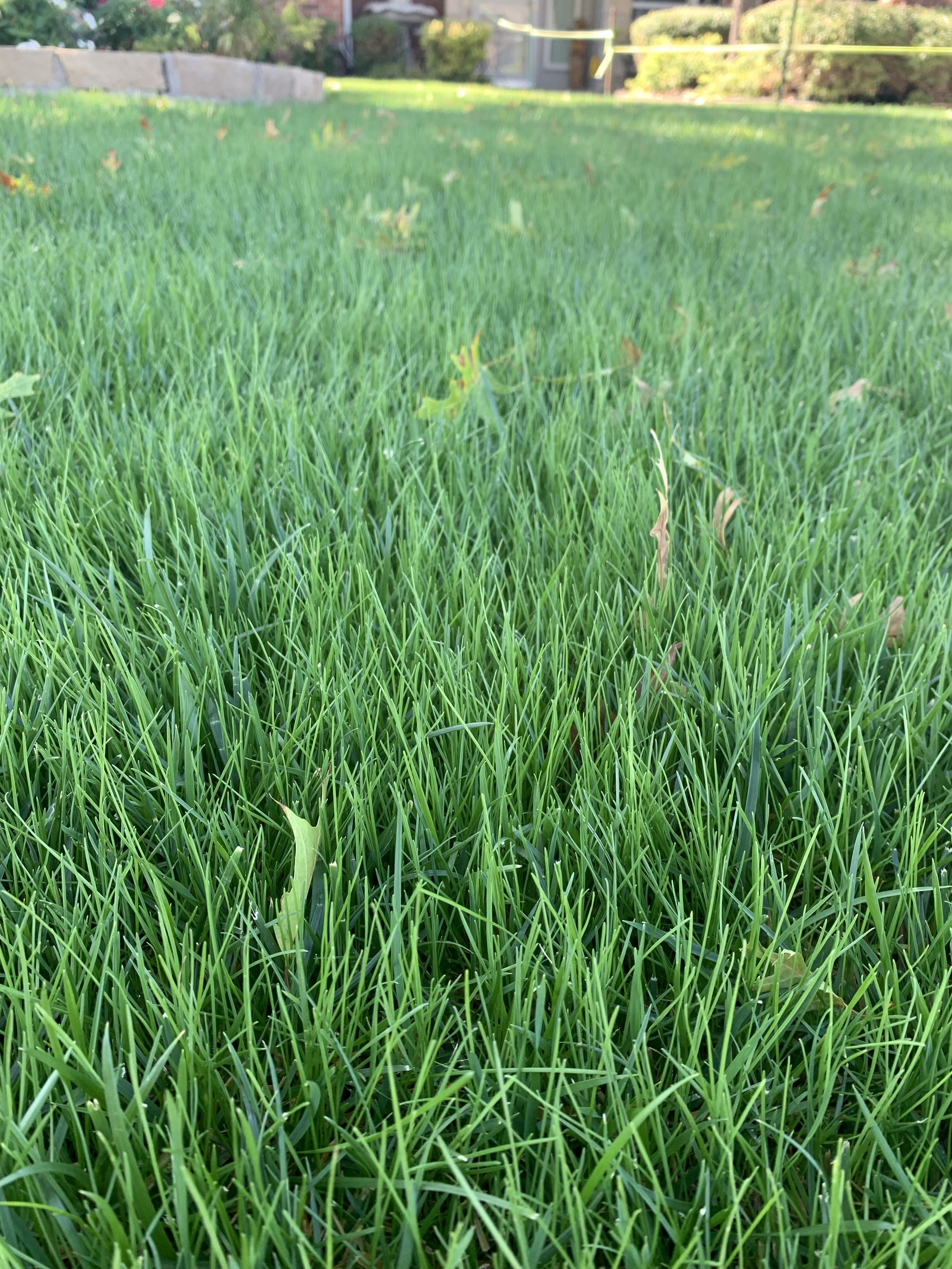
If you have a overseeded fescue or are planning to this fall, don’t skip a fertilizer application. New seed grows rapidly and needs plenty of nutrition.

Fescue lawns start their new season in the fall and benefit from two fertilizer applications during the fall.

Fescue lawns that have received fertilizer this fall are adding a rich green color to the landscape.

Fescue can be grown in full sun but it requires a very different fertilizer schedule compared to bermuda.

A healthy, thick and deep green fescue lawn next spring is easier to achieve with when a lawn receives the correct fall fertilizer applications.

The challenge for lawns with both warm season and cool season turf is they require the exact opposite timing of fertilizer applications for them both to thrive.
Why is fertilizer not recommended for Bermuda and Zoysia (Warm Season) now?
Wouldn’t fertilizer keep a Bermuda lawn green longer?
Warm season grasses are at the end of their growing season. In October and November, warm season lawns don’t require nitrogen. With shorter days, cooler days and nights, and the decrease in soil temperature, growth slows, and turf color fades.
Heavy nitrogen fertilizer in October in an effort to maintain color longer into the fall is harmful for bermuda and a catalyst for Spring Dead Spot Disease.
The chances of having Spring Dead Spot Disease next year increases when nitrogen fertilizer is applied to a bermuda lawn in the last 4-5 weeks before the first freeze, which in central Oklahoma is typically the first week of November.
So, if you are thinking because it has been a warm fall your bermuda lawn needs one more shot of nitrogen before the end of the season, don’t do it. You are doing more harm than good.

Spring Dead Spot is a disease that impacts bermuda lawns in the spring as the lawn is coming out of dormancy. One of the catalyst is heavy nitrogen applications in October applied in an effort to keep a warm season lawn green and active late into the fall.

Because bermuda starts to thin out when it receives less than 6 hours of direct sunlight it is common to see lawns with both bermuda and fescue. The problem is you try to fertilize them the same, one will flourish and the other will struggle.

Bermuda, a warm season turfgrass,, performs best when fertilized with higher nitrogen during the summer month and low nitrogen fertilizer in the fall.
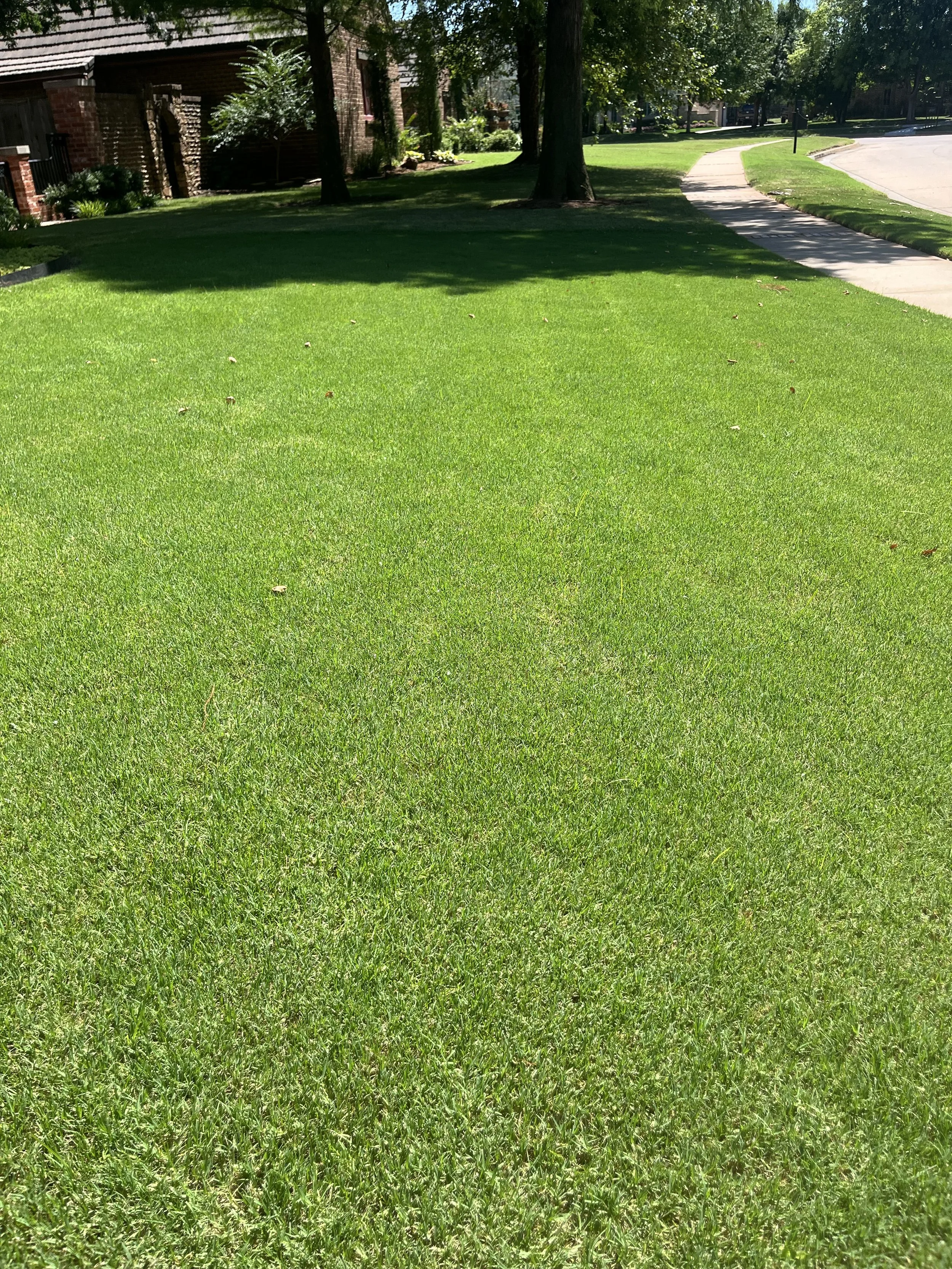
With cooler night time temperatures and shorter days, Bermuda lawns are slowing down. Resist the urgent to try keep them green and growing with high nitrogen fertilizer this month.
Problem - Fescue won’t thrive, it will actually struggle to survive, if it is fertilized like bermuda. And the same is true for bermuda. Fertilize bermuda like fescue and the result will be a thin, weak lawn.
For a successful, fescue lawn, you have to think backward from a bermuda lawn.
For a successful bermuda lawn, you must think backward from a fescue lawn.
You can’t fertilize them both the same way and expect them both to respond the same way.
The Good News –
If you subscribe to Hall | Stewart’s 7-Step Lawn Care Program, whether you have bermuda, zoysia, fescue or a combination of turfgrasses, we will make sure each type is receiving the correct fertilizer based on the current season and growing conditions. Our program recognizes that warm season grasses and cool season grasses have very different fertilization timing and needs.


Trees and Shrubs
Plants need nutrients to grow and stay healthy just like your lawn does. Signs of low nutrient levels in your landscape plants are lack of growth, dead or dying twigs and branches, off color leaves, and early Fall leaf drop.
Fertilizer applications improve the appearance of trees and shrubs, increase their vigor and help plants increase resistance to disease and insects.
An application of a complete fertilizer containing nitrogen, phosphorus, potassium and micronutrients is recommended.


The best time to fertilize trees and shrubs is after a heavy frost or freeze in the Fall, and in the spring between March and May.
It is important to avoid fertilizing trees and shrubs in late Summer to early Fall because it may result in a flush of tender new growth that may not have time to mature and will be suspectable to winter injury.
Fall fertilizer applications are good for root development and stored nutrients become available next Spring for new growth. Developing a stronger root system is important. Strong roots give the plant the ability to withstand stress during the season from drought, excess moisture, and heat.
Protect your investment in your landscape trees and shrubs with a fall fertilizer application this year.


The Good News –
If you subscribe to the Hall | Stewart Tree & Shrub Care Program you will receive the important Fall fertilization application for your landscape plants. The program includes four regularly scheduled plant health care visits to keep your trees and shrubs healthy throughout the year:
Dormant oil application to smother overwintering insects.
Early Spring application of systemic insecticide and fertilizer.
Late spring to summer application to minimize insect and disease population during the growing season.
Fall fertilizer application.
All applications are tailored to your specific plant species.
If you need have questions or need help understanding the fertilizer needs of your lawn and landscape, we would love to help.
Lorne Hall
Hall | Stewart Lawn + Landscape
(405)367-3873
Why a second Fall Pre-emergent is important

To quote Yogi Berra, “It’s déjà vu all over again!”
Last fall at this time when I was writing about the second fall pre-emergent, I started with “Calling Fall…. Hello! Hello! Hello! Fall, where are you?”
Déjà vu! Where is fall?
Even though it isn’t feeling much like fall right now, soon it will. The average first freeze in Oklahoma City is just three weeks away, November 2nd.
Before we cover why a second fall pre-emergent application is one of the most important steps to having your best lawn in 2026, let’s talk about the current hottest lawn topic…ARMY WORMS.
Army worms have plagued the metro area since July this year. We expect to see generation four of the army worm season develop over the next two weeks. If you have experienced heavy populations of small grayish to white moths when you walk across your lawn, you need to be on the watch for army worms in the next two weeks. The moths you see are the adult form of the army worm. The eggs they lay will soon develop into the army worm. Everyone should monitor their lawns over the next couple of weeks. But, if you have seen a heavy population of moths over the last two weeks, treatment in the next two weeks is a good preventive action. For more information on army worms, see our article from July 13, 2025.
Fall Pre-Emergent Applications
More specifically…Why your lawn needs a second fall pre-emergent!
What is the goal of fall pre-emergent herbicides?
Goal - Prevent winter annual weeds from germinating in your lawn this fall and over the winter.
Goal - A clean lawn throughout the winter and spring.
The most common winter annual weeds include henbit, chickweed, and poa annua. Each one of these have the ability to ruin the appearance of your lawn this winter and next spring if you skip fall pre-emergent applications.
Of the three most common winter annual weeds, poa annua is the most problematic.
Poa annua, commonly known as annual bluegrass, is the world’s most widespread weed.

Henbit is a winter annual broadleaf weed that germinates in the fall. Without fall pre-emergent applications you will have a carpet of weeds with purple flowers next March.
Annual bluegrass, poa annua, is a low growing, lime green, clumping, grassy weed with small white flowers. It is very noticeable in dormant bermuda grass from late winter through spring.
Poa annua begins to germinate when we have our first fall cool spell and there is an abundance of moisture. When nighttime temperatures drop into the 60s and daytime temperatures stay under 85, annual bluegrass begins to germinate. (Typically, late September to early October). Optimal germination occurs once soil temperatures stay below 70 degrees for 4 consecutive days. (Commonly occurs by mid-October). The rest of the fall, winter and spring, germination will continue making poa annua a several month-long battle.
Best Practices:
Apply the first round of fall pre-emergent herbicide between mid-August and mid-October.
Apply a second round of fall pre-emergent herbicide 6-8 weeks after the first application.

Poa annua thrives in thin turf. The best defense for prevention is to develop a healthy turf.
Poa Annua in Warm Season Turf (Bermuda & Zoysia) is most troublesome during the winter when poa annua is growing and seeding heavily, and turf is dormant. During the winter it does not have to compete with warm-season turf for light, water and nutrients which allows it to spread quickly in untreated lawns.
Poa Annua in Cool Season Turf (Fescue & Rye) is not as prolific since the turf is growing and thick in the cool season, but poa annua can still distract from a beautiful turf in the spring when it is producing seed heads. Maintaining a thick and healthy fescue lawn is important in the prevention of poa annua. For this reason, overseeding fescue in the fall is an important step in creating a thick turf and eliminating thin spaces ripe for weed germination.
Most concerning is poa annua has been developing an increasing tolerance for many pre and post emergent herbicides.
Tolerance is the plant’s ability to survive and reproduce even though it has been treated with a herbicide.
Herbicide resistance in poa annua first developed in Japan in the 1980s with the first occurrence in the US in Mississippi and Tennessee in 2004.

Poa annua is a clumping grassy weed with small white flowers.
Here are a few recommendations on how to best overcome annual bluegrass in your lawn:
Problem - A single fall application of a herbicide is not enough for the prevention of poa annua because germination can occur from September to March. Also, repeated use of the same herbicide will result in herbicide resistance.
First Solution – Our application #7, in October through November, is critical in the control of poa annua. This application contains a different fall pre-emergent herbicide than one applied from mid-August through September. Additionally, we use a herbicide in Application #7 that has post-emergent abilities on poa annua.
Second Solution – Application #1 in January and February contains herbicides for control of poa annua that can only be used on dormant warm season turf grasses. Once we reach March control of annual bluegrass is more difficult.

Poa annua will thrive in thin dormant turf during January and February without effective fall prevention.
Problem – Lawn care application effectiveness is reduced when the pre-emergent herbicide is not watered into the top 1” of the soil.
Solution – Always follow the watering instructions when we do a lawn care application, but especially when the application includes a pre-emergent. Pre-emergent herbicides are not effective at preventing germination when they remain on the soil surface. Effectiveness increases if the pre-emergent is watered into the soil. If you are applying your own pre-emergent herbicides, it is very important you read and follow label directions.
Problem – Unhealthy, thin turf is a breeding ground for poa annua and many other weeds. Therefore, annual bluegrass is more of a problem in dormant warm season turf. Annual bluegrass also prefers compacted soil.
First Solution – Applications during the growing season for warm season turf contain fertilizer that thickens the turf reducing area for poa annua seeds to germinate and develop in the fall.
Second Solution – Do not cut warm season turf short for the winter. Maintaining a healthy amount of top growth will inhibit some seeds from reaching the soil surface. Annual bluegrass is much more troublesome in short cut, warm season turf during dormancy.
Third Solution – Aeration in the early summer on warm season turf and in the fall on cool season turf will result in a thicker, healthier turf. Aeration will reduce the compaction and strengthen the root system of your lawn by allowing air, nutrients, and water to reach the root system.

A second fall pre-emergent is an important step in making sure your lawn isn’t full of weeds in the late winter/early spring when the bermuda is dormant.
Maintaining a thick, healthy, properly maintained turf is a critical step in the prevention of weeds.
Heavy reliance on herbicides to control poa annua increases the likelihood that it will develop herbicide resistance particularly if you are relying on a single fall pre-emergent application of the same herbicide year after year.
Effective prevention of poa annua is the result of two differing fall pre-emergent applications and a healthy turf.
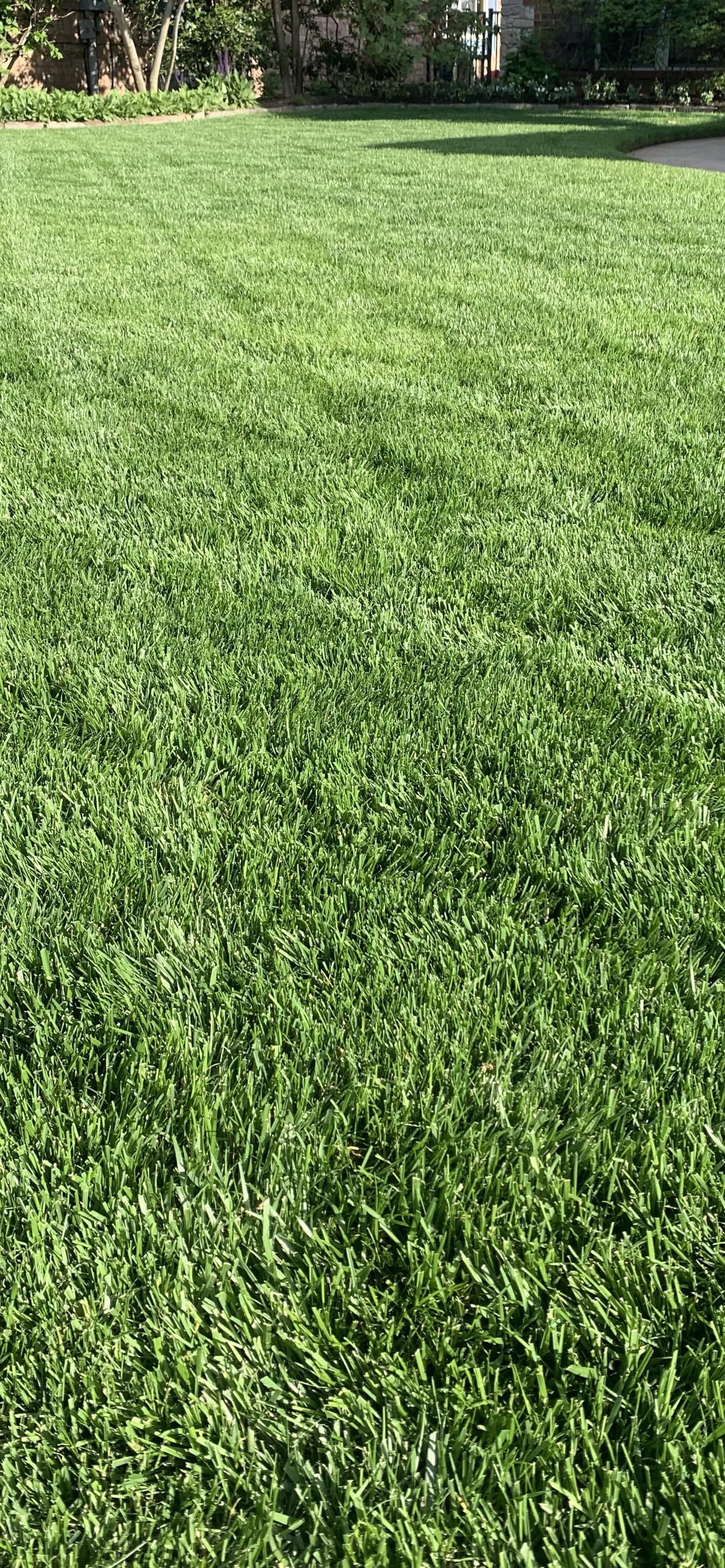
The steps to having a weed free fescue lawn next spring is overseeding this fall and fertilizer applications in the fall to create a thick lawn in the spring.

In the spring after lawns have greened up, controlling poa annua can be very difficult without damaging the turf.

Without two fall pre-emergent herbicide applications, poa annua will be prolific the next spring when the turf is coming out of dormancy.

The secret to a feed free Bermuda lawn next spring is two fall pre-emergent applications this fall, a pre & post emergent application next January through February, and good mowing, fertilizing, watering practices through the summer growing season to create a thick, healthy turf.
Our goal is to do all we can to strengthen your lawn and prevent winter annual weeds from littering your dormant lawn this winter.
We need your help in following:
Always follow watering instructions when applications are made to on your lawn.
Always maintain the proper mowing height based on time of season and turf type.
Always take both fall pre-emergent applications on bermuda or zoysia lawns.
Always fertilize on a regular schedule based on turf type to maintain a thick turf.
Add aeration to your annual services.
Add overseeding fescue in the fall to create a thick more weed resistant shady turf.
Lorne Hall
Hall | Stewart Lawn + Landscape
(405)367-3873
Fall Irrigation Changes Coming Soon!

One goal for our weekly emails is to share what we are seeing as we visit our customers’ lawn and landscapes.
So, what are we currently seeing?
Thirsty lawns and landscapes!
Since the rainy week in late August, rainfall around the Oklahoma metro area has varied. Rainfall totals over the last 30 days range from .2” inches to 1.2”. Some areas of the metro have gone 5 weeks without a .25” rainfall while others have gone 2 weeks. Typical rainfall over the last 30 days is 3.5” to 4”. So, no matter where you reside in the metro area, you are currently behind on rainfall.
All you have to do is look at any lawn, tree, shrub, groundcover, or seasonal color that isn’t irrigated to know this has not been a typical fall.
Lawns and landscapes need to be watered thoroughly in the fall to prepare them for winter.
Landscapes in poor health will be the first to suffer during stressful weather periods this coming winter.
A key to avoiding winter damage is to ensure your landscape receives adequate moisture this fall.
Pre-emergent herbicides need to be watered into the soil to be effective at stopping germination of fall and winter weeds.
Fescue lawns with the correct amount of moisture and nutrients rebound from the stress of summer and flourish in the fall.
One of the most important things you can do to have a healthy lawn and landscape are to align your watering habits with weather patterns.
Healthy irrigation is watering based on need.
Healthy irrigation is infrequent, deep watering.
Unhealthy irrigation is shallow, frequent watering.
Unhealthy irrigation is setting your irrigation in the spring on an ODD or EVEN setting and leaving it the same until you shut it off in the winter.
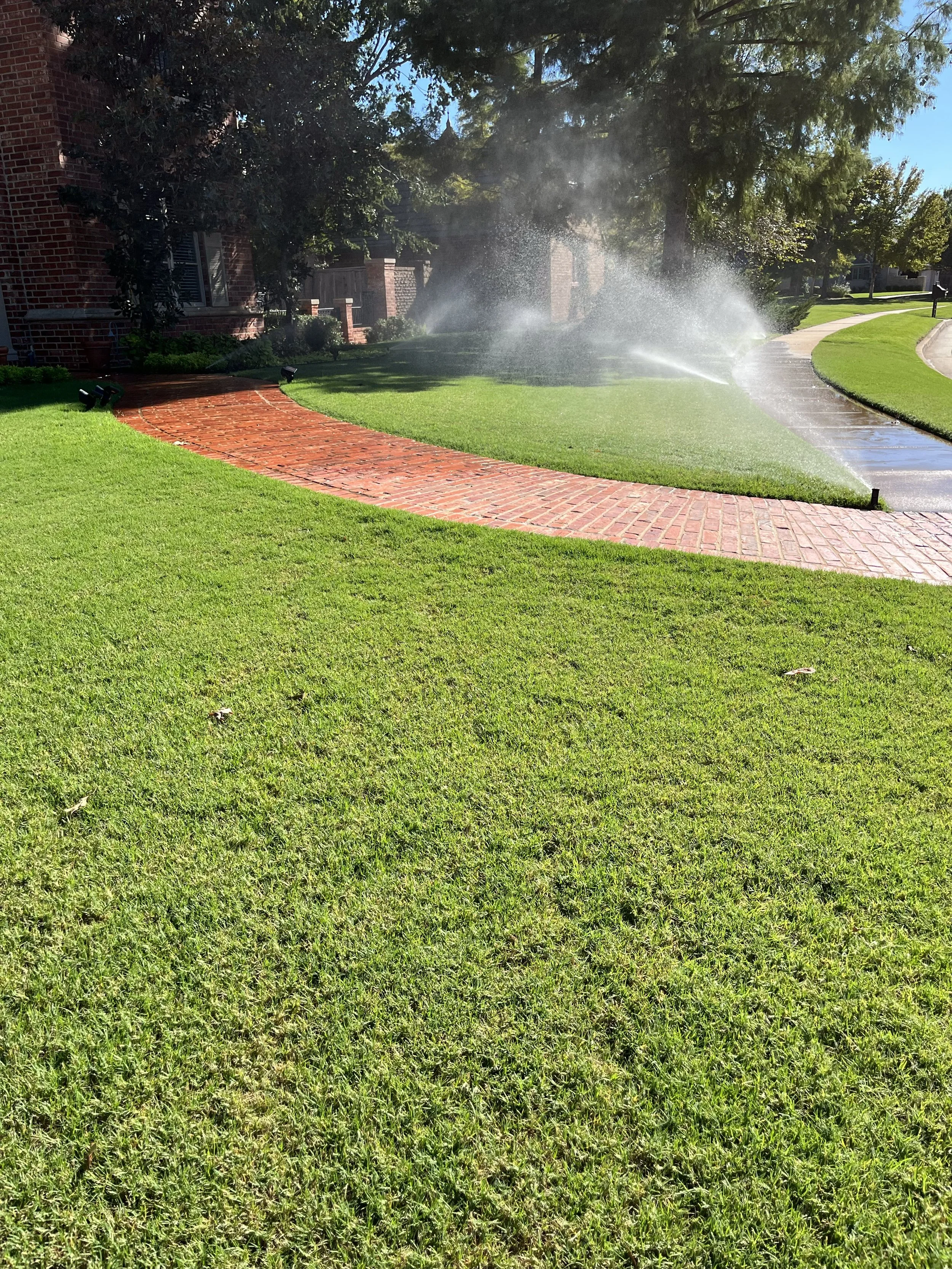
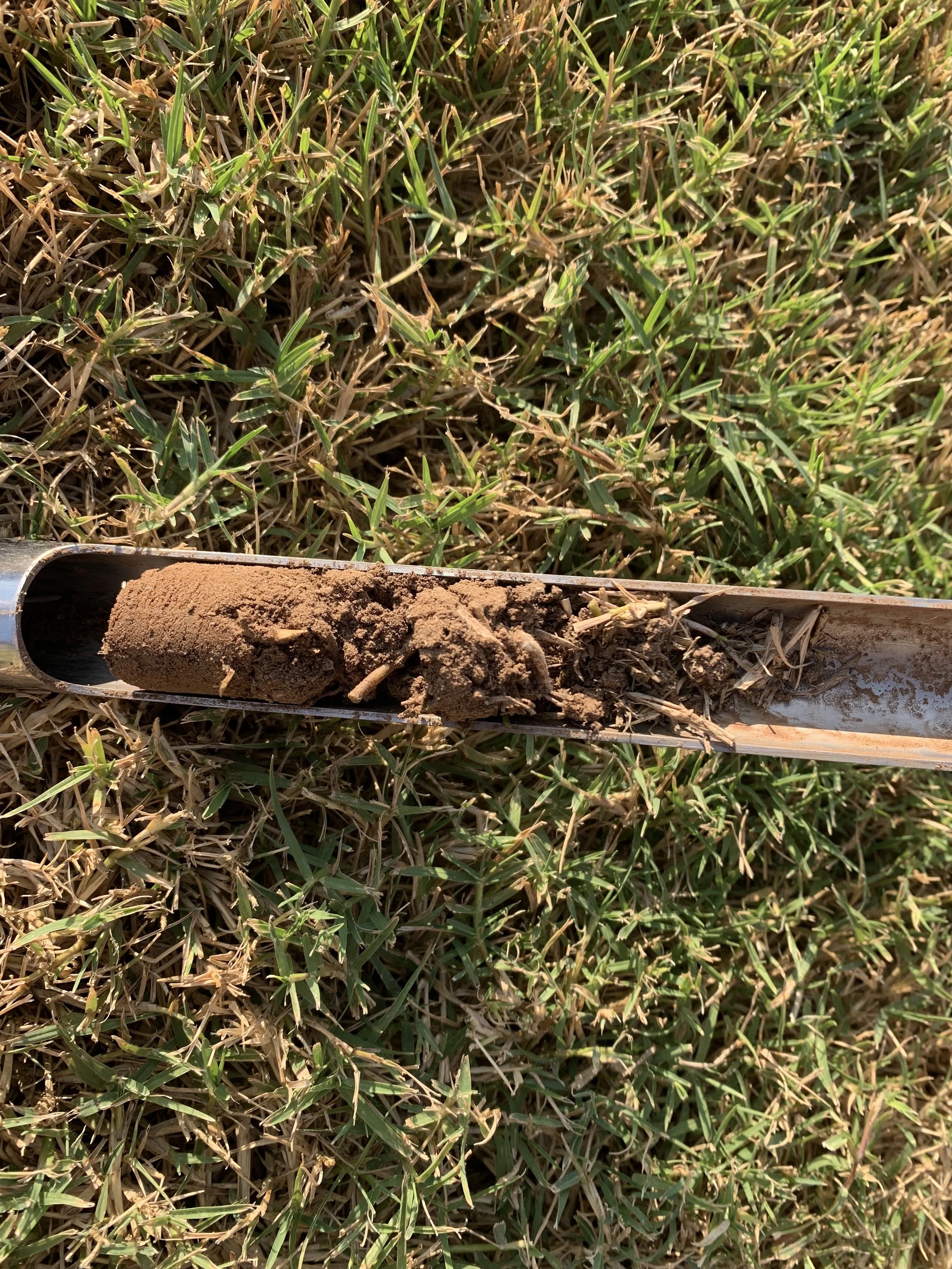
From lawns that are not irrigated, cores are shallow with bone dry soil. Sadly, we are finding similar cores in irrigated lawns with watering habits that are only keeping the top 1/4-1/2” moist.
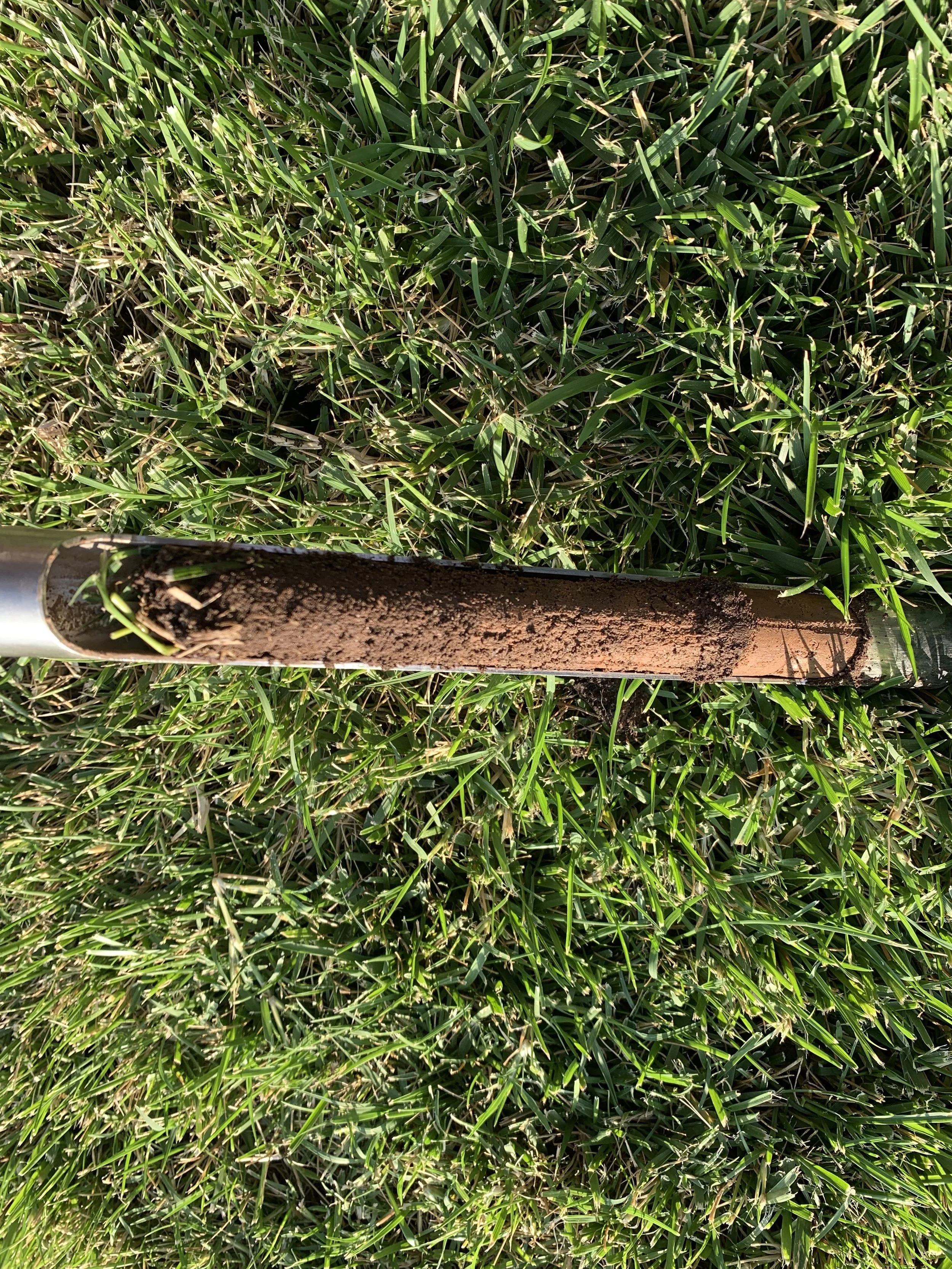
From lawns that have been watered deeply over the last 6-8 weeks, we are able to easily pull deep cores that have adequate soil moisture to withstand the summer heat.
We have visited too many lawns and landscapes over the past few weeks as the heat and dryness lingered that were being watered, but yet they still showed signs of drought stress. Lawns that when you pulled a soil core, you found soil moist only for the top ¼” to ½” and completely dry soil below. Lawns with roots only ½” deep. Lawns that were dependent on daily watering.
If you want the best lawn and landscape, learning to water based on need is a critical element.
Soon temperatures will cool, day length will become shorter and shorter, and occasional rains will return… and your lawn and landscape will need less moisture. But for now, they still needing 1” of moisture per week to be healthy.
Don’t assume that because our calendar’s say it is fall, that it is okay to stop making sure your lawn and landscape sufficient moisture.

Irrigation systems with uneven water distribution issues are very noticeable after a very dry and warm September.
Follow these irrigation tips through the Fall:
Water Less Often – Don’t reduce the length of time each zone runs. Instead, water less often. Set your irrigation to run every 4 days instead of every other day.
Common question: “Should I reduce how long my system runs by 50% now?”
Answer: “No. Keep the run time the same and water less often.”
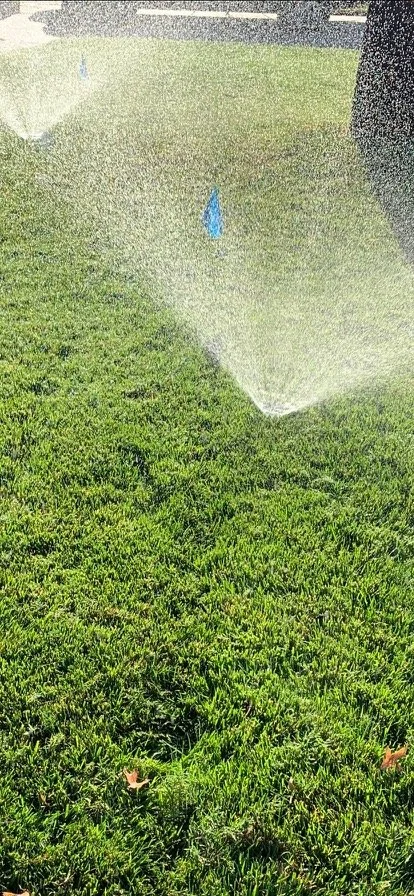
This fall instead of reducing how long a zone runs, water less often for the same amount of time you watered during the summer heat.

Water Deep Not Shallow – Deep watering is important in every season. Shallow, frequent watering promotes shallow roots, increases weed content, promotes diseases, and reduces cold hardiness. If you can get 1” of water on your lawn in a single watering without causing excessive runoff, water just one time per week. But, for most of our soils you should plan on watering ½” twice per week. It is best to saturate the soil each time you water and then allow it time to dry before watering again.
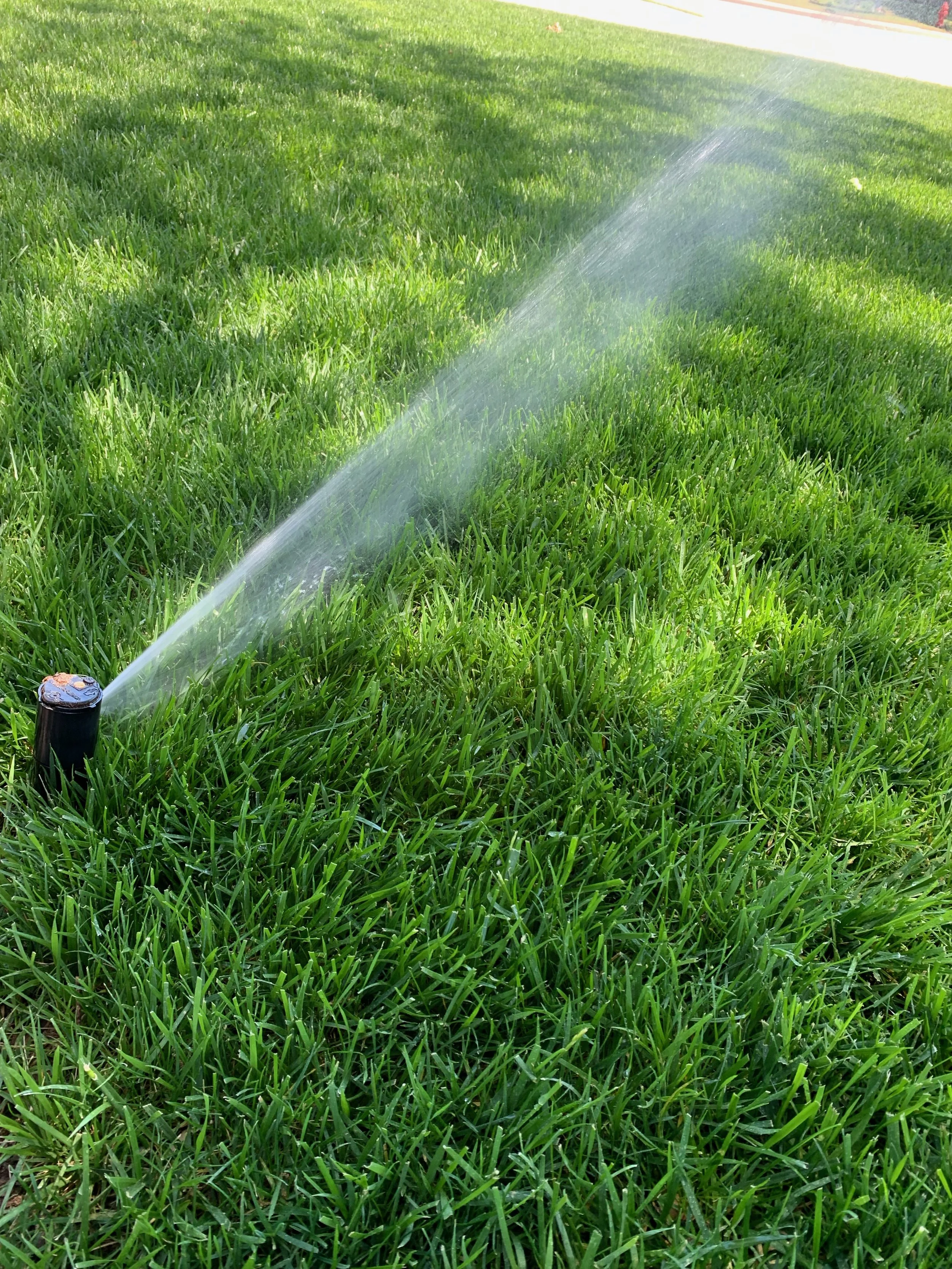
Deep soaking, infrequent watering is an important best practice in developing a healthier, deep rooted lawn even in the fall.
Know How Long You Need To Water – One piece of information that will make a big difference in your watering decisions is knowing how much water your lawn and landscape is receiving each time you run your system. Place your Hall | Stewart Rain Gauge or any small container in your lawn. Run your system through a cycle and measure the amount of water in the container. If your system puts out ½” of water, watering every 4 days this fall is perfect. If it puts out less, don’t increase how often you water, instead increase the amount of time each zone runs until your containers receive ½”.
If you have areas of your lawn that have lost color this month, checking the amount of water the area is receiving should be your first step. There is a good chance the area needs a head or nozzle adjustment.
Don’t assume that the way you have always set your irrigation is best. Do the work. Find out if your lawn is actually receiving the amount of water it needs to be healthy.
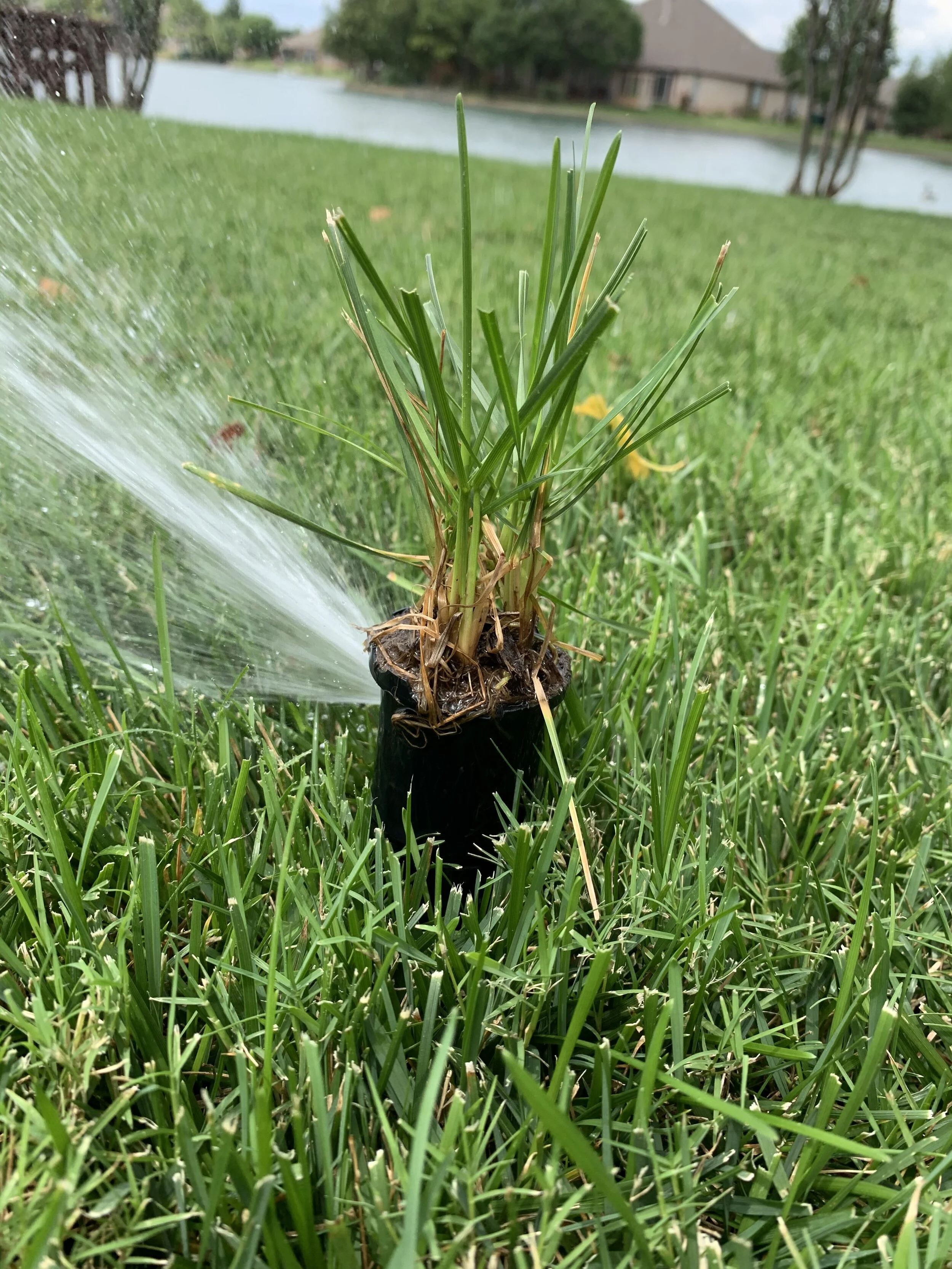
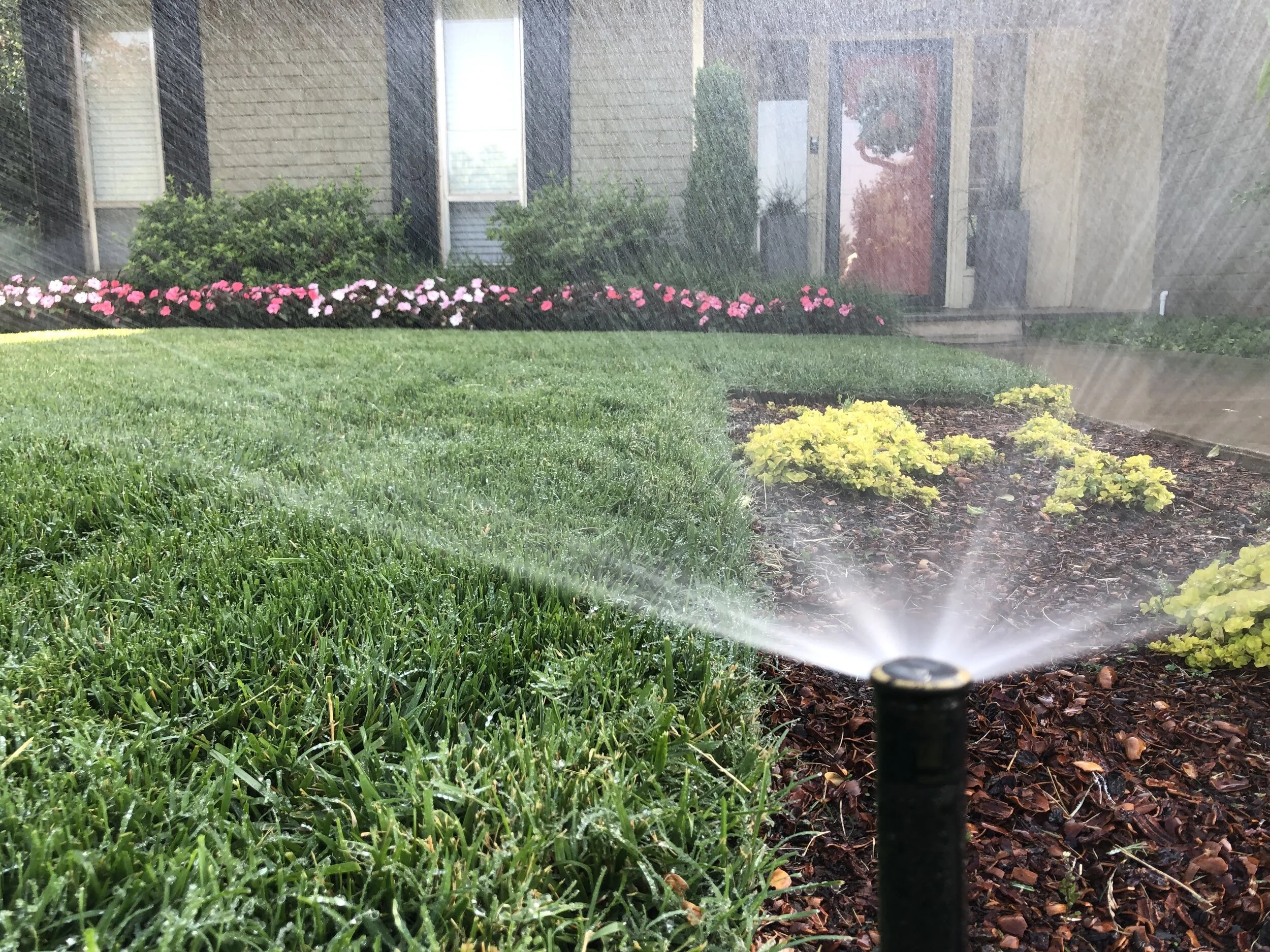
Water Based on Need – The perfect situation would be to inspect your lawn every few days and make watering decisions based on need. If the grass doesn’t spring back up after walking on it, it is time to water. If plant leaves start showing signs of wilt, it is time to water. Another easy test is to take a long screwdriver, if it slides easily into the soil you don’t need to water. Remember, plants and turf will spring back quickly from slight wilt. They don’t recover quickly from being over watered.
One of the best gifts you can give your lawn and landscape is to take a moment to inspect it each week.
Just a few minutes looking and asking yourself if everything looks healthy.
Just a few minutes of being proactive instead of reactive.
Water Based on Weather – Over the next 90 days, the average rainfall in the Oklahoma City area totals 8.5”. Your lawn and landscape will need 10-12” over the next 90 days. There is a good chance your irrigation system will be in the off position often over the next 90 days.
The Mesonet is a great weather resource for making water decisions.
This Mesonet Water Index will give you the amount of moisture in the top 2” of the soil. A reading of 1.0 tells you the soil contains all the moisture it can absorb, and any additional water will run off, a big waste of money and water.
The current average fractional water index in the metro area is .2.
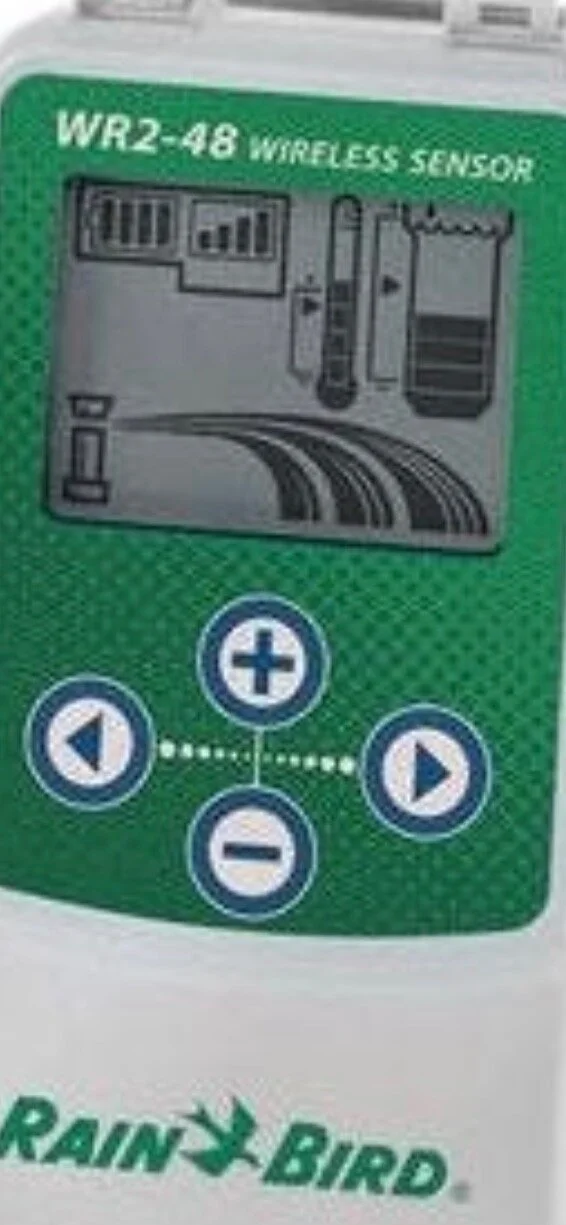
A rain/freeze sensor will interrupt the watering cycle anytime it rains or if temperatures are below freezing.
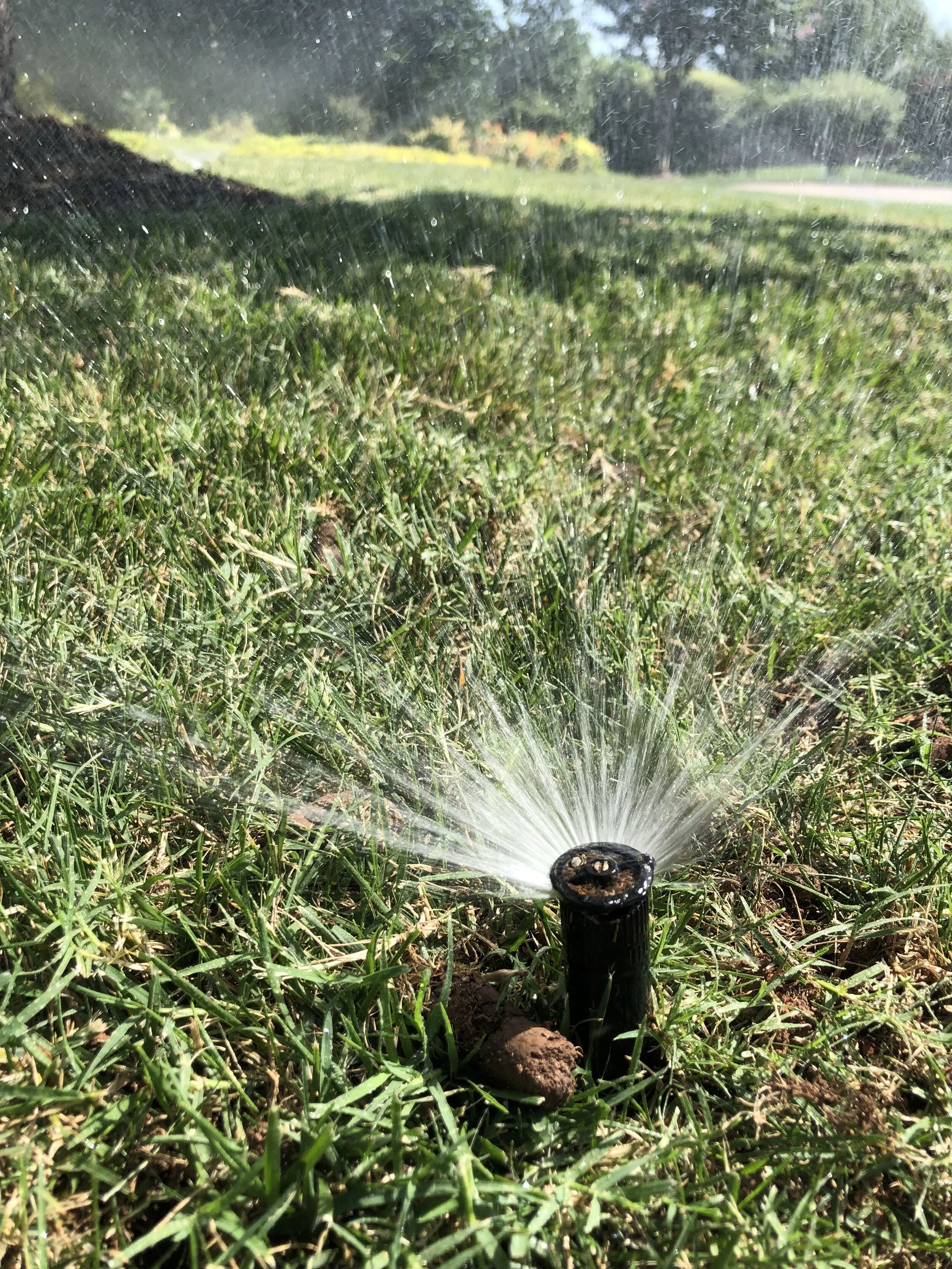
A key to successful overseeding this fall is keeping the area tacky moist until the seed germinates.
Overseeding is the Exception to the Rule – If you are overseeding with fescue this fall, one of the keys to success is keeping the seeded area tacky moist until the seed germinates. Typically, this takes two weeks. We recommend setting the zones in the seeded areas to run three short cycles (3-10 minutes depending on type of head) per day: 4:00 AM, 10:00 AM, and 4:00 PM.

Tools to Improve Watering Efficiency:
Add A Rain/Freeze Sensor – A sensor will interrupt a run cycle when we have had enough rainfall. A rain/freeze sensor will pay for itself in water savings.
Add a Wi-Fi Link – Several of our customers have installed the Rainbird Wi-Fi Link and allowed us the ability to monitor their irrigation systems. Daily, we survey the Mesonet site for key weather data, make moisture need decisions and adjust systems. A rain sensor will stop a cycle, but with the Wi-Fi Link we can remotely adjust your system based on current weather data.
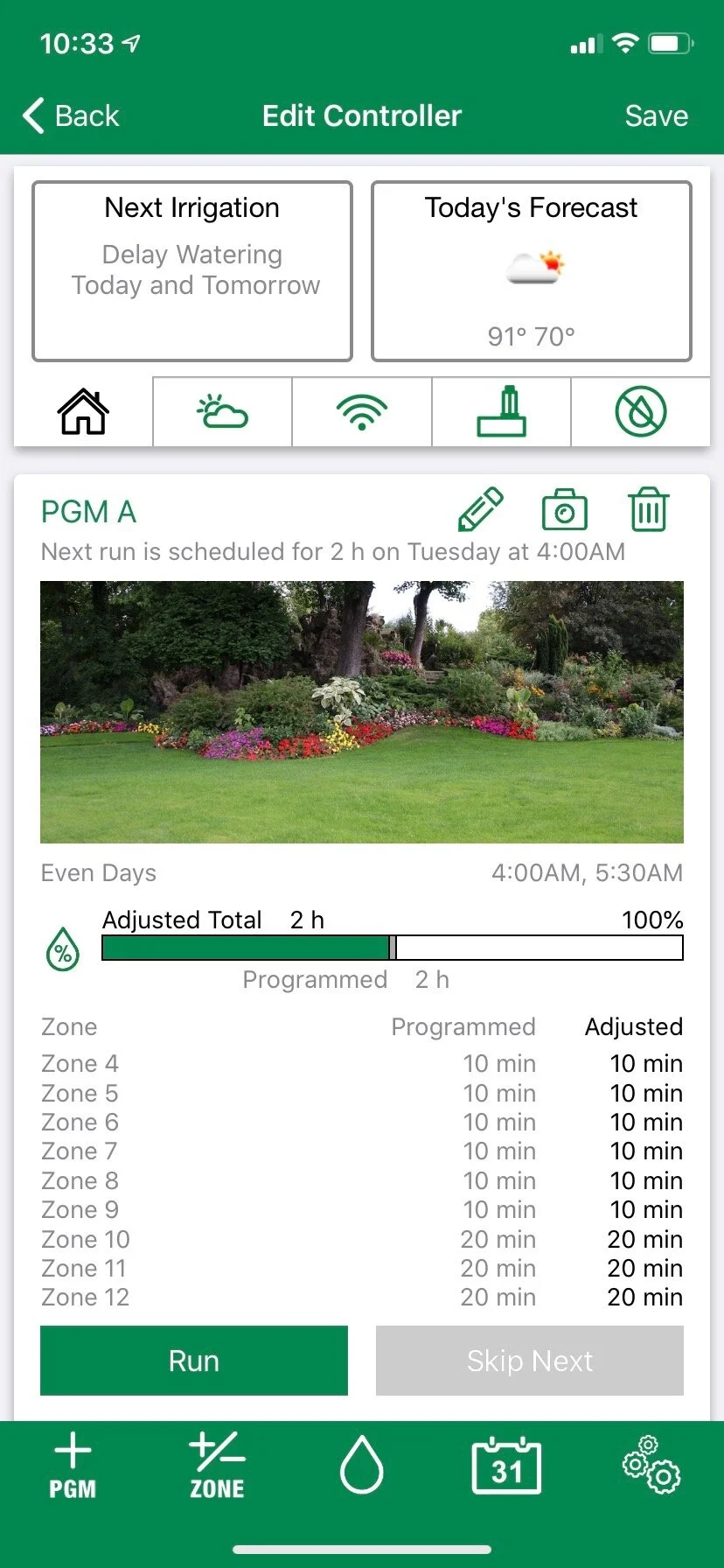
With the Rainbird Wi-Fi Link system, we are able to make adjustments to your system based on actual rainfall and moisture readings in your area.
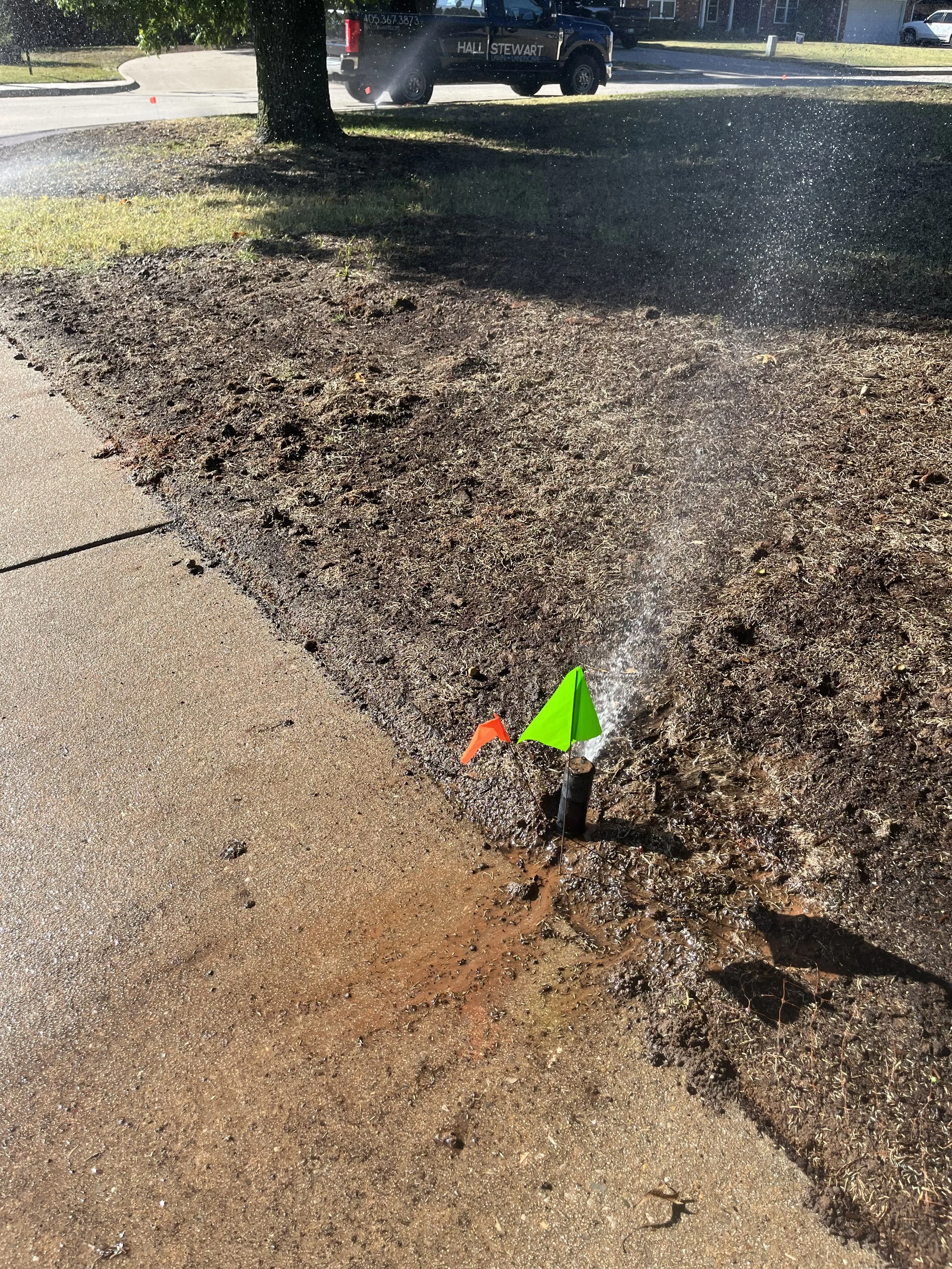
The most critical step in successful fall establishment of fescue is keeping the seed moist until it germinates.
Tree Watering Tip – Trees planted in the last few years often need more water during periods of heat and drought than your irrigation system will supply. The goal is to give them 10 gallons per week. A simple way to ensure they are receiving enough water is to take a 5-gallon bucket and drill 3-5 small holes in the bottom. Place the bucket near the base of the tree, fill with water and allow the water to slowly soak into the soil. Repeat twice per week. (If you are concerned about the way it looks, use this trick overnight.)
Irrigation systems are great tools for maintaining great lawns and landscapes. But irrigation systems are not an asset when they are “set and left” with the same program in all seasons and weather conditions.
If you need help with watering issues, let us know. We would enjoy helping you manage your landscape’s water needs in the most economical and efficient ways.
Lorne Hall
Hall | Stewart Lawn + Landscape
(405)367-3873
October Lawn & Landscape Tips
The cool start of September had everyone thinking fall. But, since then, summer has been making an attempt to over overstay its welcome.
Still, I am confident we will soon be enjoying crisp, cool evenings and pleasant days.
For your lawn and landscape, fall is the transition period. Much of your lawn and landscape activities in October prepare your lawn and landscape for winter and sets them up for success next season.
Here are a few things to stay focused on during October:
Watering
Over the last 30 days rainfall has varied around the metro area. There are areas of the metro that received a good rainfall a week ago while other areas of the metro haven’t received a ¼” rainfall since the end of August. This is a reminder that it is important you know how much rainfall you have actually received, not the official rainfall for Oklahoma City.
Your lawn and landscape require at least 1” of moisture every week through the fall.
Moisture is important for plants as we head into the winter. Don’t allow your landscape to experience drought stress now.
Because day length is shorter, the sun angle is lower, and temperatures are cooler in October, deep soaking every 4 days for established lawns and landscapes is the best practice. Newly planted fall seasonal color or new landscape plantings will need to be watered more often.
One of the best practices for your lawn and landscape this fall is to continue to water for long periods just like you do in the summer but reduce how often you water. Shallow rooted landscapes are often the result of shallow, frequent watering. Healthy, deep-rooted landscapes are the result of deep, infrequent watering.
Overseeding
September and October are the best time of the year to establish Fescue from seed. This year, due to warmer temperatures, many have waited to seed their fescue. If you have not overseeded your fescue areas yet, now is the time to get it done. October seeded Fescue will have time to germinate and mature before winter.
Remember, the keys to successful seeding are good seed-soil contact and keeping the seed consistently moist until it germinates.
Most disappointments with overseeding are due to not keeping the seed consistently moist for two weeks until it germinates. The worse thing for new seed is for the seed to be moist, then dry out, then moist, and then dry out again. Pay extra attention to lawn edges where the soil dries more quickly, and water coverage may not be perfect.
Lawns that have already been overseeded and have been kept consistently moist for at least two weeks are flourishing. But, lawns that have not been kept moist or have uneven water distribution have areas that are lagging. If you have areas that are struggling to germinate, supplemental watering in those areas will get the seed germinating.
For more information on overseeding, visit our article on September 7, The 4 Most Common Ways To Fail At Establishing Fescue.
As I have been making our customary two-to-three-week follow-up visits after overseeding, I have witnessed the impact of not keeping the seed consistently moist.
Results on lawns seeded the same day in the same neighborhoods vary greatly depending on if they are kept moist or allowed to dry out between watering.
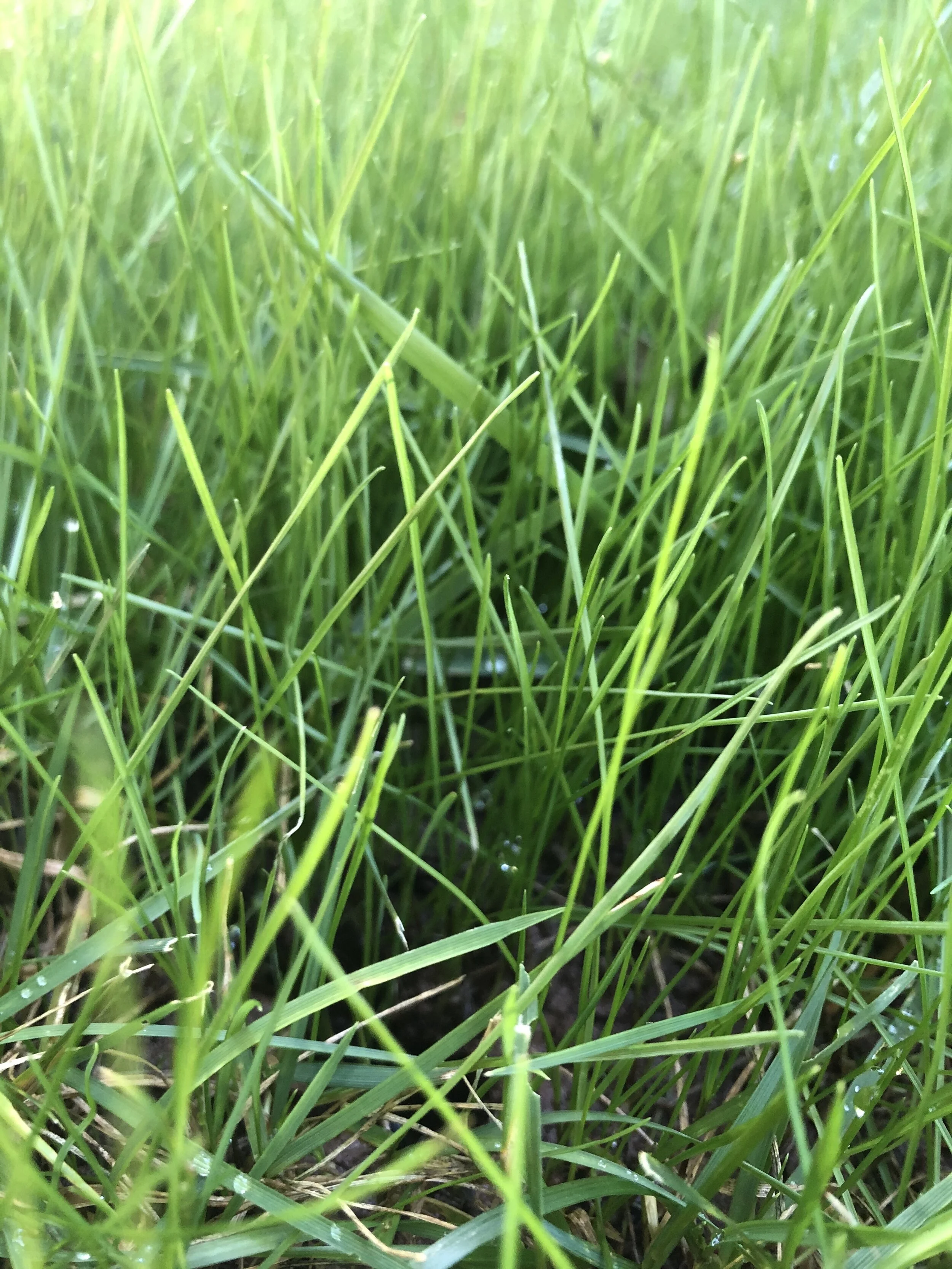
Newly seeded fescue 14 days after germination.
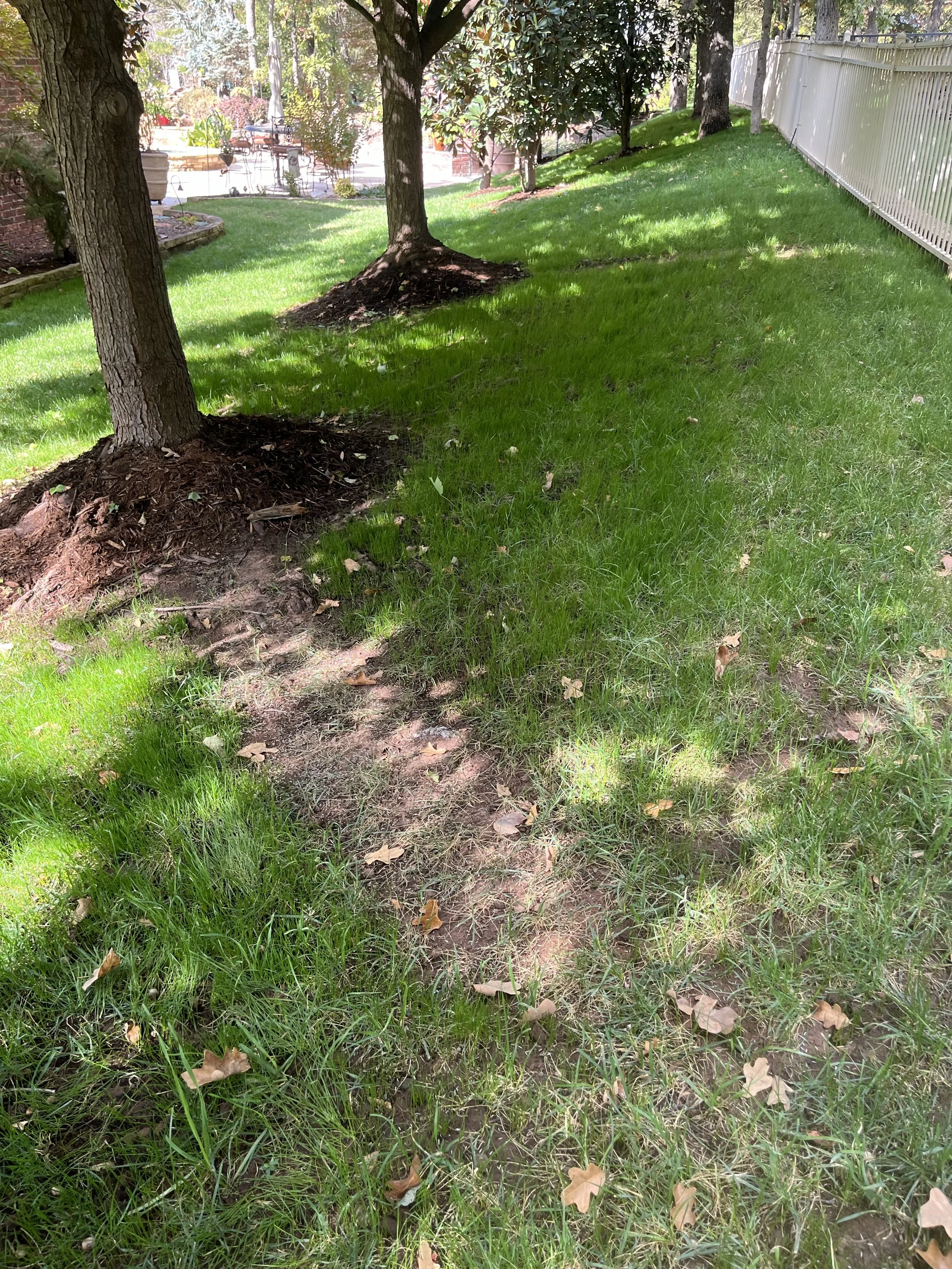
How important is even water distribution when it comes to getting your fescue seed to germinate? Check out the pattern of ungerminated seed where the tree is blocking the water flow.
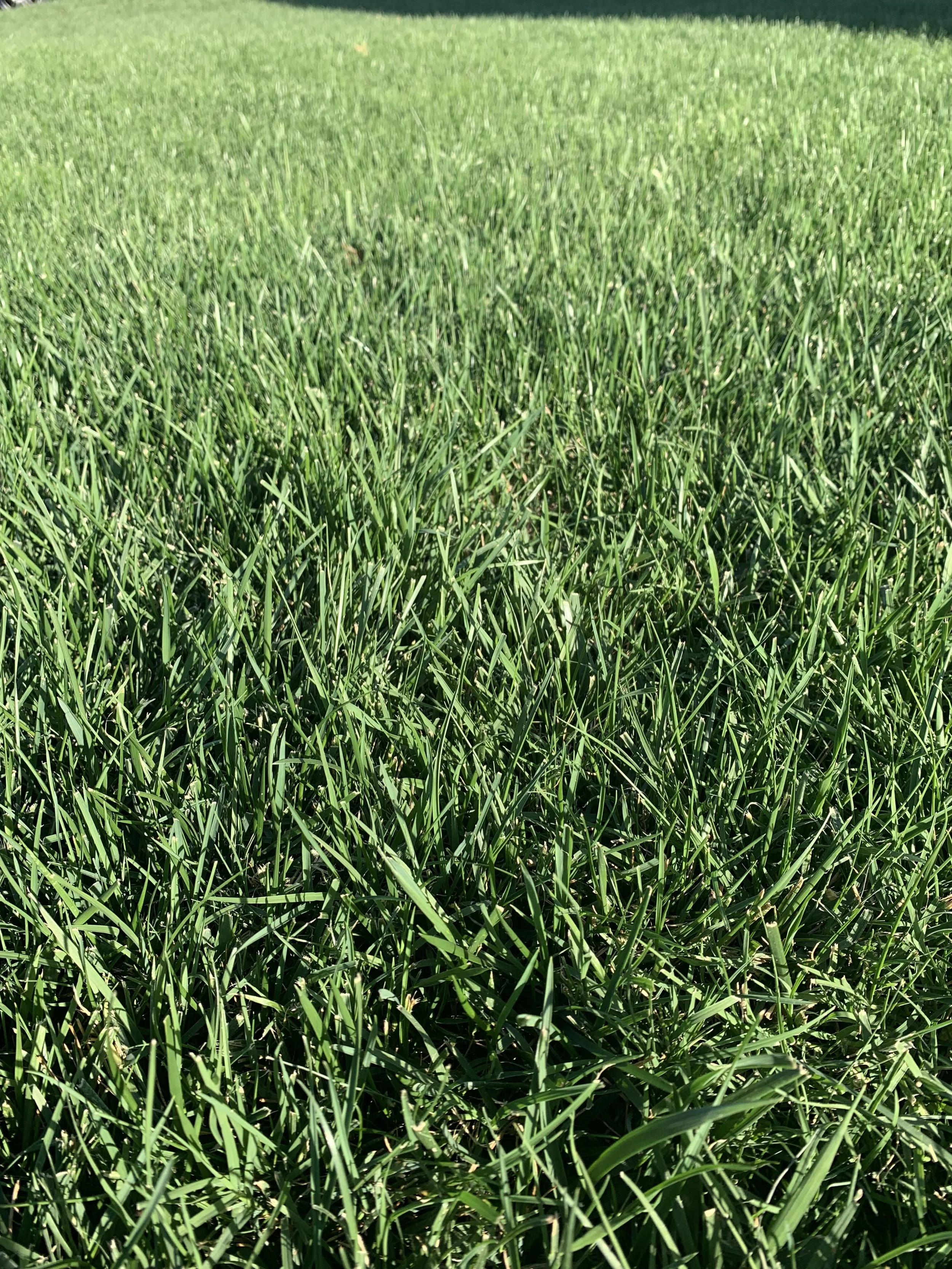
This fescue lawn was overseeded the first week of September. The area is watered with spray-type heads on 12-15’ centers. The system was set to run at 4:00 AM, 10:00 AM & 4:00 PM, 4 minutes per zone, daily for two weeks. Successful seeding in early September is less about the afternoon temperature and more about consistent moisture.
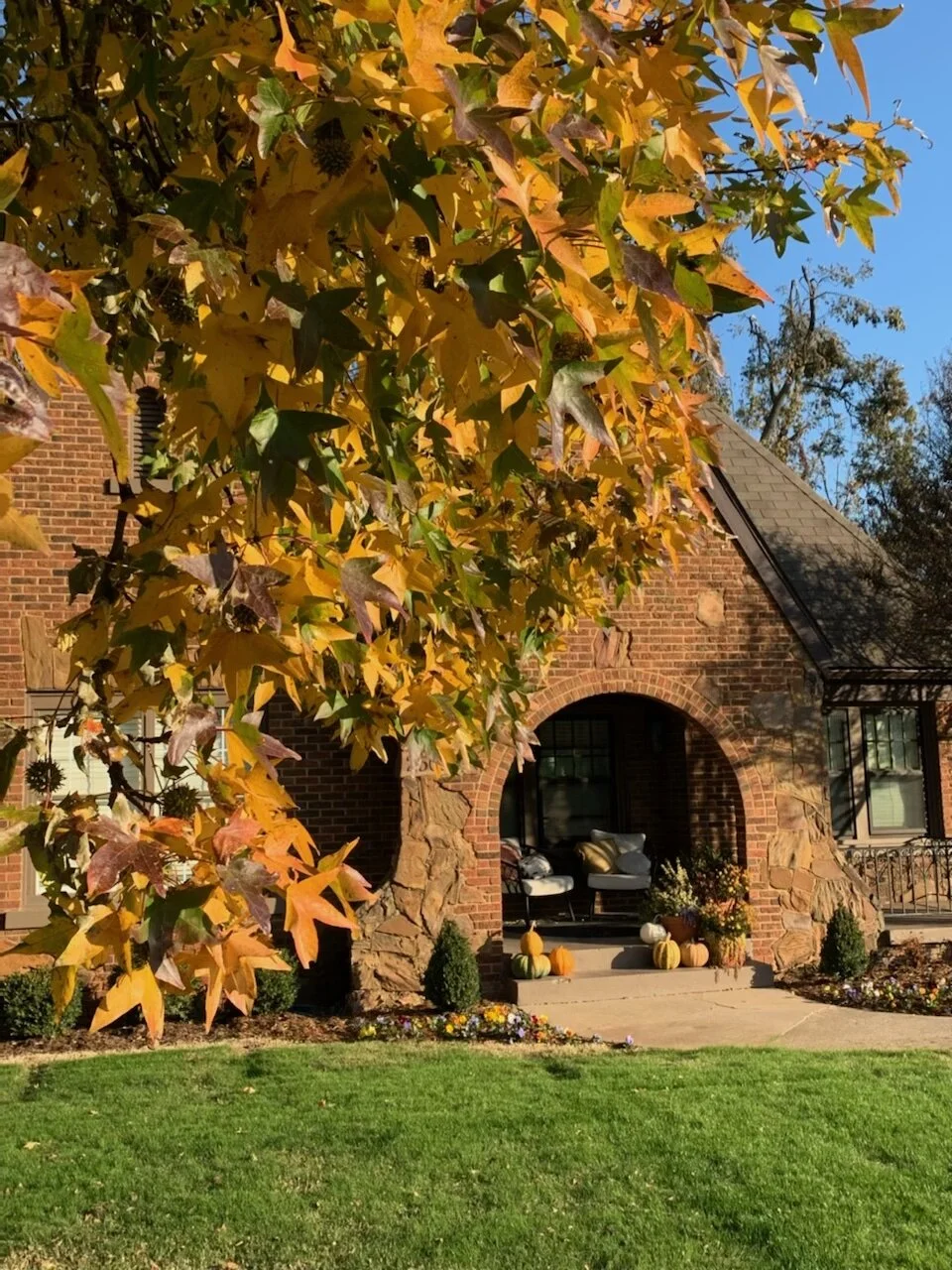
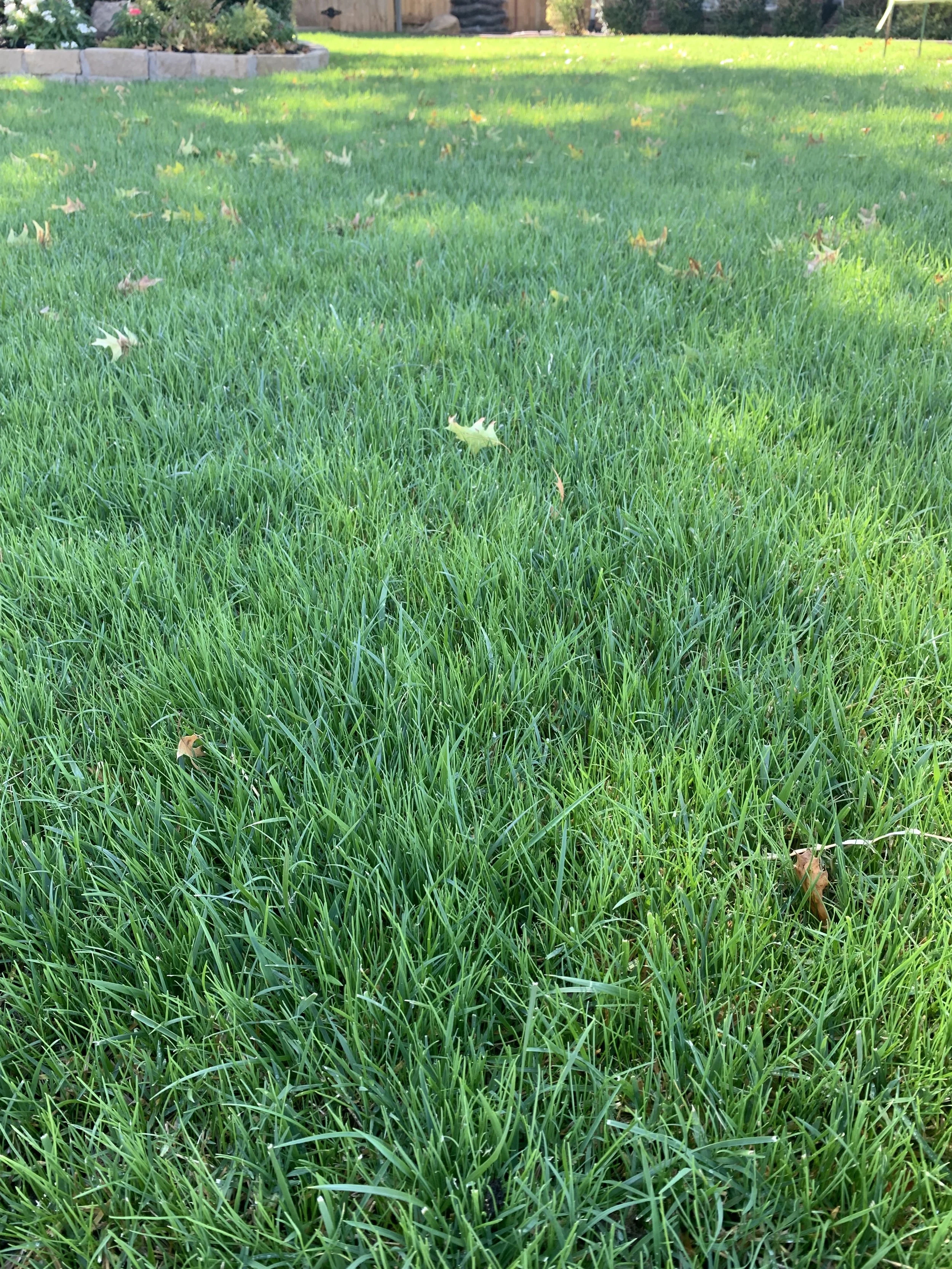
This fescue lawn was overseeded 2 weeks ago. The lawn was kept consistently moist resulting in successful germination. The lawn is watered with rotor-type heads on 25-30’ spacing which ran for approximately 10 mins 3x per day since seeding.
Bermuda Lawn Maintenance
As cooler nights arrive, and days continue to get shorter, warm season lawn growth will slow in October resulting in fewer cuttings in October.
Avoid scalping the lawn short to finish off the season. Anytime grass is scalped the plant uses nutrients stored in the roots to produce new leaf blades. Scalping in the fall will result in a weaker root system going into winter. Leaving your bermuda lawn at 2” to 2.5” during the dormant season gives your lawn a layer of protection against extreme cold temperatures and weed germination.
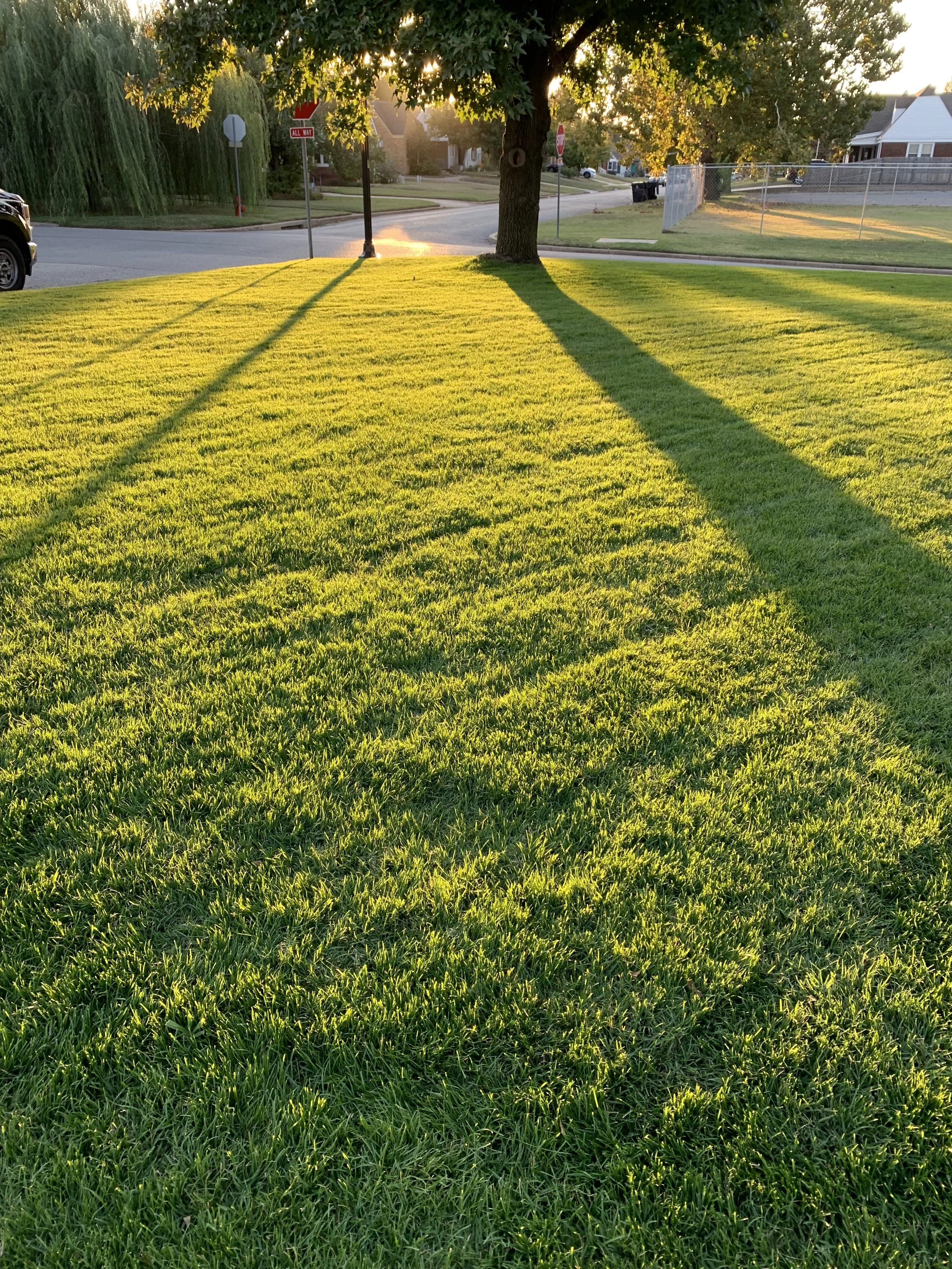
It’s hard to beat the deep rich greens of fescue in October!
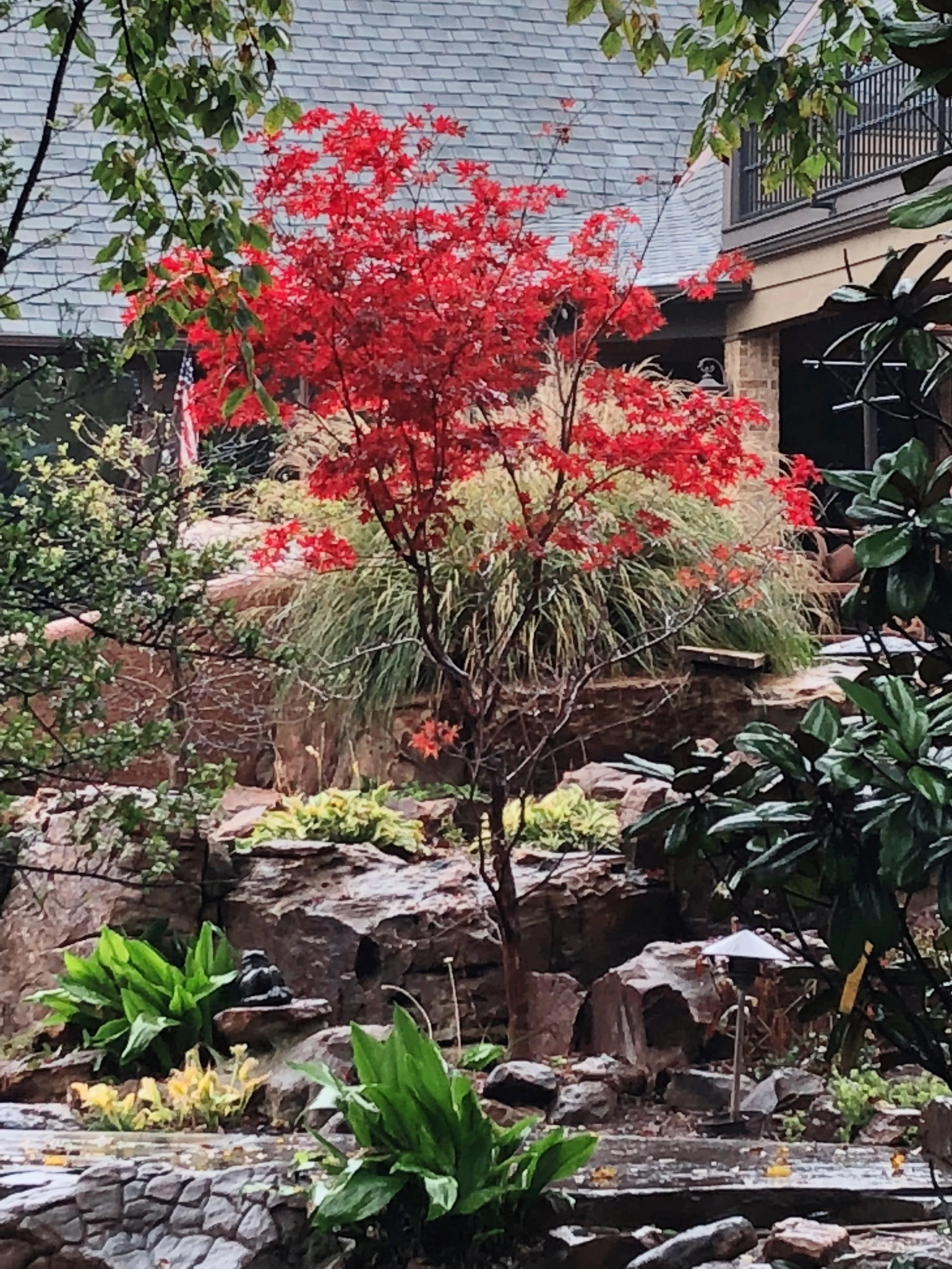
Japanese Maples return to bright red this month.
Lawn Fertilizer
Fertilize cool season lawns with a high nitrogen fertilizer this month. Fall is the best time to feed fescue.
If you have a bermuda lawn, put away the high nitrogen fertilizer for the season. Even though soil temperatures are still warm enough to promote growth and add color for bermuda lawns, late nitrogen applications are considered a causal agent in the promotion of spring dead spot.
Fescue Lawn Maintenance
Fescue thrives when nighttime temperatures are cooler, and day length is shorter.
Have you noticed the recovery of fescue lawns since the rain of late August?
The beauty of fescue in the Fall is unsurpassed by any other turf grass. Mow regularly. Avoid cutting more than 1/3 of the leaf blade off each time you mow.
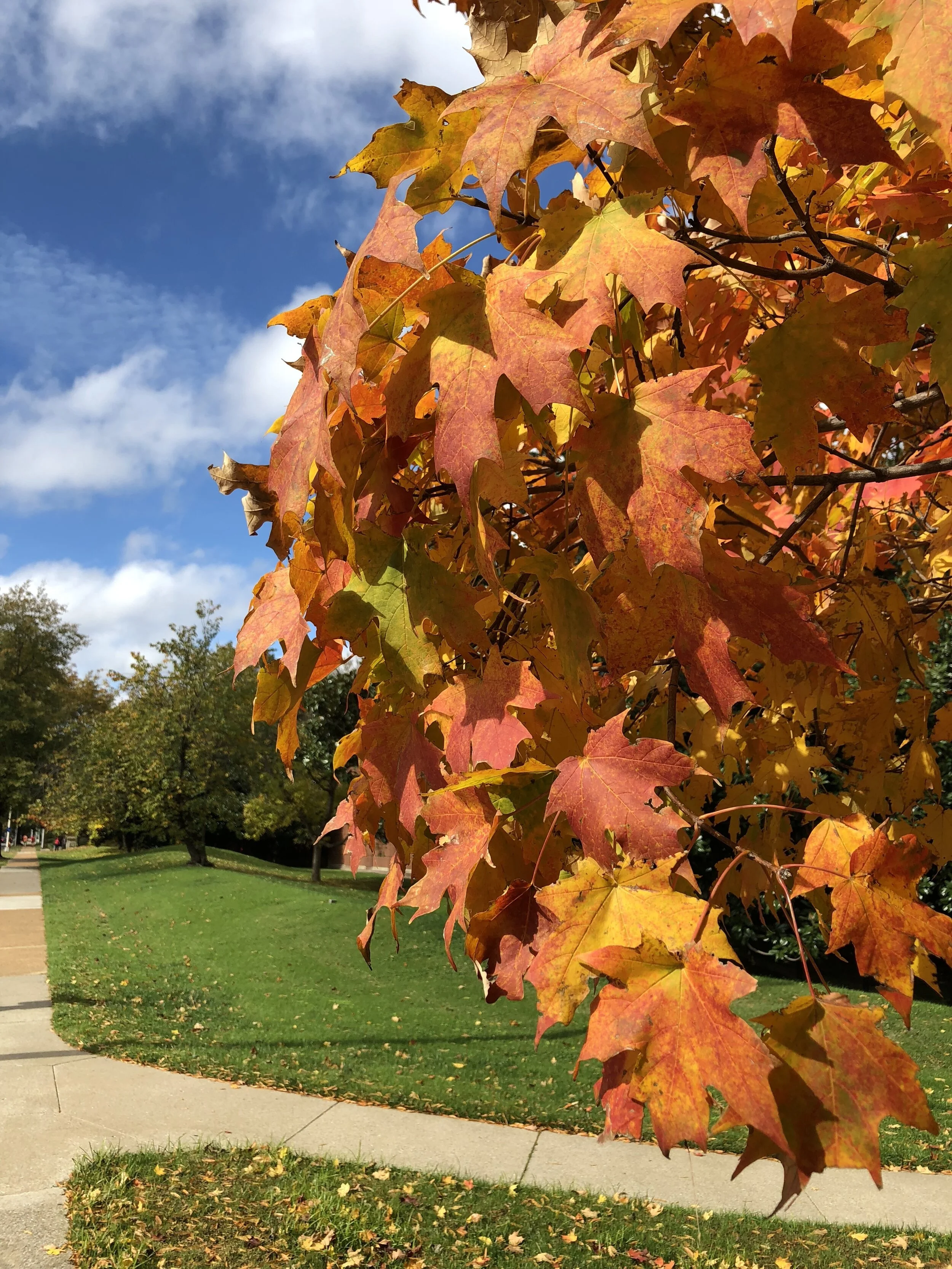
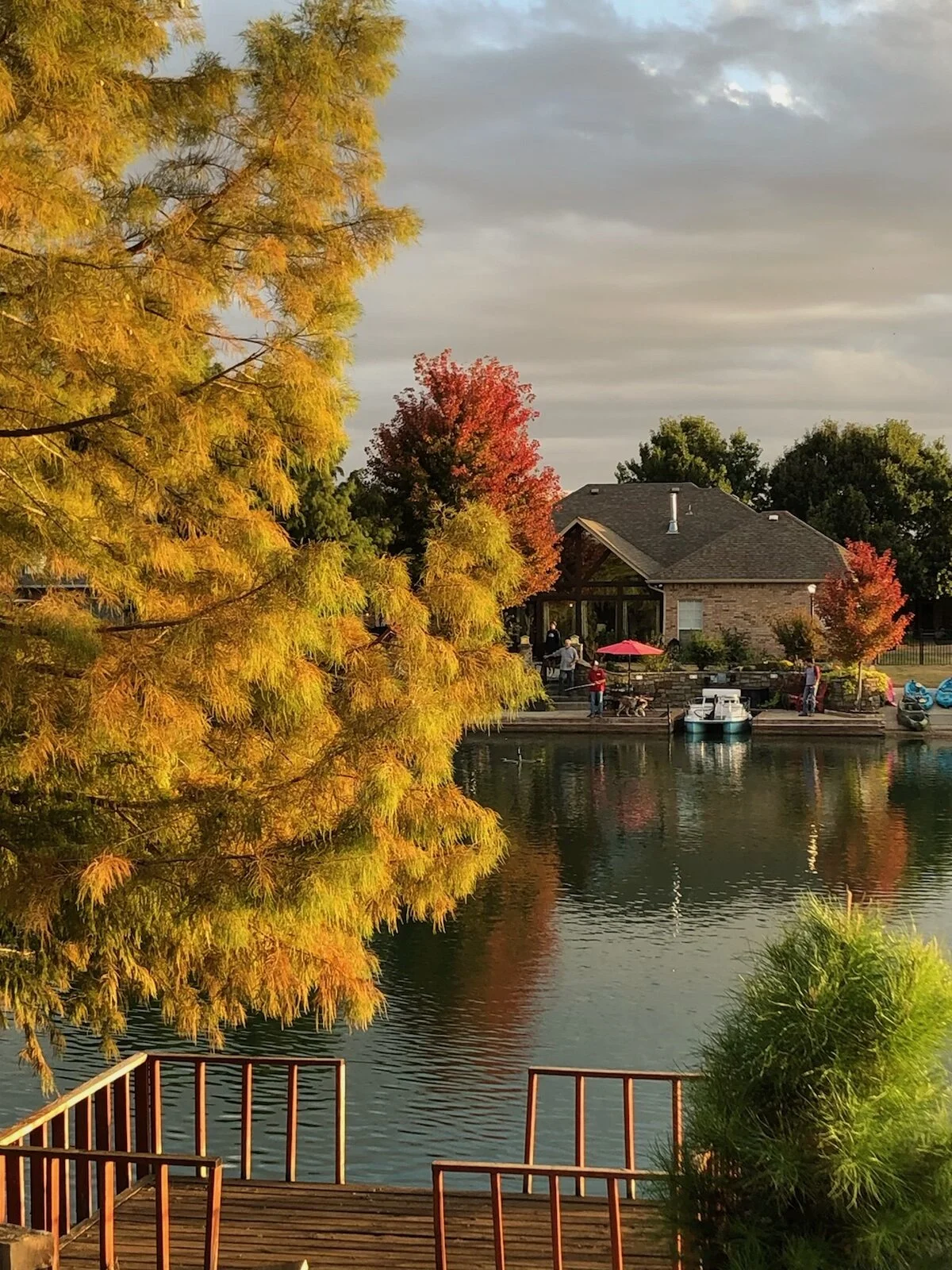

Bald Cypress turn a beautiful rusty red in October.
Turf Weed Control
Warm season lawns need two fall pre-emergent applications. If you have not applied the first fall pre-emergent yet, please do so as soon as possible. For the best prevention of fall and winter weeds the first application before soil temperatures consistently drop below 70. The current 3-day average soil temperature in the Oklahoma City metro is 74.
October through early December, a second, winter pre-emergent needs to be applied to keep your lawn weed free until next spring.
Fall is also a great time to control many broadleaf weeds in warm season turf and established cool season turf.
If you seeded your fescue this fall, wait until the new grass is up, actively growing, and has been mowed a few times before you apply any pre-emergent herbicides.
The best way to have a clean lawn next spring is to apply two fall pre-emergent applications this fall, one early and one late.
Spring Dead Spot
A common disease of bermuda lawns that is visible in the spring, but infection of the disease starts in the fall when soil temperatures drop below 70 degrees. Bermuda lawns that receive late season applications of nitrogen to extend color are more prone to the development of Spring Dead Spot. Effective fungicides for control are not available for homeowner use, but certified lawn care technicians have fungicides in the Fungicide Resistance Action Group available to treat for Spring Dead Spot. Two fall applications are required for the best results. The first application should be made when soil temperatures are in the low 70s with the second application 30 days later.
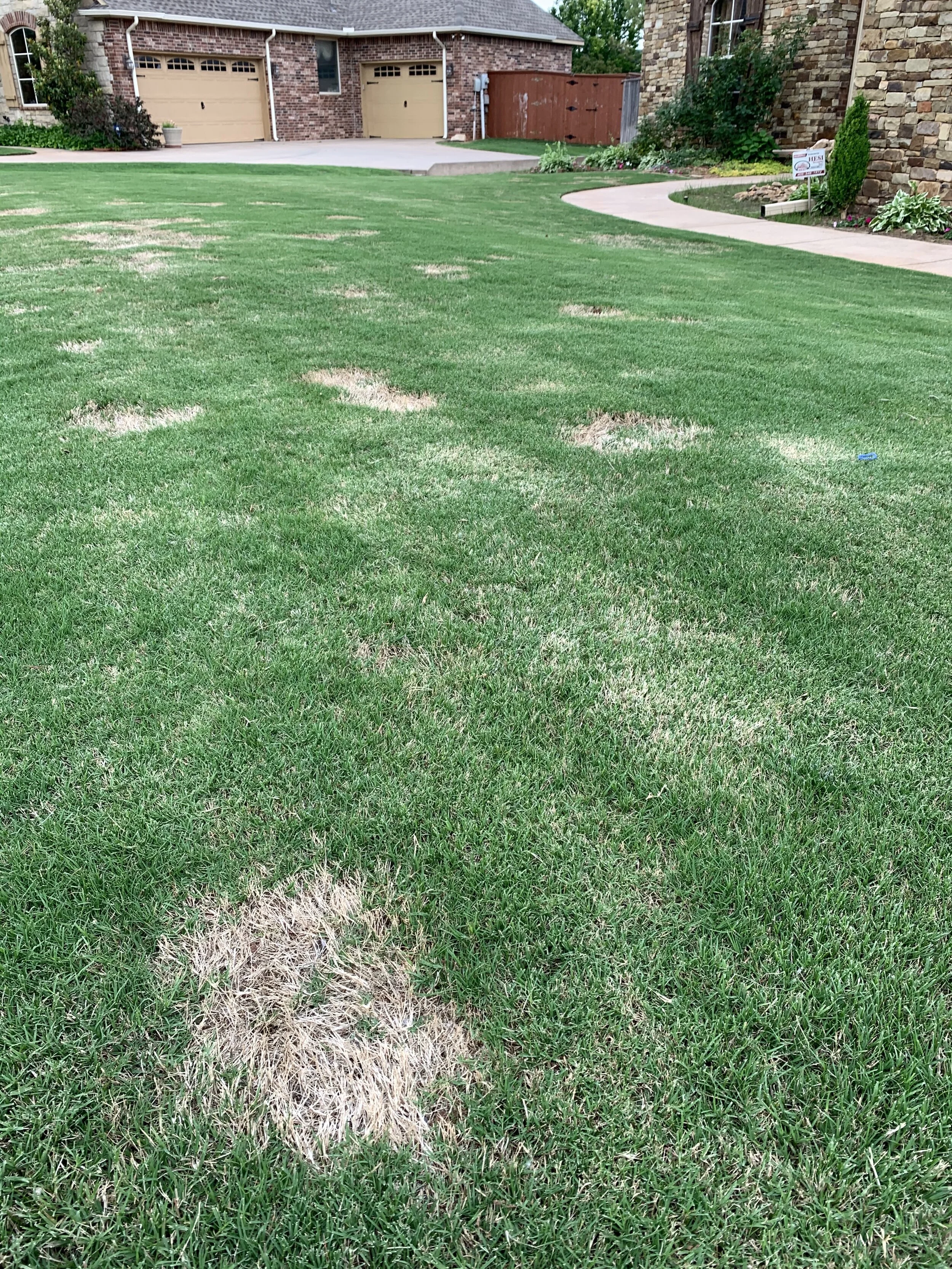
Spring dead spot damage is noticeable in the spring. If you have experienced this disease, now is the time to treat with a fungicide to stop the spread of the disease.

Maples are one of the first trees to celebrate fall.
Tree and Shrub Fertilizer
Do not fertilize trees and shrubs in October. Fertilizing now can encourage new growth that will not have an opportunity to harden off before the first freeze, which may result in plant damage. Wait to fertilizer after we have received our first heavy frost or light freeze.
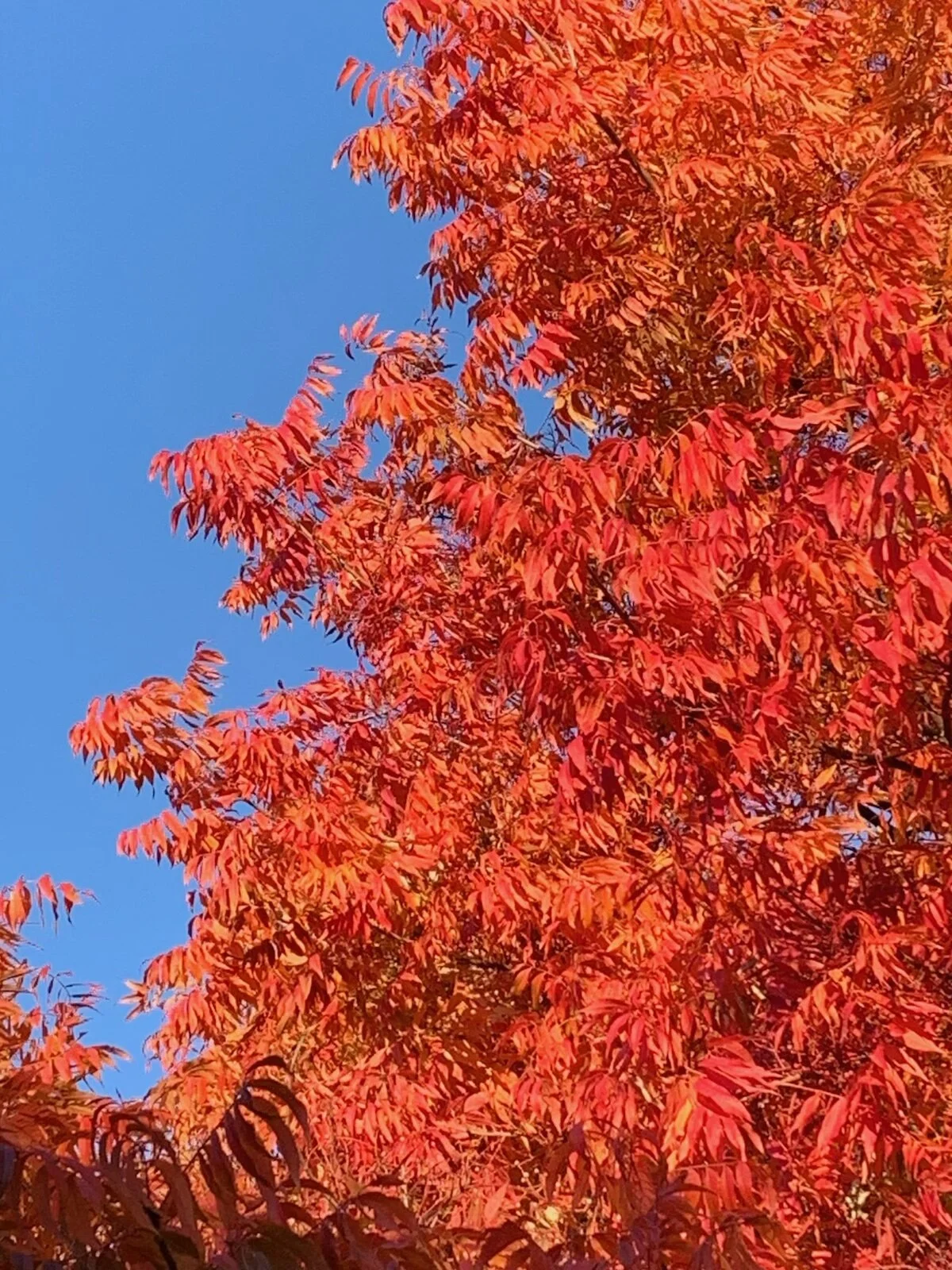
Seasonal Color
Remove your summer annuals and replace with pansies, kale, and mums for great fall color this month. Pansies love the cool weather. Not only will they provide great color this fall, but if they are not allowed to dry out during the coldest periods of winter, they will offer a wonderful blast of color next March and April.
We covered fall seasonal color in more detail in our September 21, article, Coming Soon to a Landscape Near You – Fall Seasonal Color.
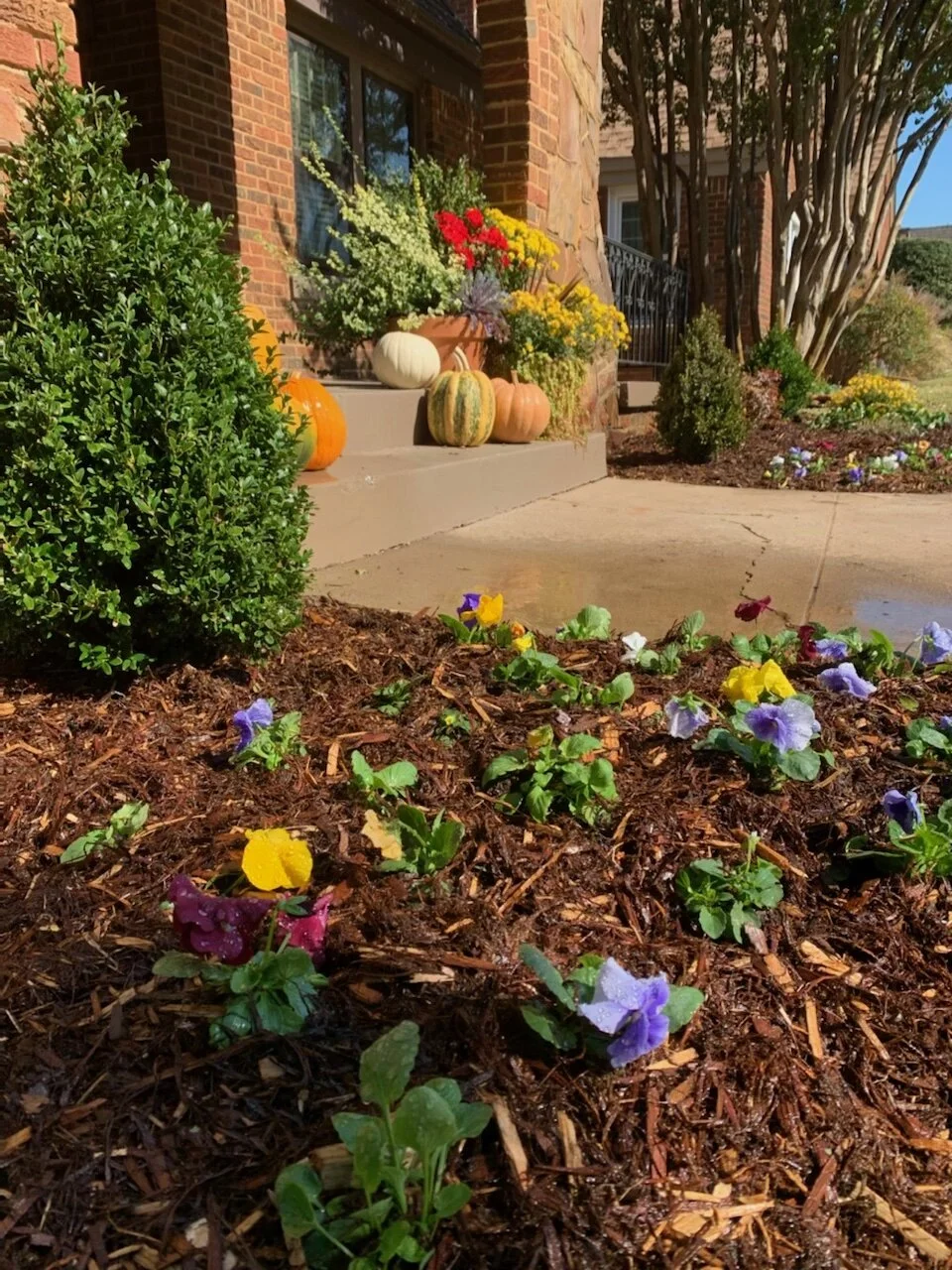
October is the month to remove your summer annual color color and replace with pansies.

Nandina and many other shrubs add bright red berries to the landscape during the fall.
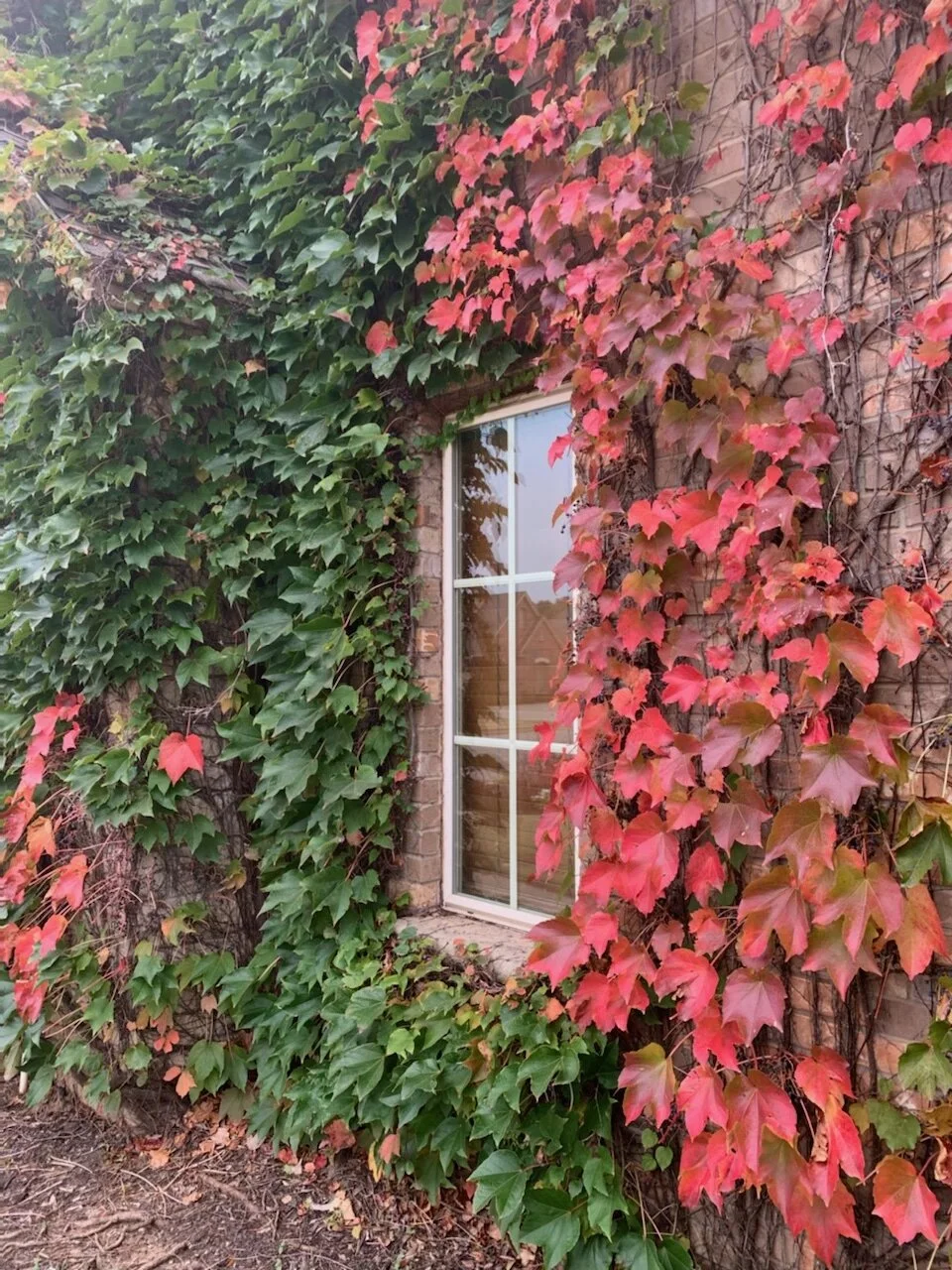
I’m looking forward to the bright October red of Boston Ivy.
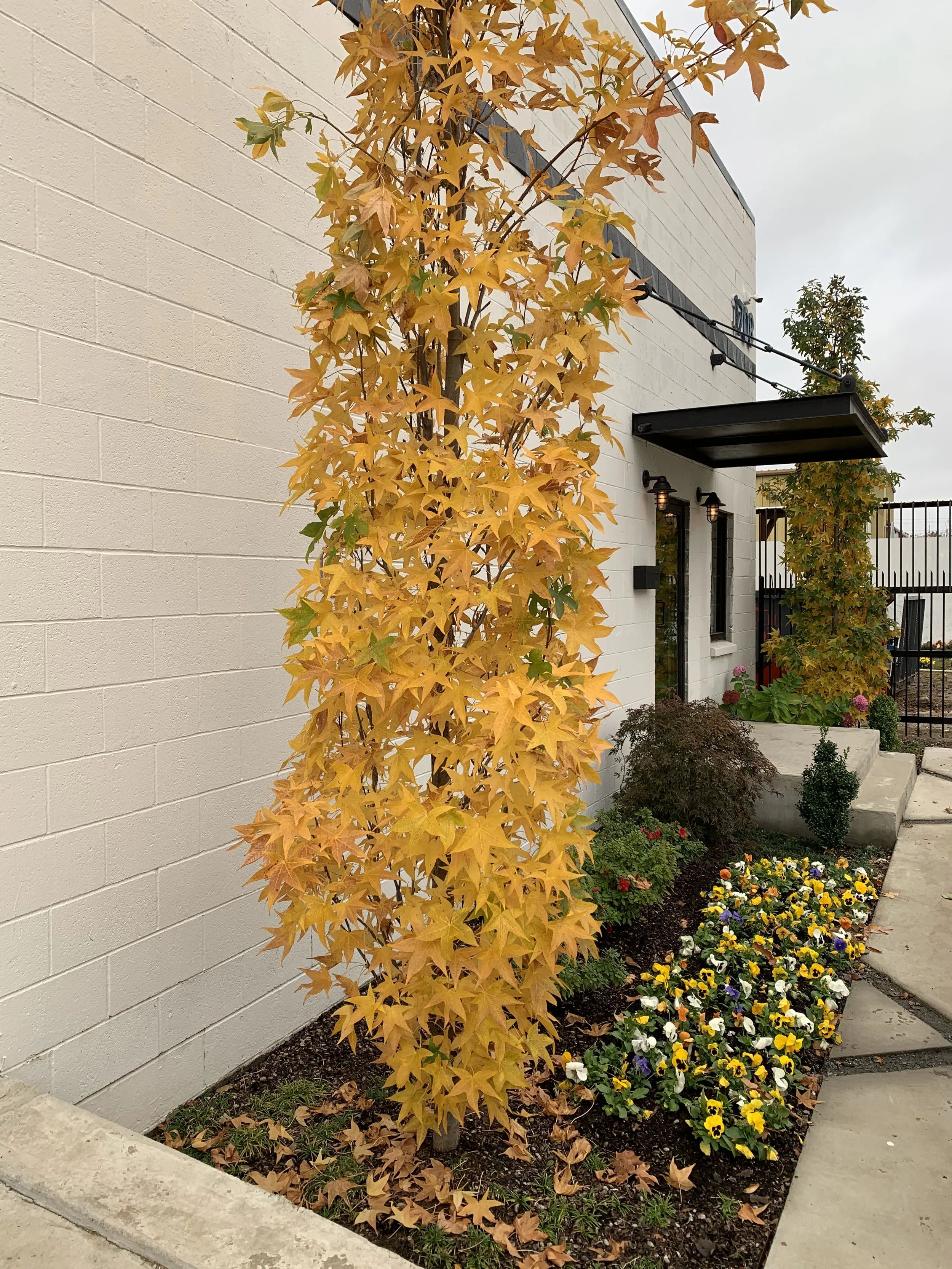
Shillouette Sweetgum, a great tree for small spaces, will put on a great show late in October.

Fall seasonal color change.
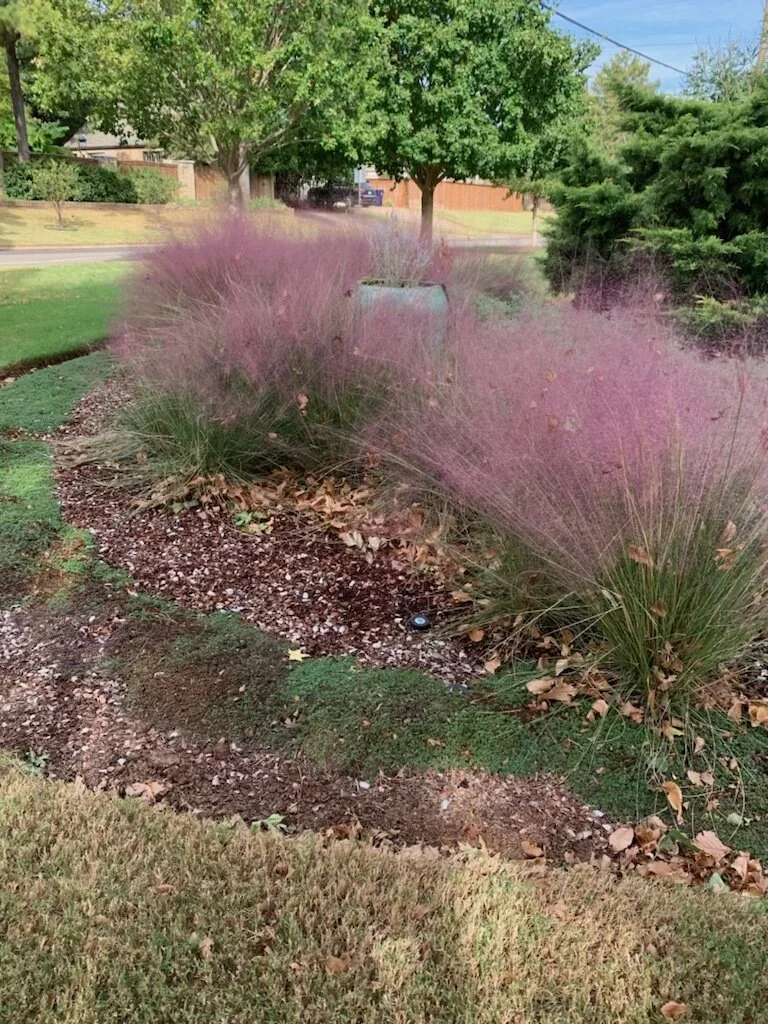
An unexpected fall color is the bright plumes of Pink Muhly Grass.

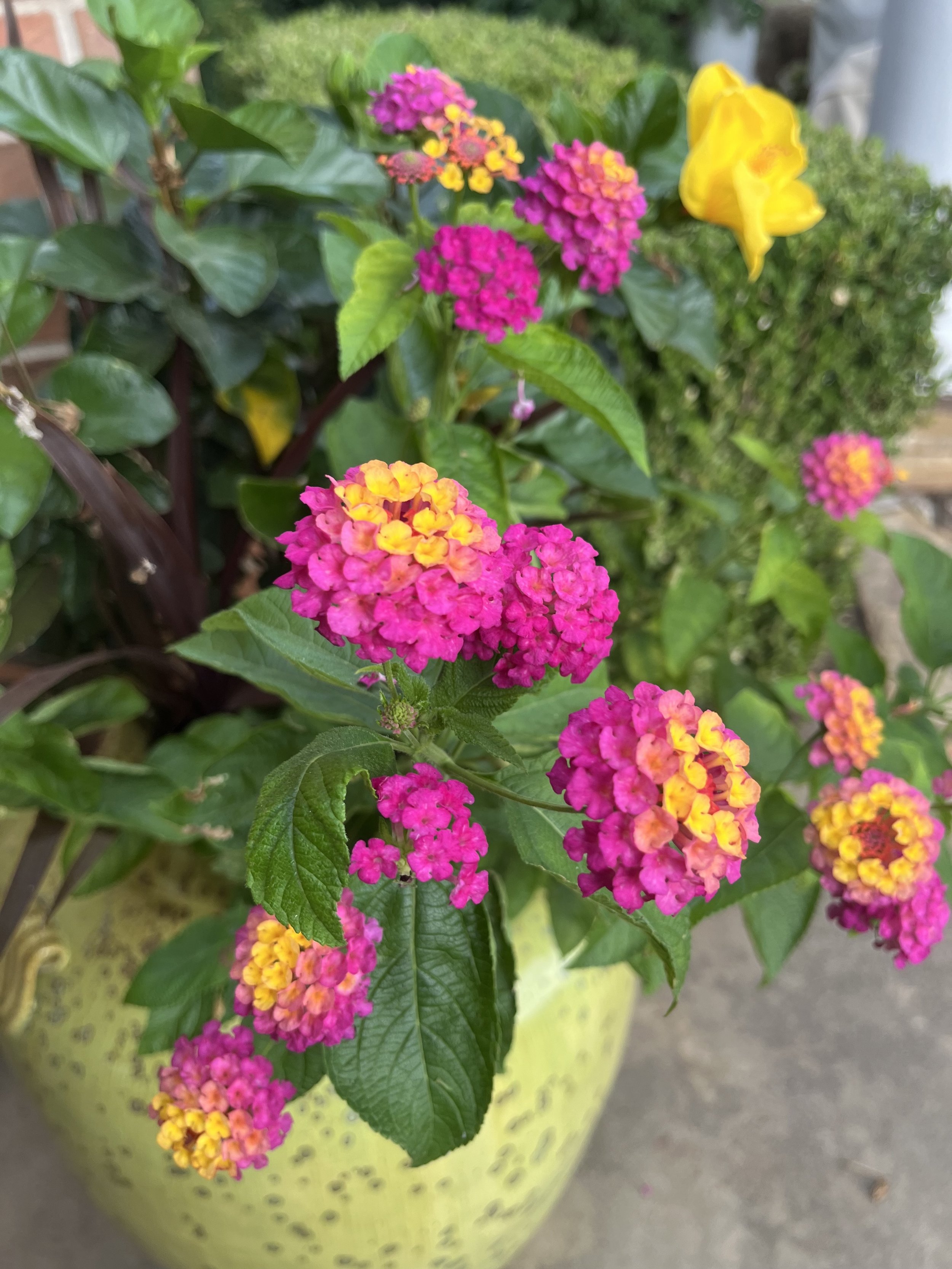
Following the moisture of late August and the warm temperatures of September, Lantana will continues to add color to the landscape.
Landscape Plantings
Fall is the best time to plant most container grown trees and shrubs. Because soil temperatures remain warm long after the days turn cooler, materials planted in the fall develop strong roots before the following summer heat arrives.
Often late spring and summer planted container materials don’t develop roots till the following summer.
Fall planted materials can gain an entire year of development over plants installed in the spring and summer. Wait to plant ball and burlapped trees until after the first freeze if possible.

Fall is the best time to add new plants to your landscape. Consider adding Pyracantha. It is a bold, upright shrub with an intense display of berries in the fall and small, white flowers in the spring. It is an excellent shrub used along a wall or fence as an espalier.
Army Worm Watch
Army worms were back on the scene in September devouring lawns as they marched from lawn to lawn. The cool, wet late August were the right conditions for heavy populations of army worms in the middle of September. If you are noticing an abundance of light gray-white moths around your lawn and landscape, you need to be watching for another generation of army worms in October.
From our July 13th post, The Return Of The March Of The Army Worms, here are a few key things you need to know about army worms:
The adult form of an army worm is a light gray-white moth with mottled wings with a 1 ½” wingspan. Because army worms do not overwinter in our climate, the moths migrate from the Gulf Coast and Mexico each year arriving in our area in late June.
Each moth can lay over 1,000 eggs.
By early July the first generation of eggs have hatched, and the caterpillars go on a feeding frenzy that lasts 2-3 weeks.
Early caterpillars are green and very small and don’t cause any damage until the reach 1”. Quickly they grow into a brown, almost black, 1 ½” long caterpillar with black and reddish-brown stripes on each side of the body and small black spots on the top. Their distinctive mark is an inverted “Y” on the front of the head.
At the end of the 2-3 week feeding period, the worm burrows 1” into the soil and enter the pupal stage. 7-10 days later they emerge from the soil as a moth, and the life cycle starts all over.
The average entire life cycle lasts about 28 days. There can be 4 to 5 overlapping generations from July through early November, or until we have our first hard freeze.
Again, army worms are always present in our summer lawns and landscapes. When populations are normal you may never know they are there. But, with the right conditions we can see an explosion to turf damaging levels in a matter of days.
THE COLORS OF OCTOBER

Over the next few weeks Bald Cypress will add rusty orange shades to the landscape.

Autumn Blaze Maples will be one of the first trees to burst with color this month.

Pyracantha will add color to the landscape this month with bright reddish-orange berries.

Mums are the perennial stars of October.

If you leave your faded blooms on your Endless Summer Hydrangeas they will turn a vibrant pink this month.

Purple Muhly Grass is a cool season ornamental grass that graces October with purple feathery plumes.

Mums
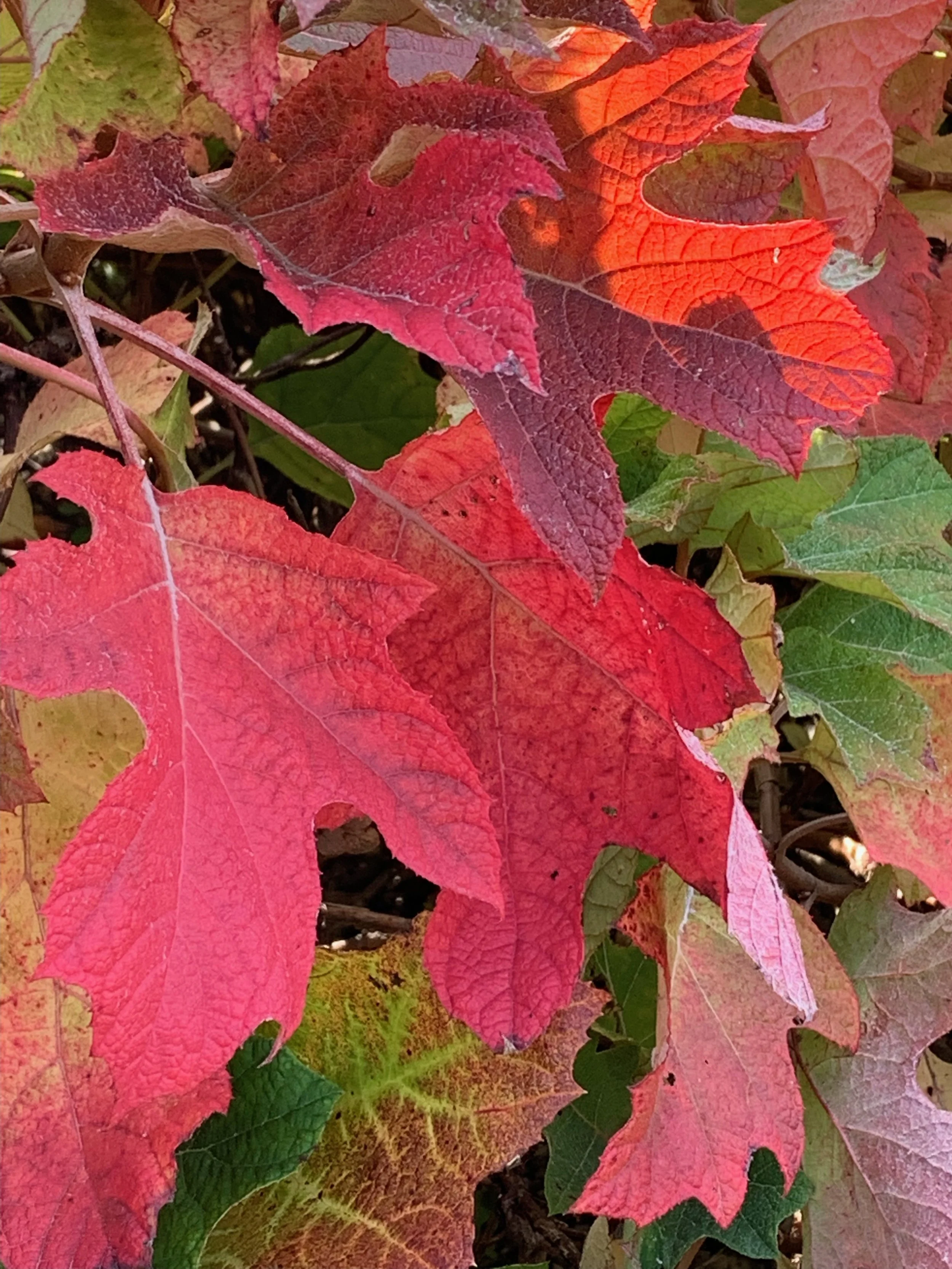
Oak Leak Hydrangeas are also known to brighten the October landscape with hues of red.

Pansies will replace the colors of summer this month in your seasonal color plantings.

Burr Oak

Autumn Blaze Maple

Euonymus Burning Bush will be an eye catcher in late October.
Don’t lose your focus on good lawn and landscape practices as the season slows down. Your efforts this month will not only reward you now but will also set your lawn and landscape up for a great spring.
Now, head outside and enjoy Fall!
If you have questions or need help with any lawn and landscape needs, simply respond to this email or give us a call at (405)367-3873.
Lorne Hall
Hall|Stewart Lawn + Landscape
(405)367-3873
Coming soon to a landscape near you -- Fall Seasonal Color!

The first week of September had everyone in the mood for fall. But, in true Oklahoma fashion, the last two weeks reminded us summer isn’t quite over.
Following the rain the last week of August and cooler temperatures the first week of September there is a good chance your summer seasonal color looks better right now than it has all summer.
Sadly, the summer annual seasonal color show only has a few weeks left.
As days in the 80’s are replaced by days in the 70’s the change in the landscape will be most noticeable in your summer annual color.
Next up for your landscape…. Fall Seasonal Color!
One thing before we start dreaming about fall seasonal color, I need you to do me a favor…
Grab a note pad and your smart phone, head outside, and take pictures and jot down notes of your summer seasonal color.
Right now, is the perfect time to update your Seasonal Color Journal. (You have one, don’t you?)
Seasonal Color Defined:
The planting of annual (plants that only last one season) flowers in the landscape to add a seasonal accent of color. Annual color can have more impact in the landscape than any other design element. Seasonal color plantings can be large and bold, or they can be small plantings near the front door or planted on the edge of the patio to catch your attention, or they can be as simple as a few colorful landscape pots welcoming guests to your home. The key is to only plant as much color as you can adequately care for. Seasonal color, large or small, is a statement piece in your landscape.
A few pictures from our Summer Color Journal:

Coleus did a great job of adding color and texture to the summer landscape.

Sunpatiens have performed well in the last half of the summer. This year many Sunpatiens plantings were slow to get going, but the ones that survived look wonderful now.

Periwinkle is an old time summer seasonal color that is making a resurgence with new varieties. Periwinkle very well may be the star of this summer’s seasonal color. It is hard to beat its performance in a hot and dry summer.

A good sunny color combination this summer has been Coleus, Periwinkle and Lantana.

Lantana is always a great performer in hot, sunny locations from late June through September.

Penta and Joseph Coat have both performed well in the summer heat this year.

Always a summer favorite for shade is Caladiums and Inpatients.

The Impatiens did so well this summer that they overpowered the Caladiums.

In previous summers the combo of Impatiens and Caladiums in front of the Azaleas created a great three layers of color.

With plenty moisture in the early summer and again in late August our planting of Lantana, Penta, Sunpatiens, Joseph Coat, and Coleus added colorful interest to our landscape all summer.

Tropical Hibiscus have been one of our favorites this summer for container plantings.

Landscape containers filled with Lantana, Angelonia, and Coleus in full sun, hot areas, are still putting on a color show in late September this year.

In our full sun areas of the backyard the Lantana looks great now but was slow to put on a color show this year. Most likely the cooler June slowed the blast of color for heat loving Lantana.

Caladiums and Impatiens added bright color all summer in the shady areas of our landscape.
Fall seasonal color options:


A key to pansies surviving the winter is moisture. A good deep soaking once per week in the winter will help them overwinter.

Pansies
How ironic! The cool season annual that is the toughest…the best at surviving the cold of winter is called a Pansy! Planting pansies this fall will add vibrant yellows, blues, purples, oranges, whites, and reds to your landscape for 7-8 months. The key to pansies surviving the winter is keeping the plants from being bone dry when cold fronts arrive. Pansies love fertile, well-drained soil. For the best results add compost to the soil when planting. For the best show, plant on 6” centers. Pansies are available with a clear face or with a blotch. I love both but enjoy the added color contrast you get with the blotch.
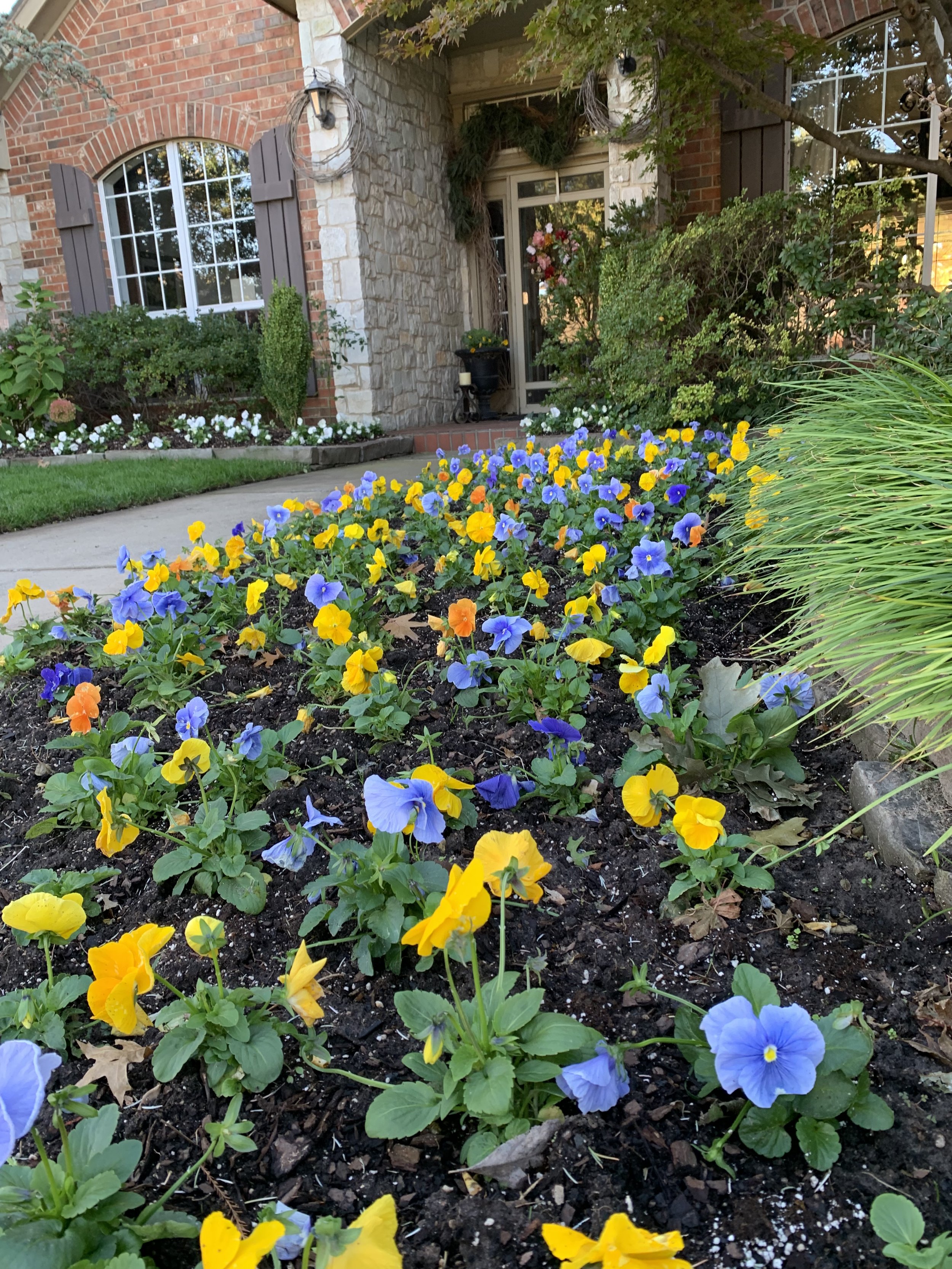
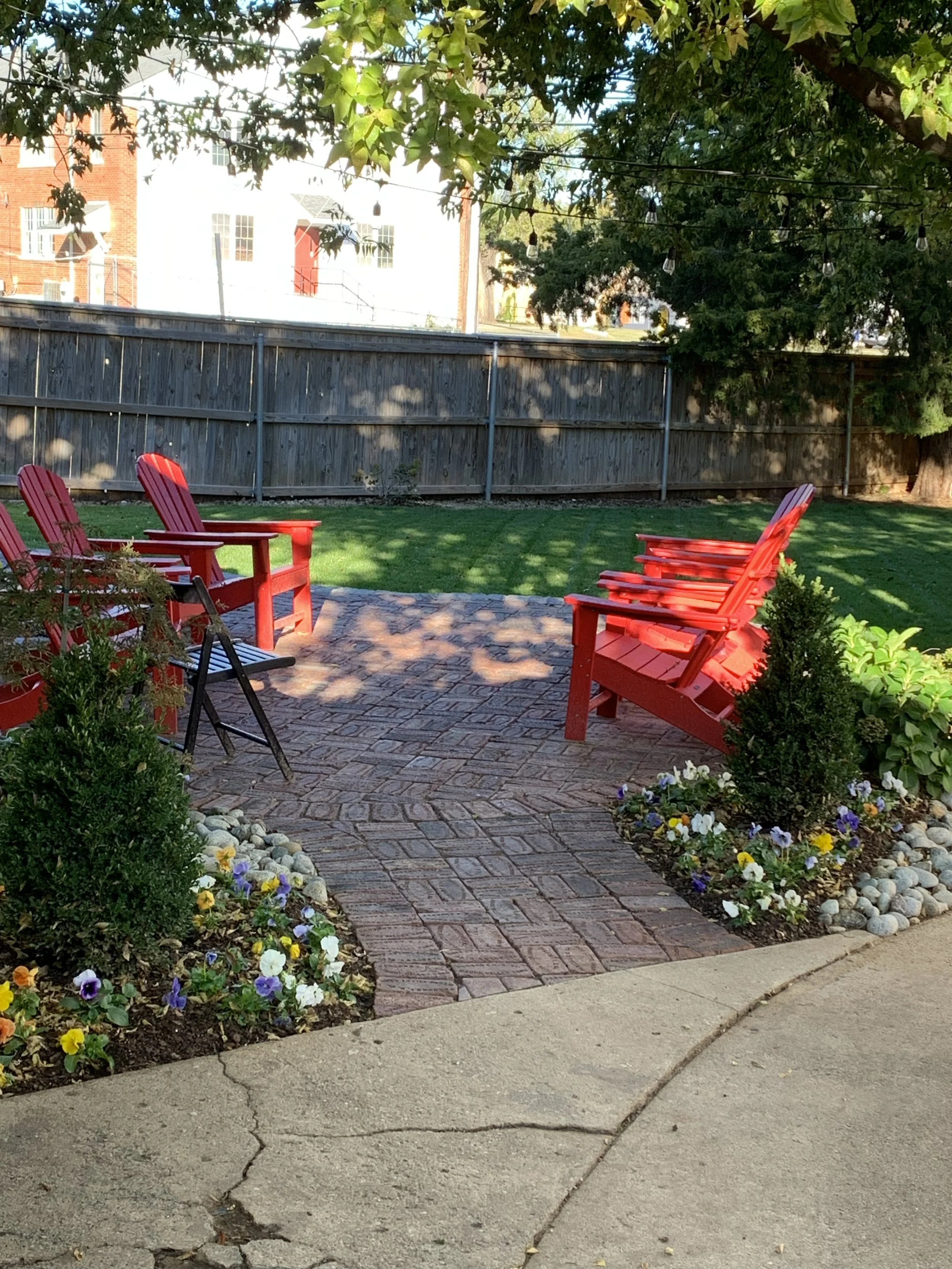
Use seasonal color as a welcoming statement for your guests.


Mums
They are actually a perennial but can double as an annual for dramatic color during October and November. They are traditionally used in pots and overlooked as a bedding plant. Use mums in the landscape for bold, eye-catching color. An added bonus – after the blooms fade, transfer the plants to a place where they will accent the landscape as a perennial in the coming springs and falls.


Kale riding out an ice storm.

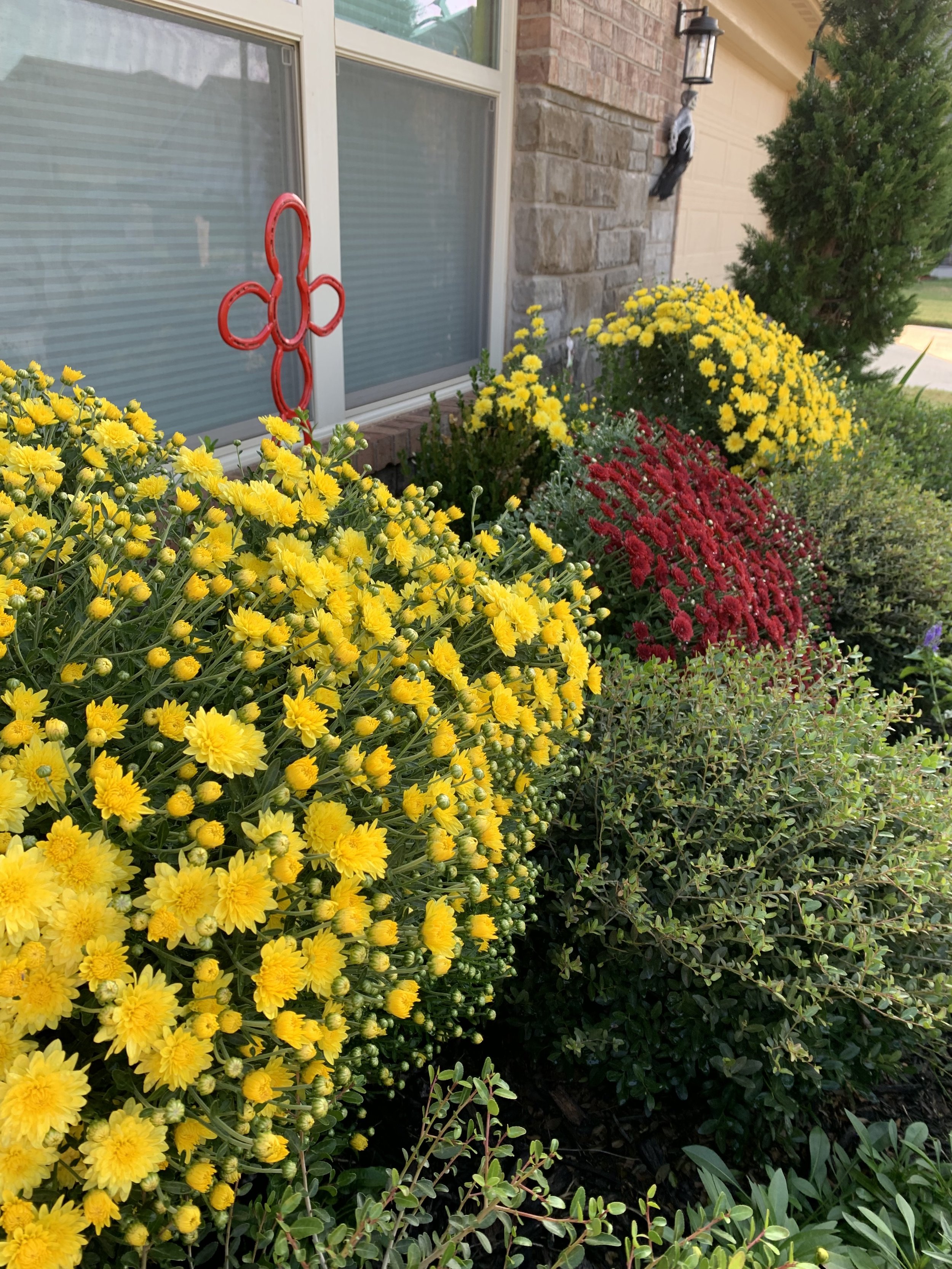
When you use mums as perennials they add a splash of color to your fall landscape.

Kale and Ornamental Cabbage
A leafy annual that adds texture along with hues of purples, pinks, and whites to the fall landscape. Most winters kale and cabbage will add interest to the landscape through the holidays and occasionally into the spring. Just like pansies, the most damaging thing you can do is allow the soil to be dry when cold spells sweep in.

Pansies, kale and mums make a great combination for your fall landscape containers.
Bulbs: Tulips, Daffodils and Hyacinths
Not fall color, but they must be planted in the fall for color next spring. We will spend more time talking about spring flower bulbs later, but now is the time to start making your plans. Bulbs put on their best show in the spring when they are planted with several bulbs together in a group.

Spring flowering bulbs aren’t fall color, but you have to plan for them now and plant them in them in November for a spring show.


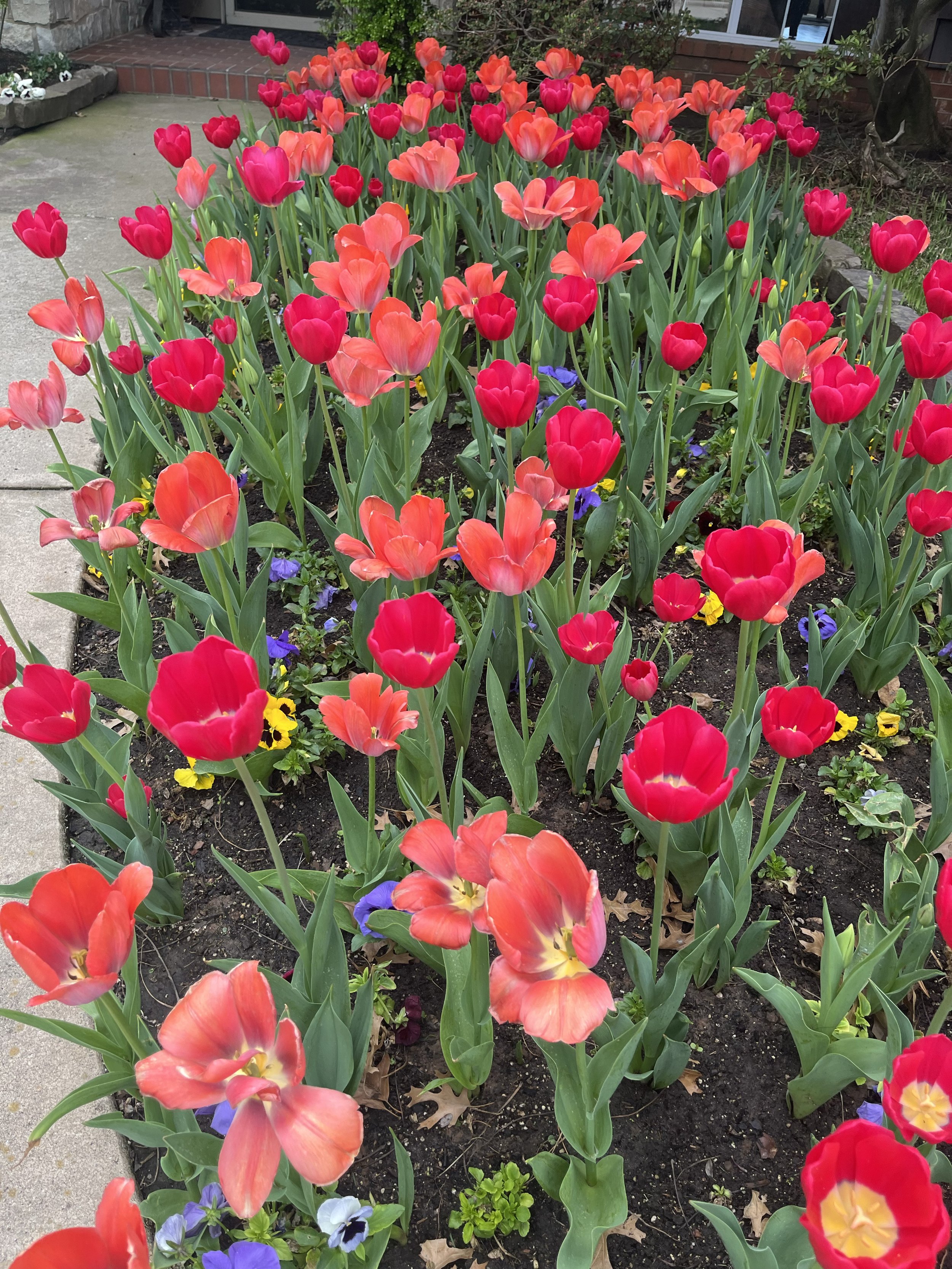
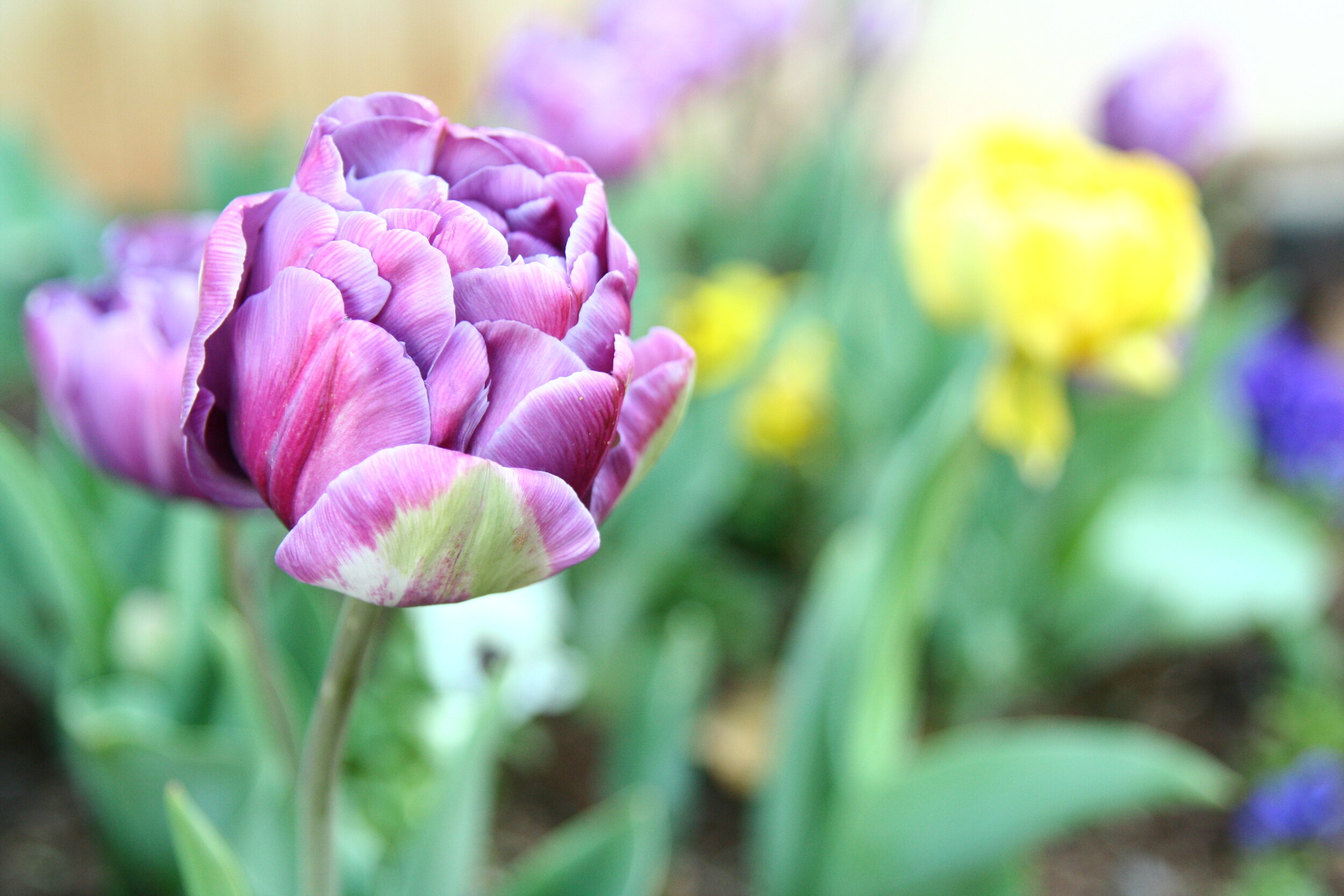


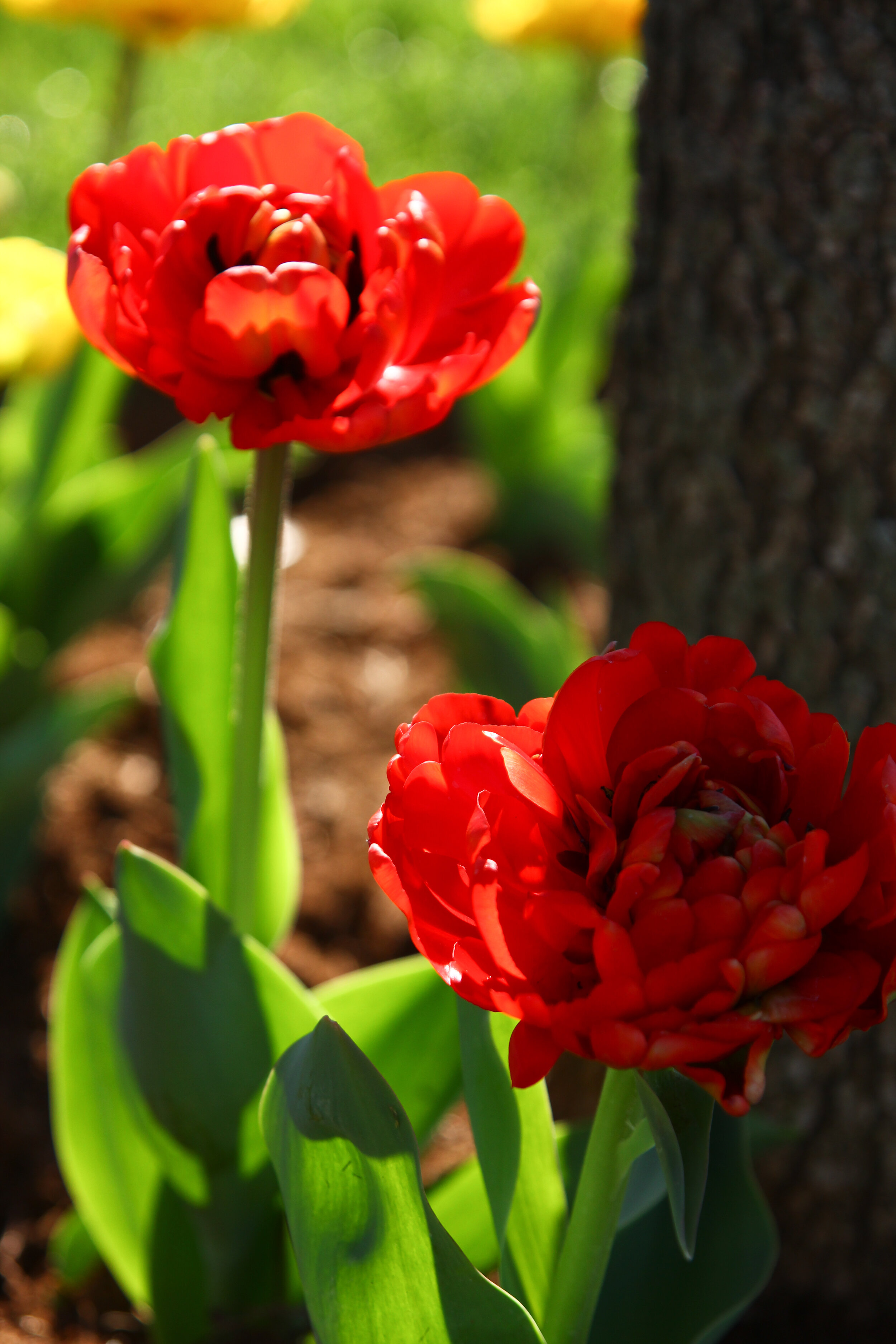
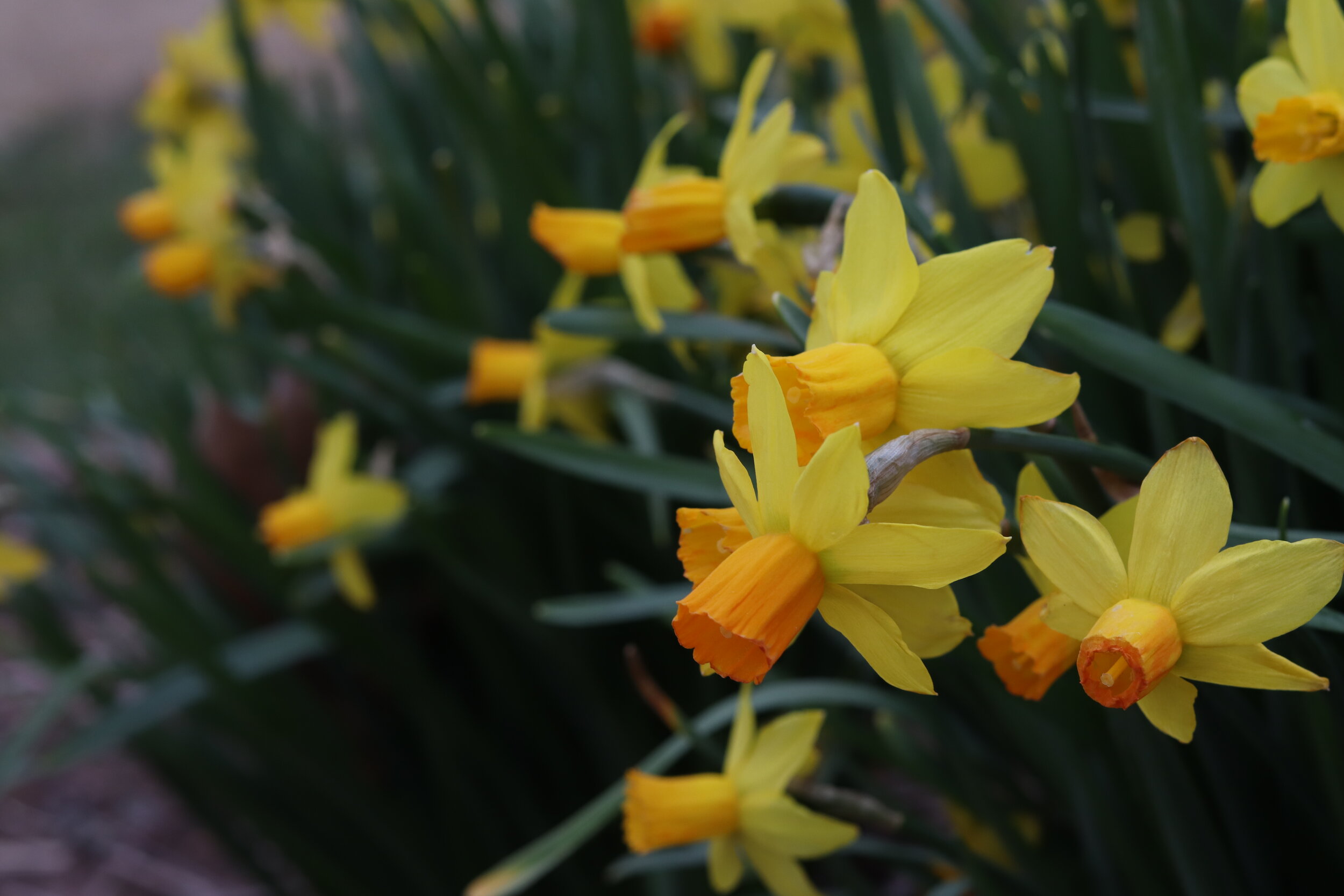
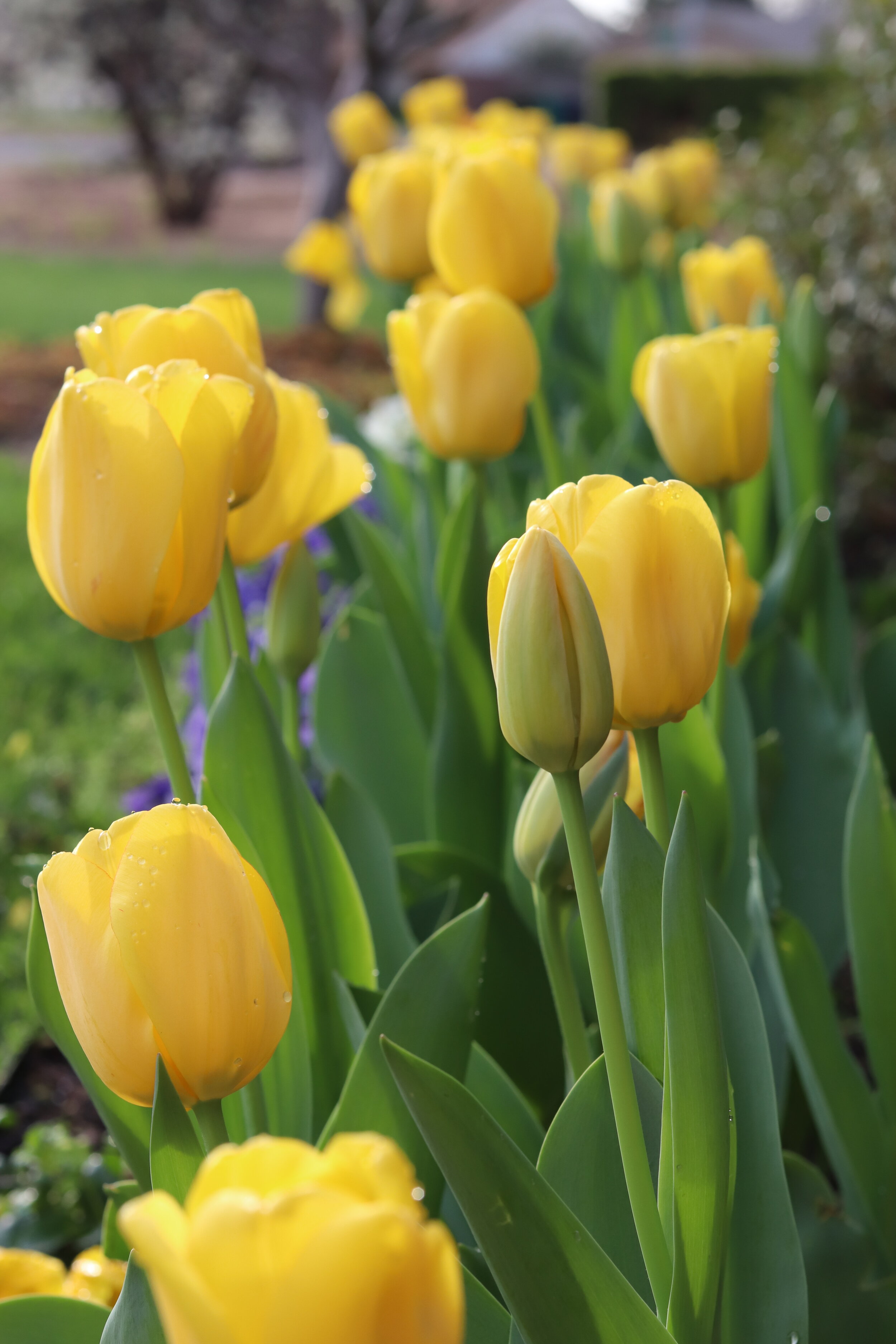

It’s still too early to plant spring-blooming tulip bulbs, but it isn’t too early to start planning your color scheme and where you are going to plant bulbs.
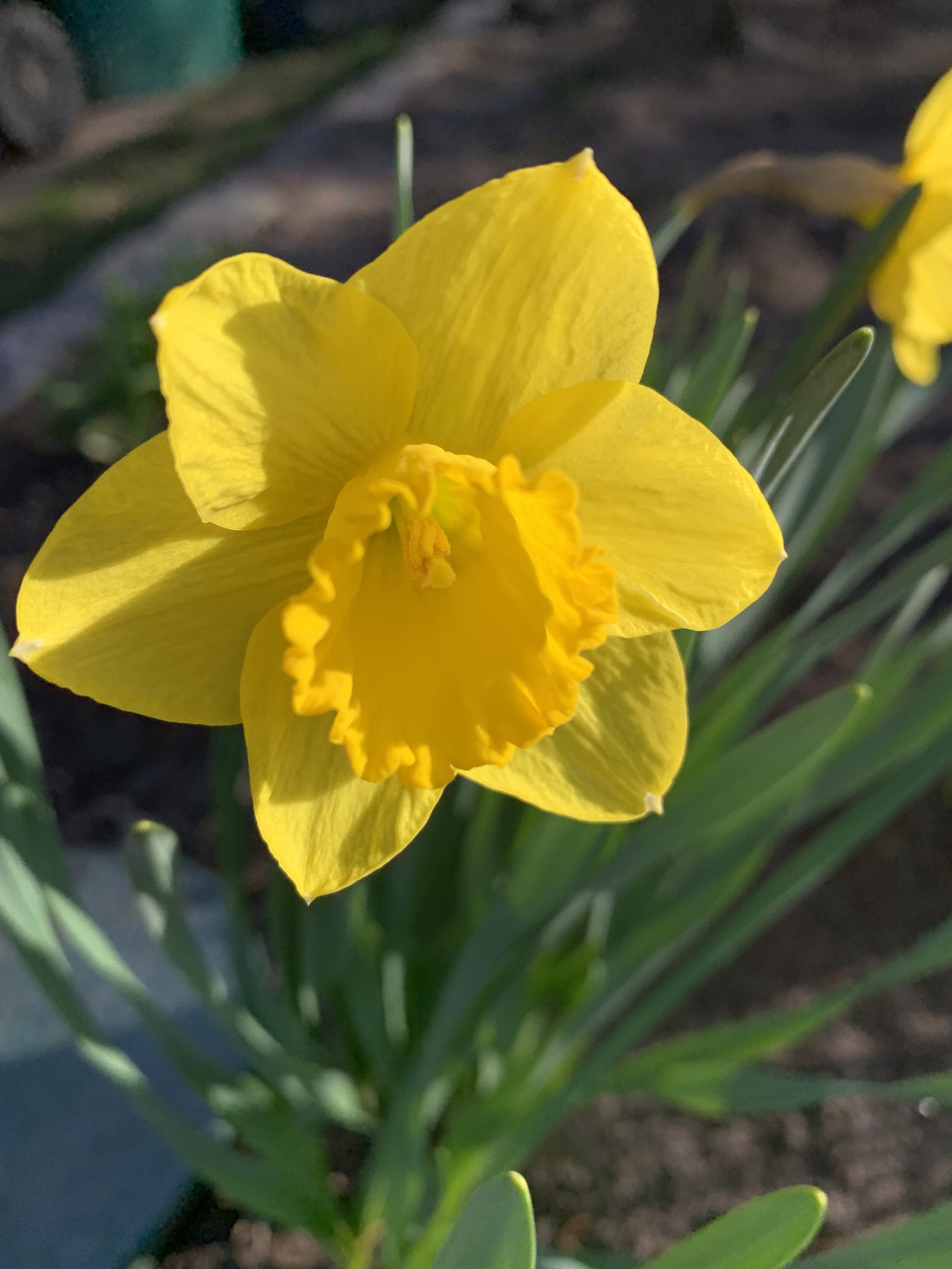
Tip - For the best color show, limit mums and/or kale to 20% or less of your planting. Because of the short bloom time of mums and the chance kale will not last till spring, you will limit your spring color show if you have too much of them. Or, plant your spring bulbs in the same area as your mums and kale. The bulbs will fill the void with a burst of color next spring.
Your lawn and landscape assignment for this week…
Document your summer seasonal color.
Plan your October seasonal color change.
Remember…Great landscapes should include plants that add color and interest in every season!
You really don’t want to be without color for the next 7-8 months, do you?
Lorne Hall
Hall|Stewart Lawn + Landscape
(405)367-3873

A blanket of pansies with kale. In this landscape tulip bulbs are planted in November every year in the area of the kale to add more color next spring.

Bad news - you only have a couple more weeks to enjoy your summer annual color. Start planning now to replant seasonal color areas in October with cool weather loving pansies, mums, and kale.
Four reasons fall is the best time to plant

Have you ever wondered when is the best time to plant new shrubs and trees?
Spring is the best time to plant, right?
Spring is when we all get the bug to add something new to our landscape.
Spring is when garden centers are loaded with colorful plants just begging us to take them home.
The belief that spring is the best time to add new shrubs and trees to your landscape is a myth.

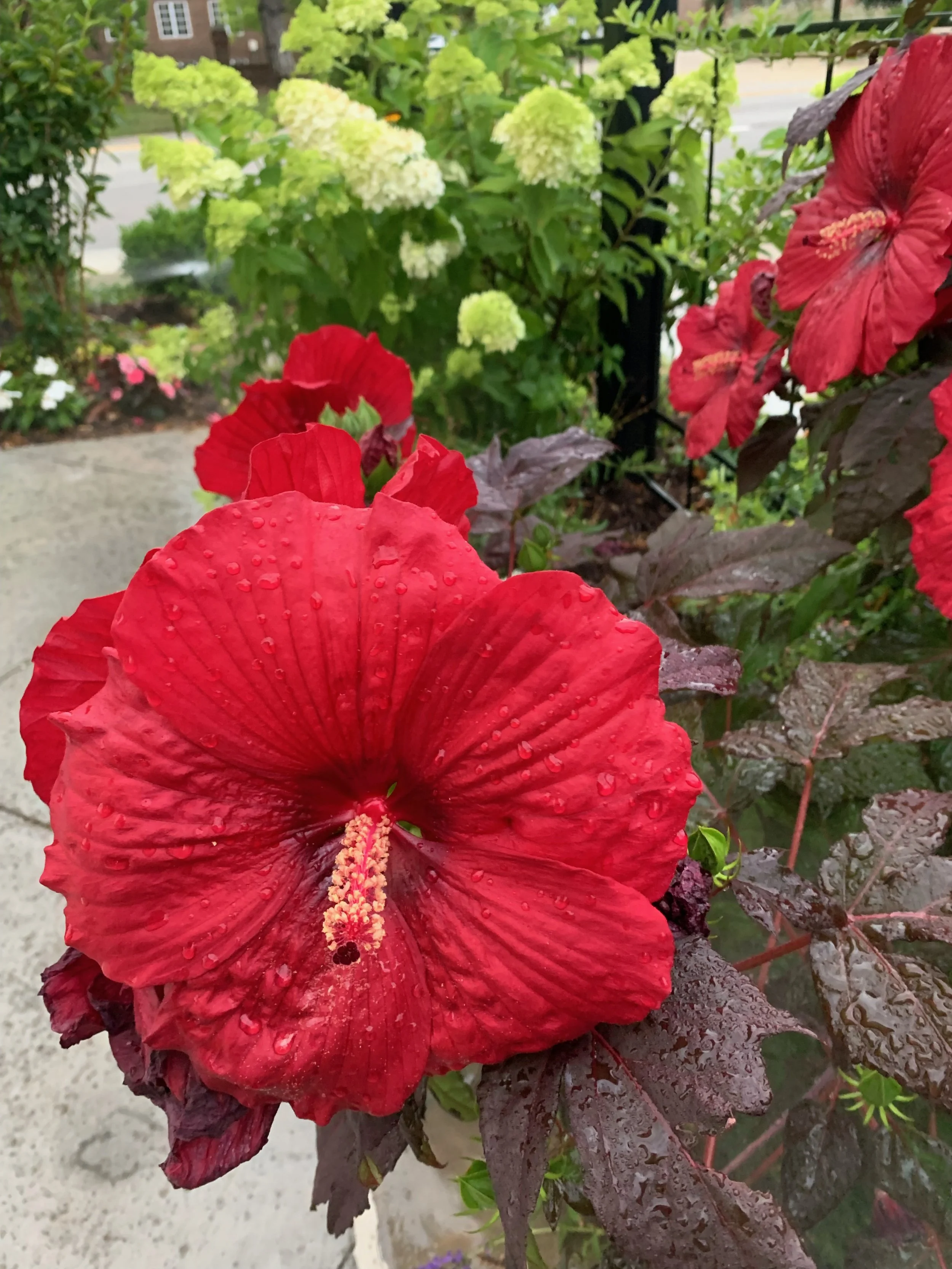
Hardy Hibiscus is a large, shrub type perennial with large flowers through the heat of summer.
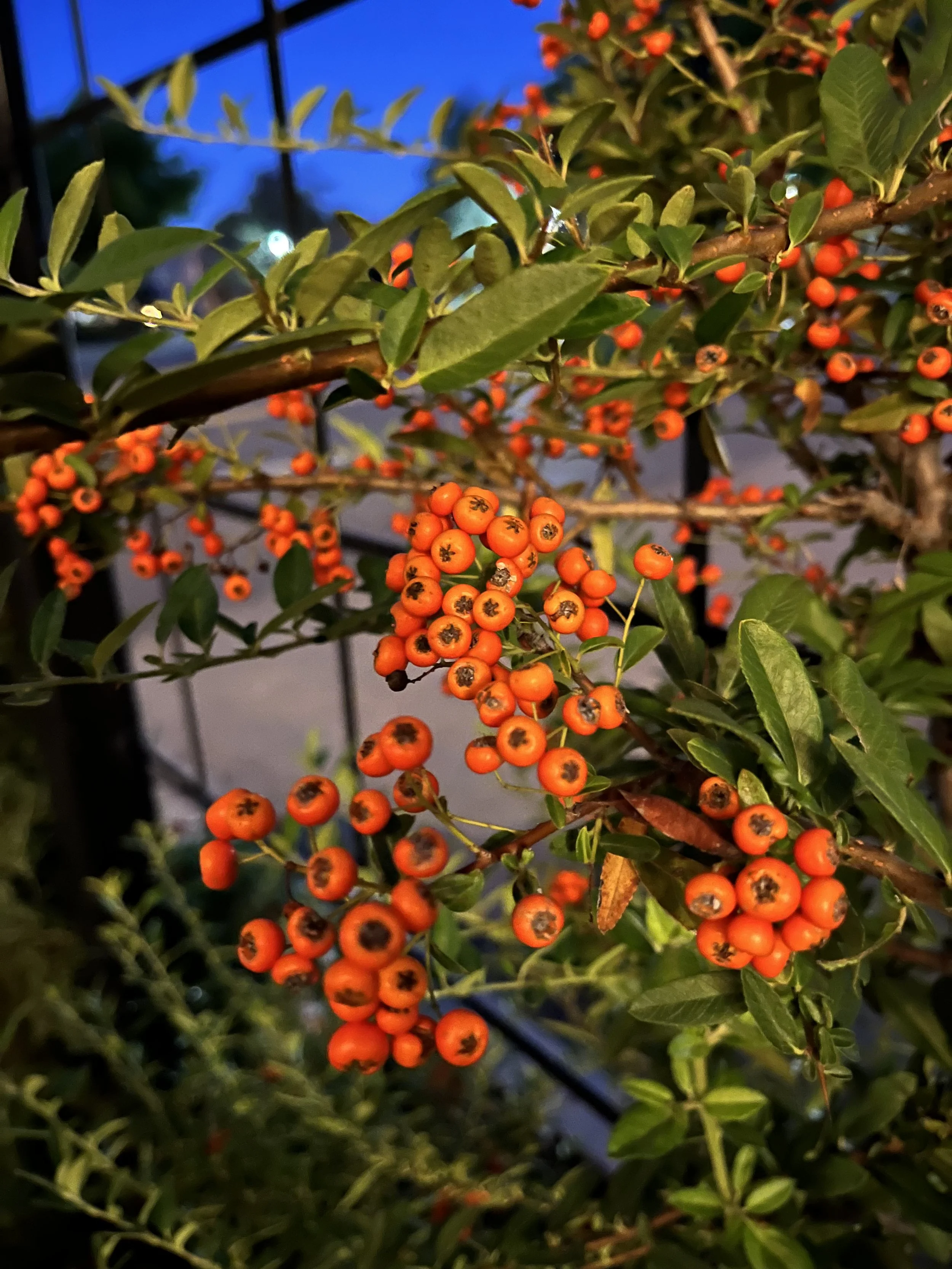
Pyracantha is an old fashioned shrub with bright orange to red berries in the fall and winter.
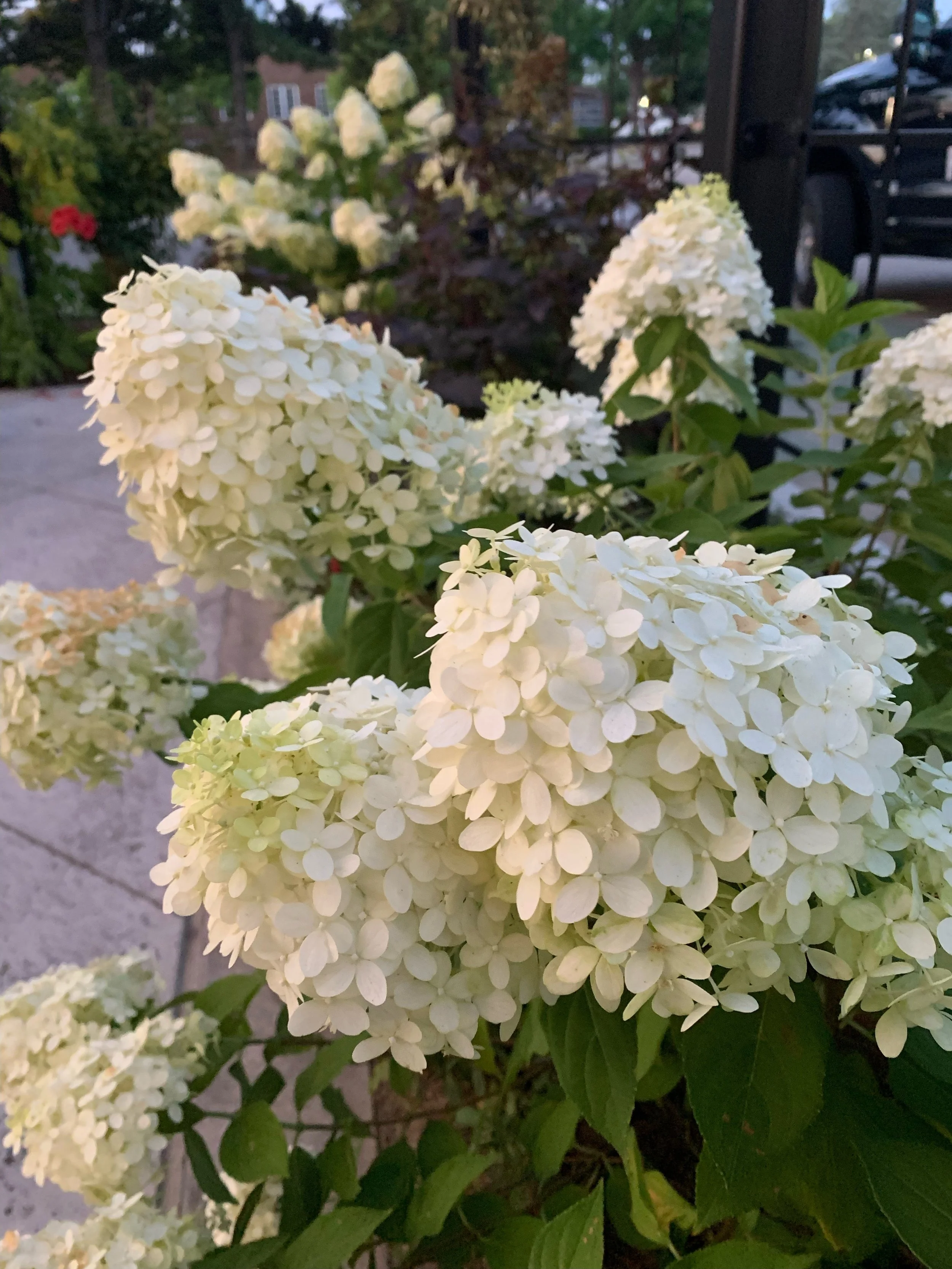
Limelight Hydrangeas brighten the late summer landscape with white blooms that fade to like green.
Four reasons why fall is the best time to plant:
1. Warm Soil Equals Root Growth
Soil temperatures remain warm well into the fall and early winter resulting in root development. Shrubs and trees put their energy into growing roots more in the fall than any other time of the year. Fall planted landscape materials have more time for the root system to become established before the onset of summer heat. Plants installed in the spring don’t have the root system needed for growth and spend the first summer just trying to survive.
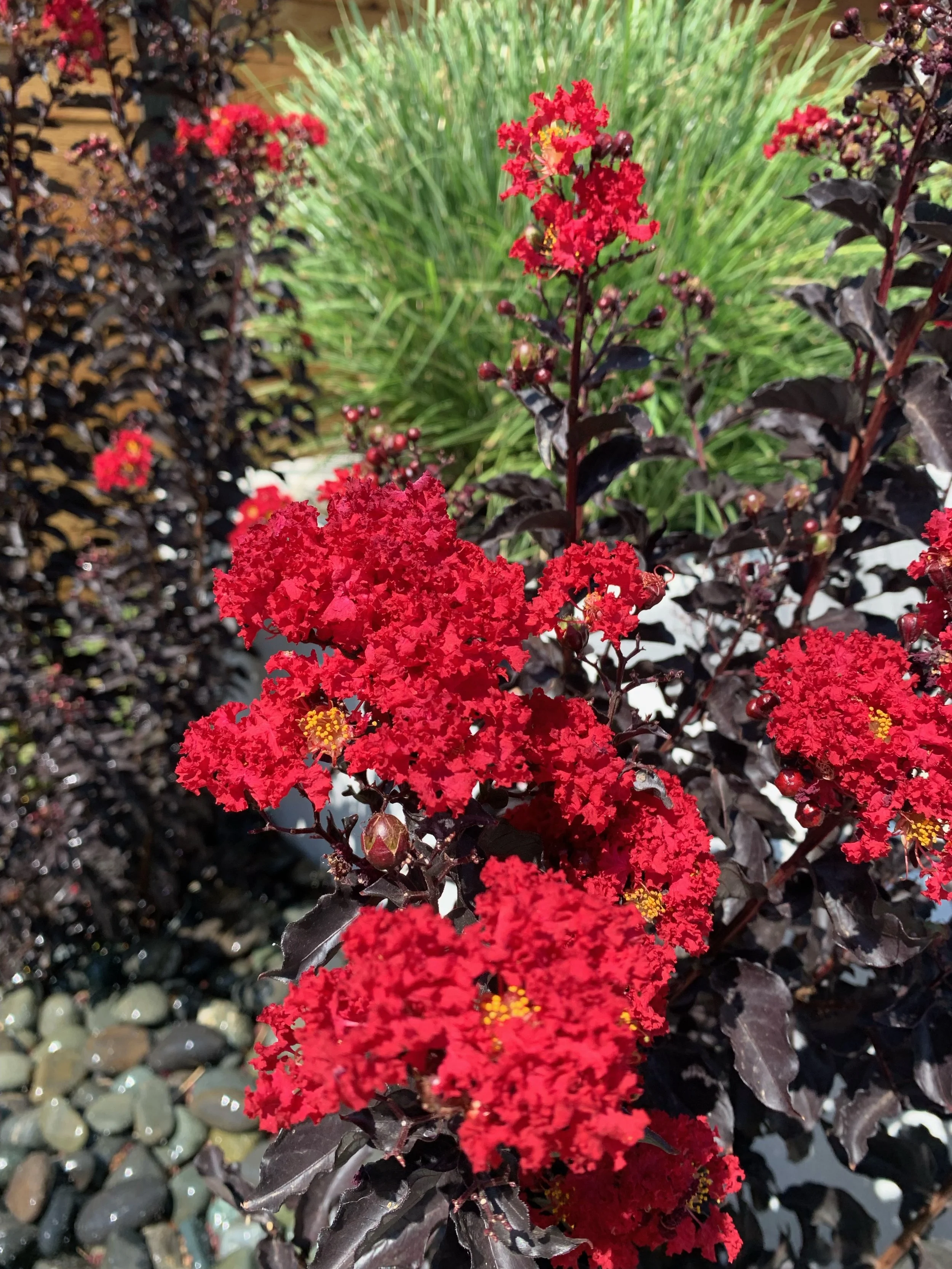
Ebony Fire Red Crape Myrtle with intense, black foliage, is a fun twist on a traditional plant. Ebony and Ivory is a white blooming black leaf Crape Myrtle.
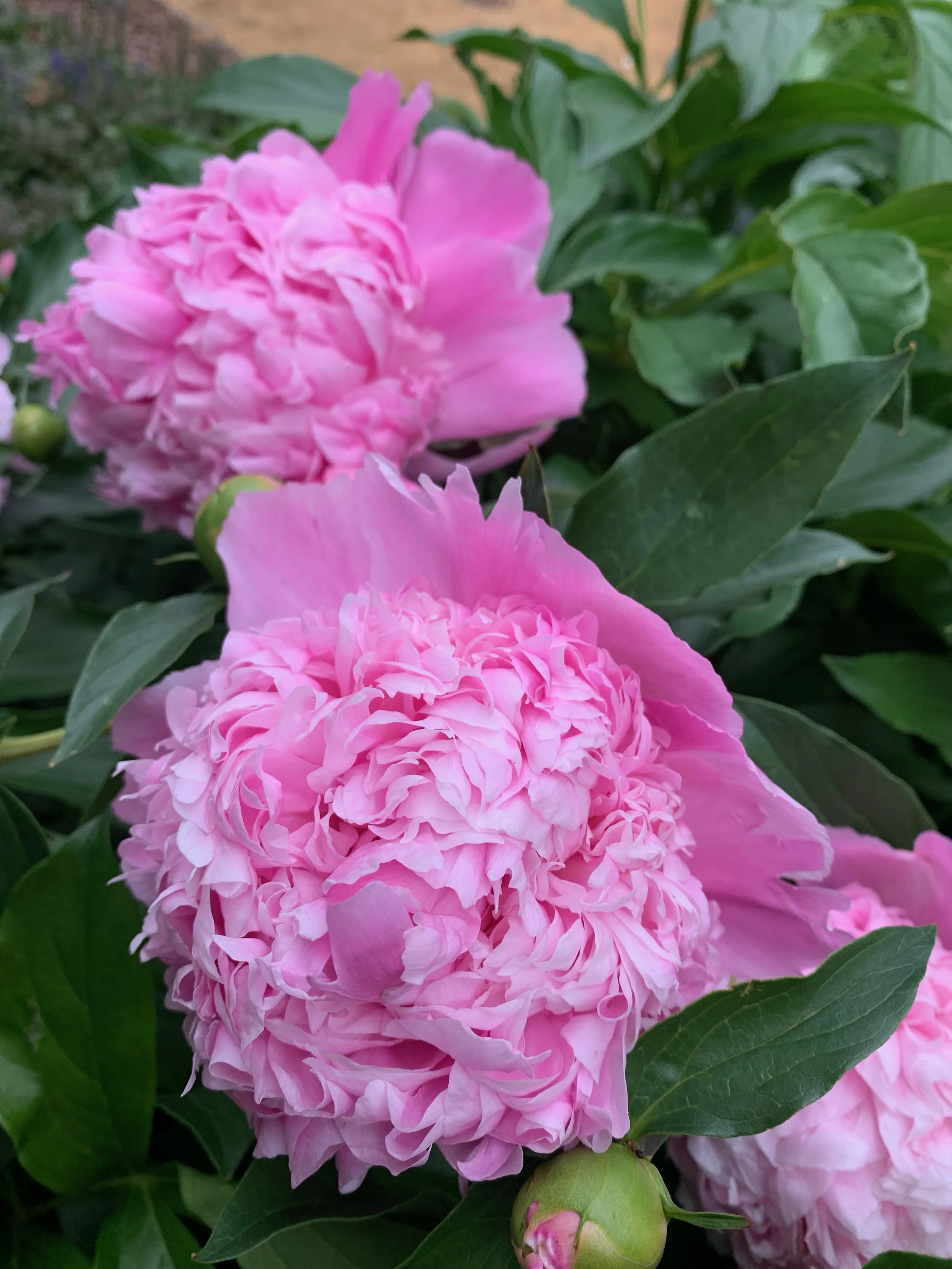
Peonies, a perennial, puts on a dynamic burst of color in mid spring with large blooms that are great for cut flowers.
3. Fall Weather Brings More Moisture
Spring and summer planted shrubs and trees require supplemental, deep soaking during the summer. During the summer newly planted trees and shrubs need at least 2” of moisture per week. But, during the fall and winter, when temperatures are cooler, plant materials require a lot less moisture, only ½ to 1” of moisture per week, which is much more likely to occur naturally. During the summer, chances are you will be spending time hand watering your new plants just trying to keep them alive.
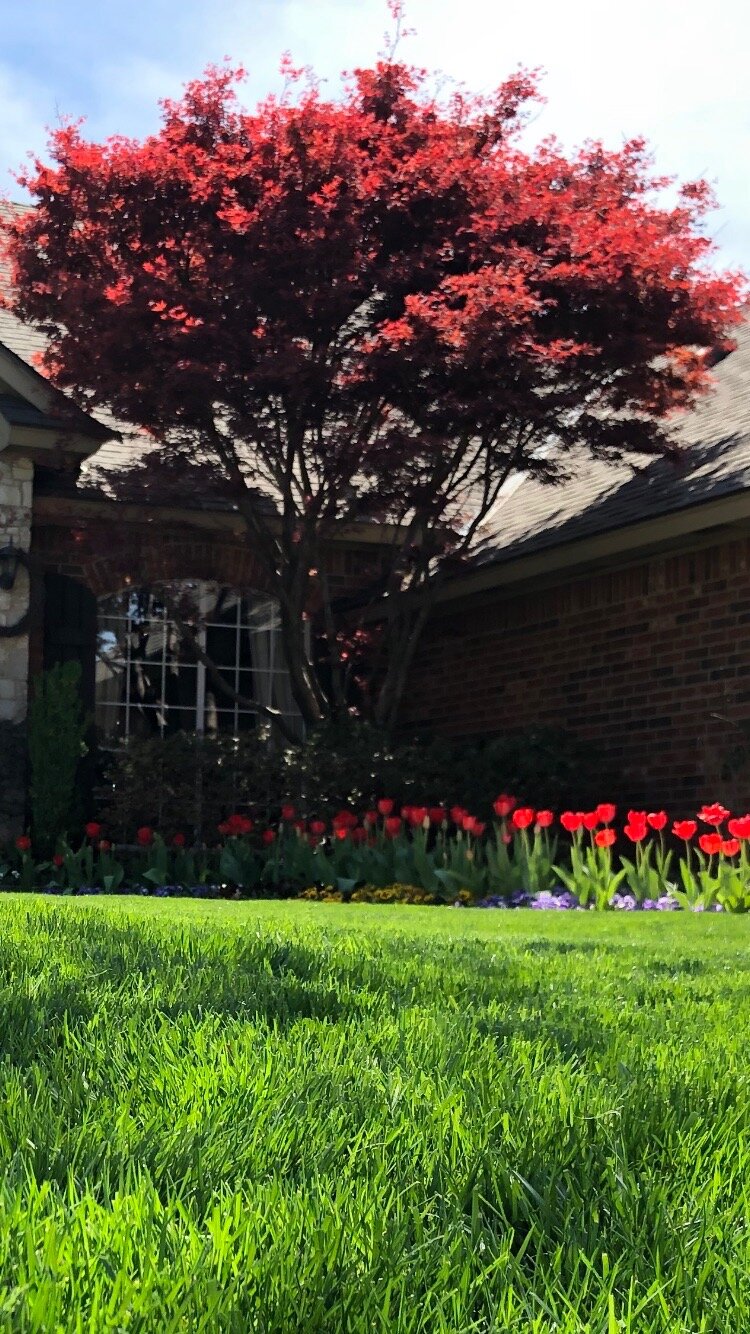
Plant a Japanese Maple this fall and have more red in your landscape next spring when leaves emerge.
4. Head Start on Next Year
This is the biggest reason you should plant in the fall…. Fall planted materials can gain an entire year of development over spring and summer planted shrubs and trees. Fall plants will start developing roots soon after planting. Next spring and summer they will have a root system that will produce top growth. Spring and summer planted materials produce little growth until they develop roots in the fall. It has been my experience that a 3-gallon shrub planted in the fall will be the same size as a 5-gallon shrub planted in the spring after one season. Save money. Plant in the fall.

Crape Myrtles planted in the fall will bloom more their first season than ones planted in the spring or summer.

Limelight Hydrangea adds large white blooms to the late summer landscape.
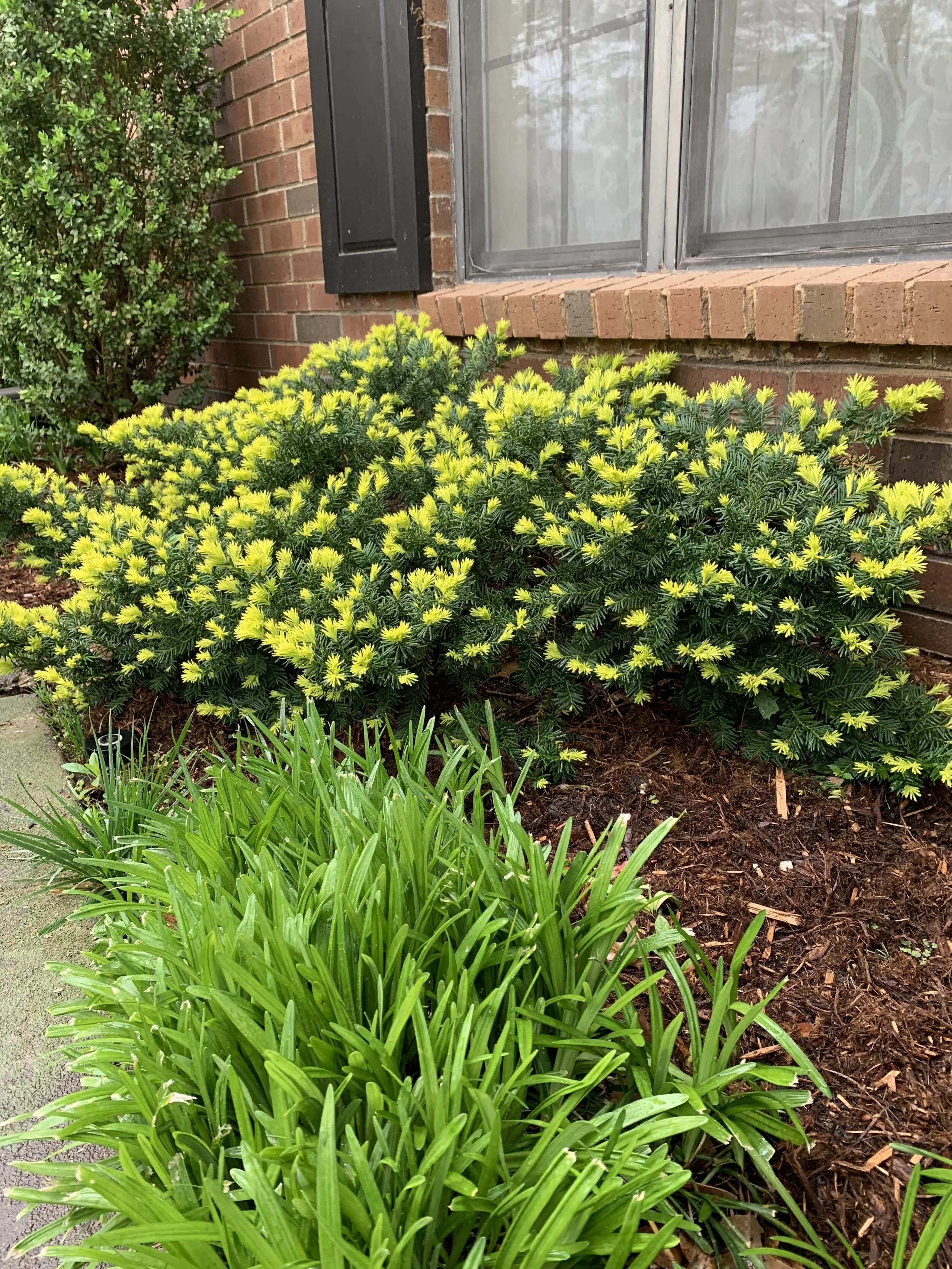
A great evergreen shrub for shady areas is the Japanese Yew.
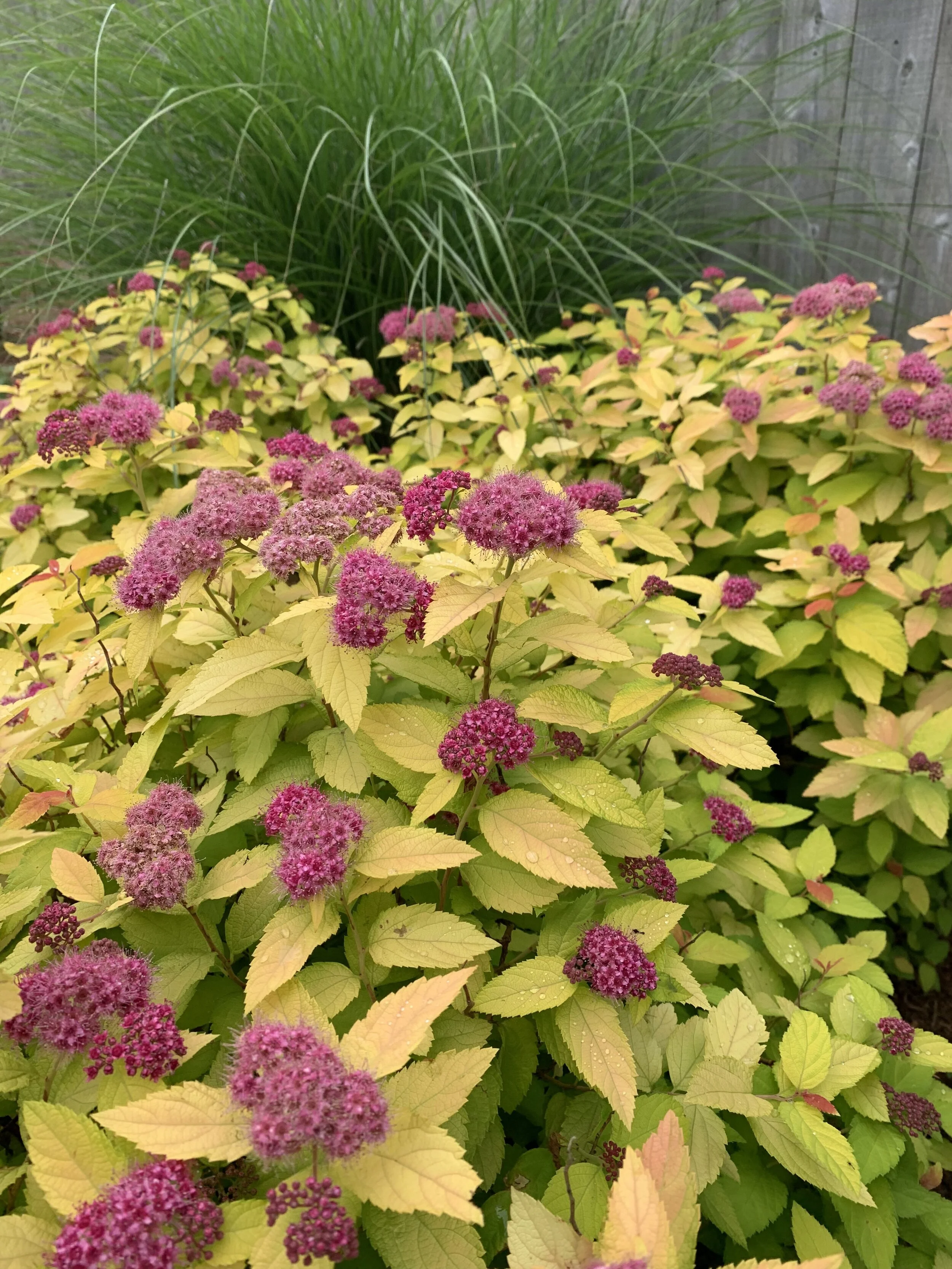
Goldmound Spirea is very similar to Limemound only with yellow-gold foliage.
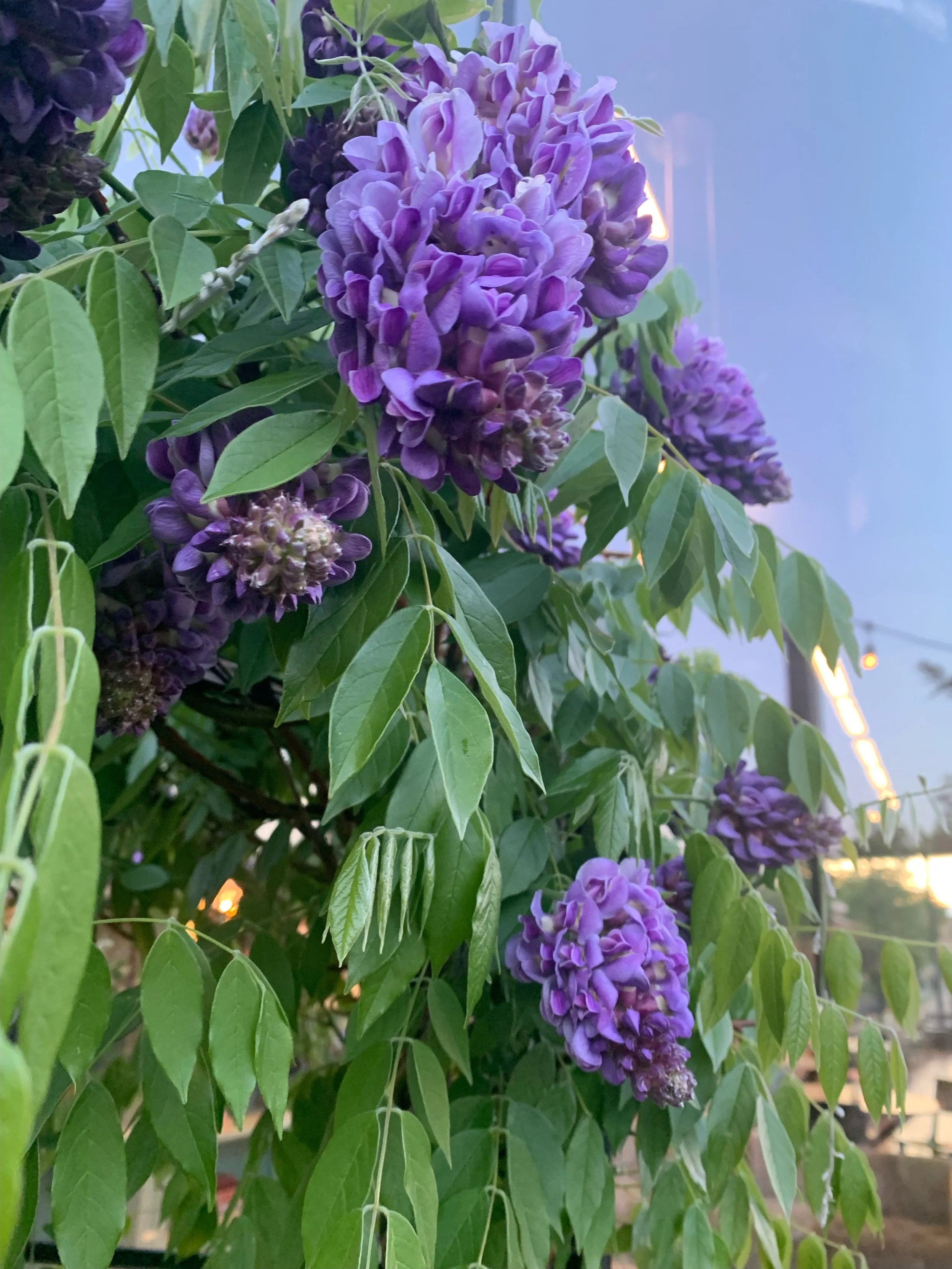
Wisteria produces showy clusters of fragrant purple flowers. Great for training on an arbor, trellis or fence.
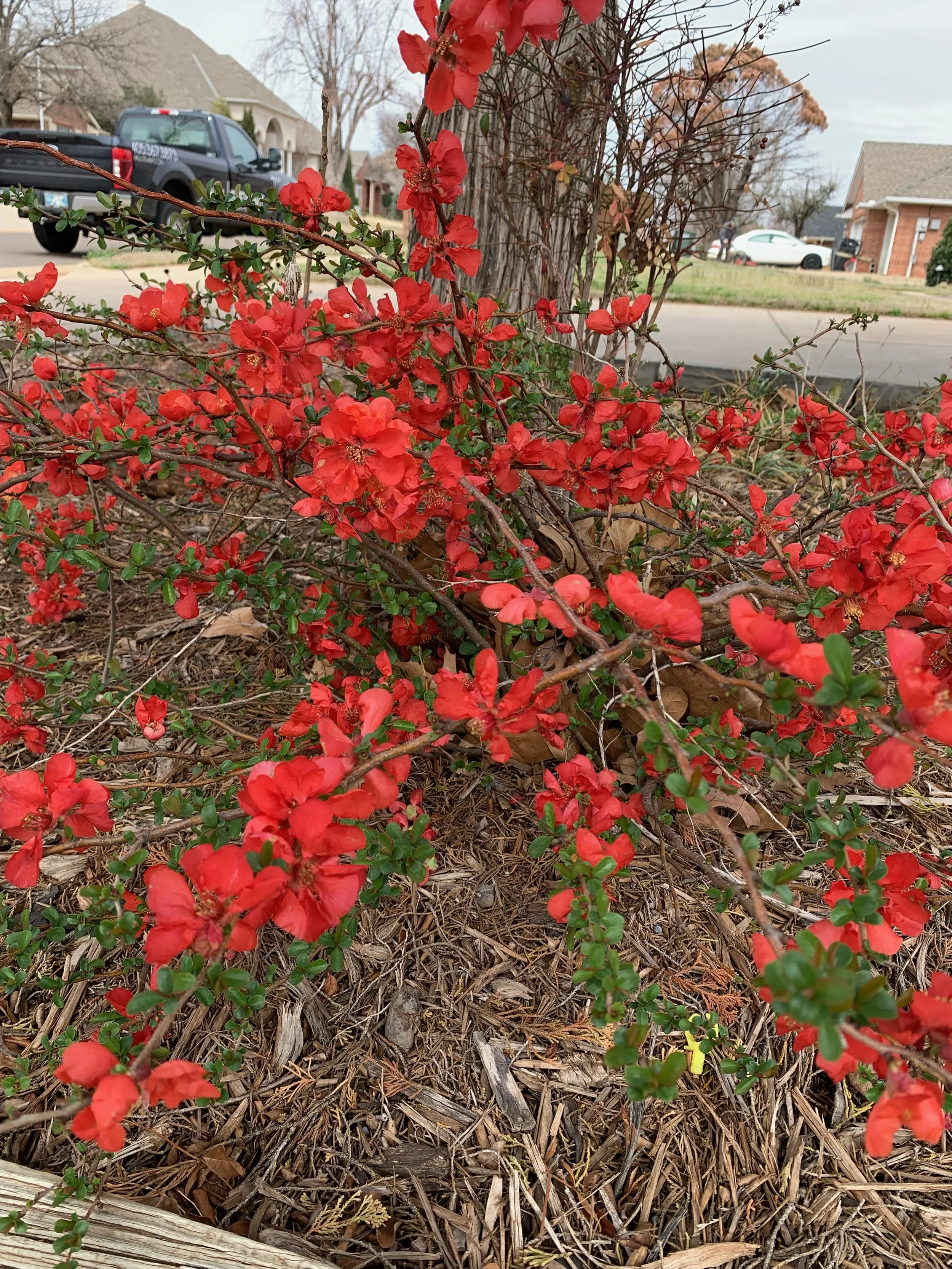
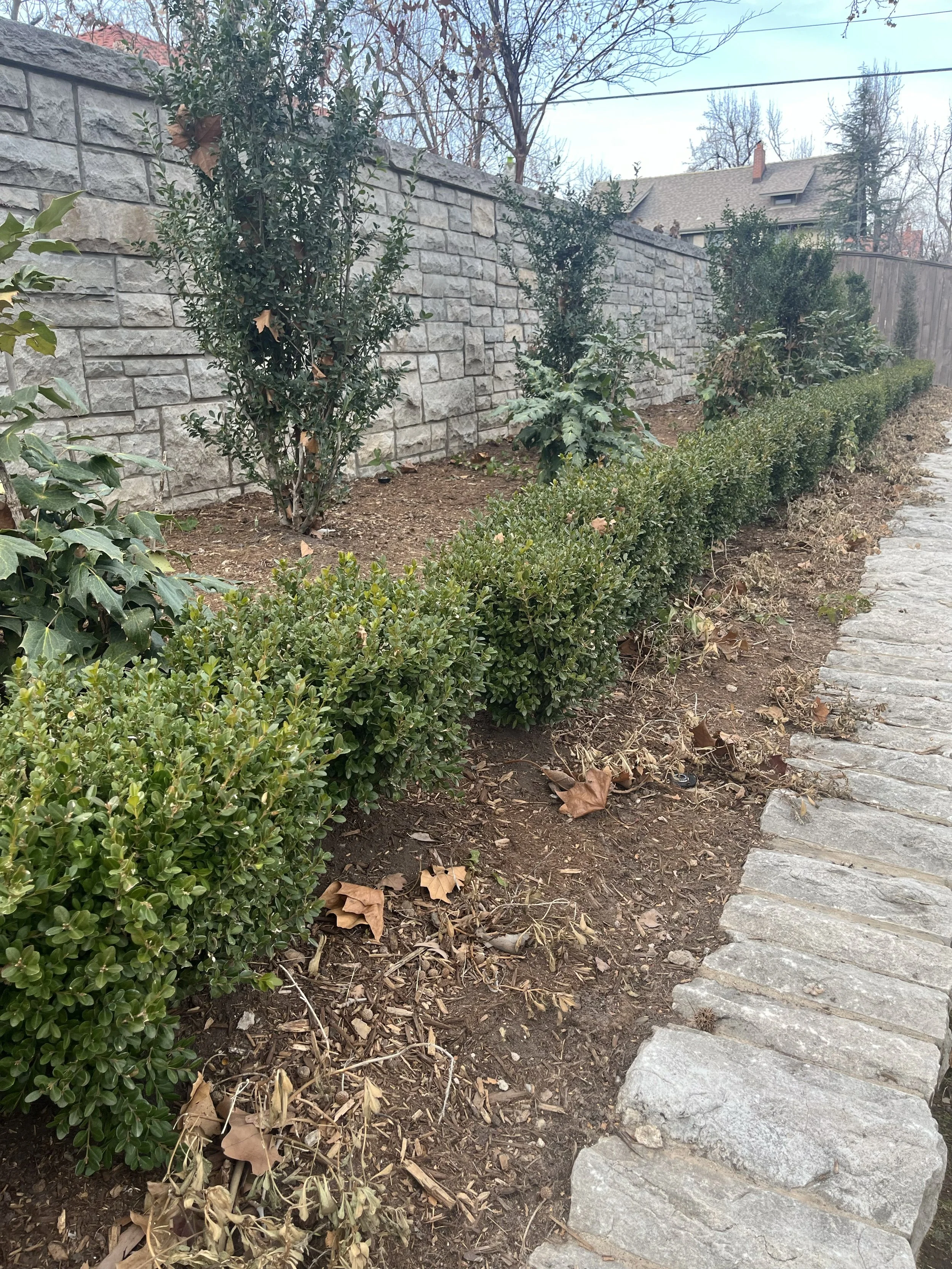
Thinking of adding a row of shrubs to your landscape? Save money by using a smaller size in the fall. Often they will catch up in size the next spring.
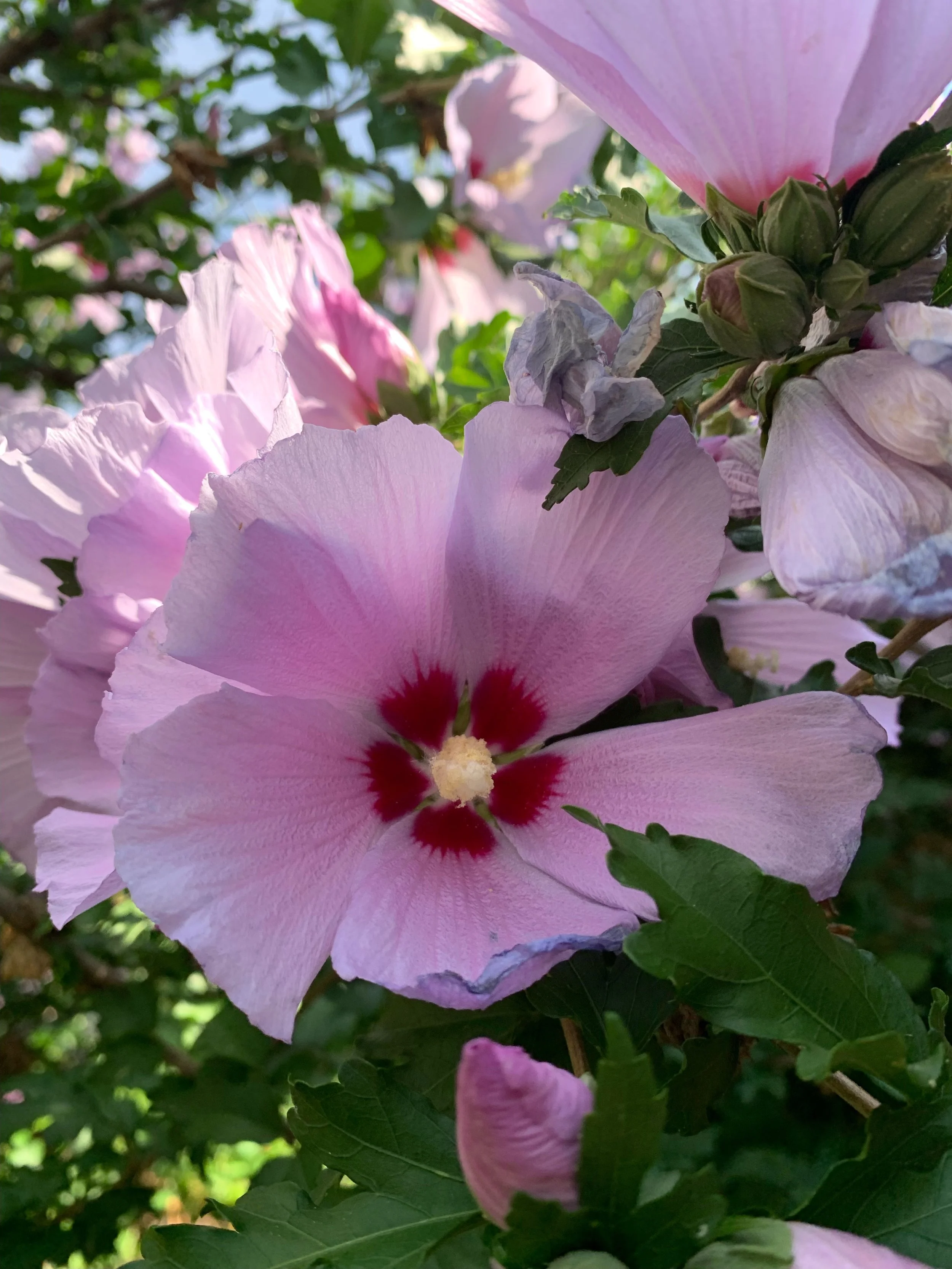
Rose of Sharon is a blooming large shrub to small tree that adds a soft color to the summer landscape. Blooms range from white, pink, and purple shades.

Plant perennials in the fall for great early blooms next spring.

Limemound Spirea returned to my favorite list this year for their hardiness and the interest they add to the landscape with their soft pink blooms and light green color.
2. Cool Days Are Less Stressful
Warm days are hard on all plants and are particularly hard on the newly planted. New shrubs and trees have a limited root system that struggles to support plant leaves in the heat resulting in desiccated, burnt leaves.
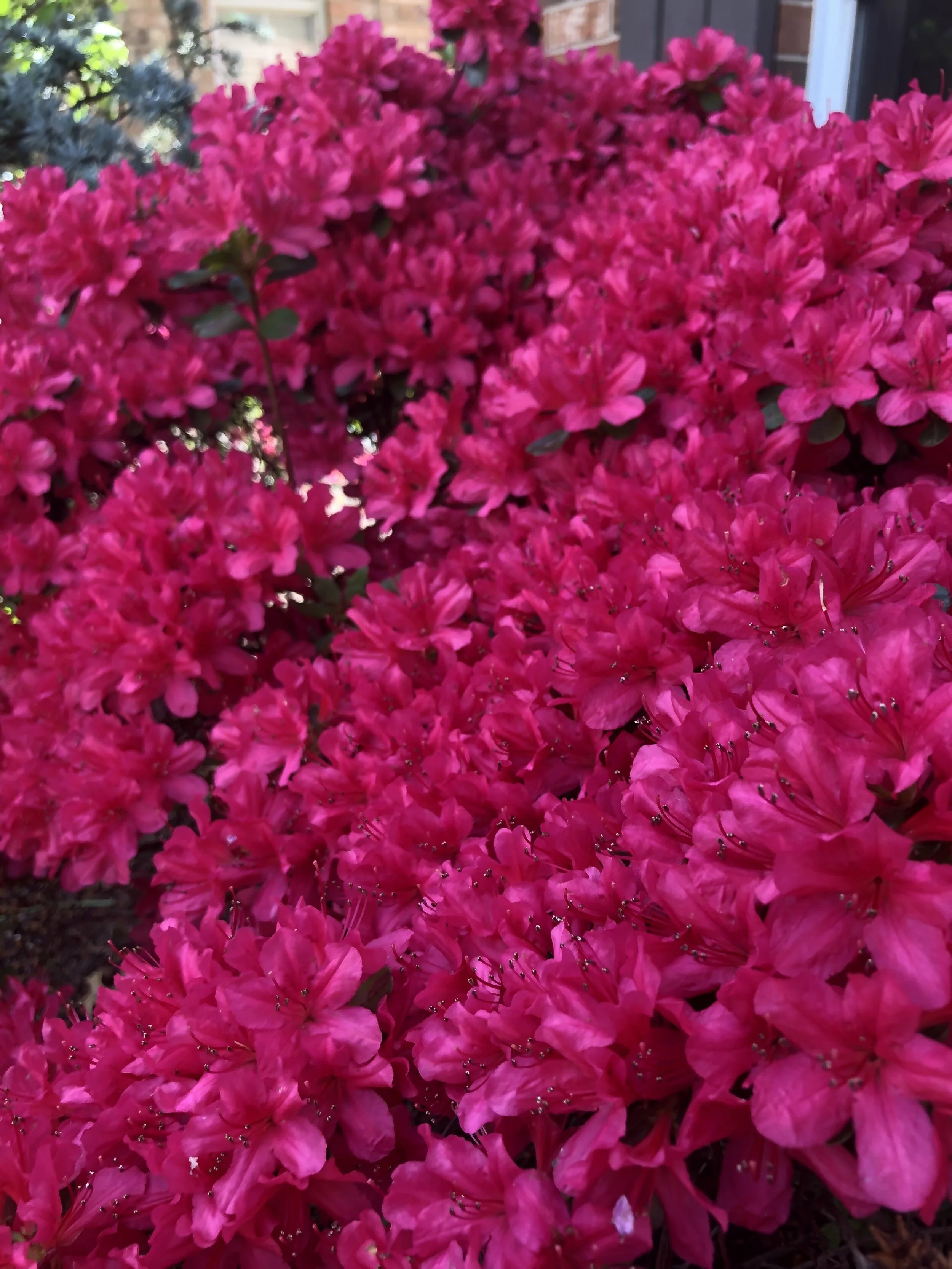
When azalea are planted in the fall, they establish roots and bloom well next spring.
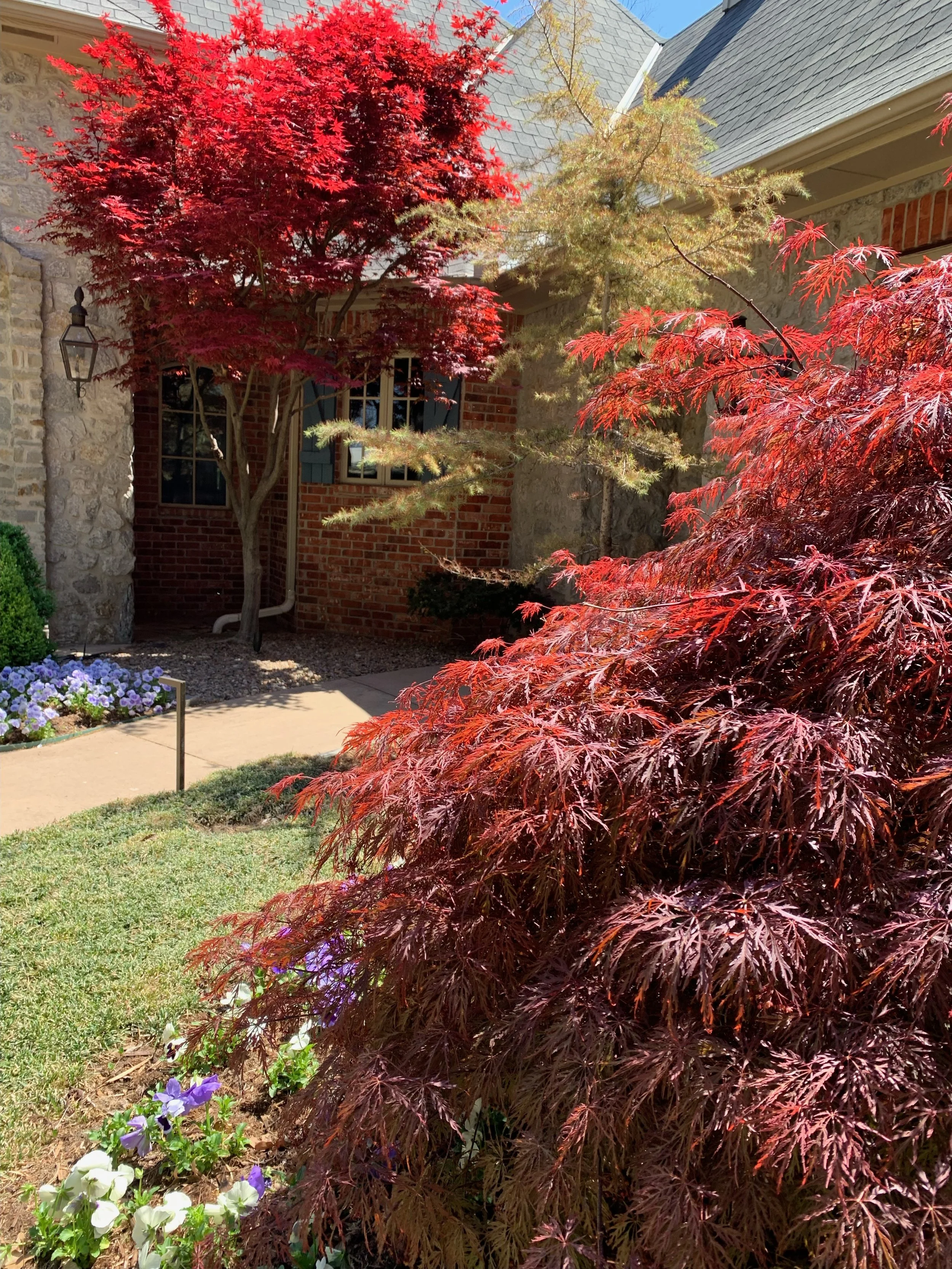
Japanese Maples add bright red leaves to the spring landscape.
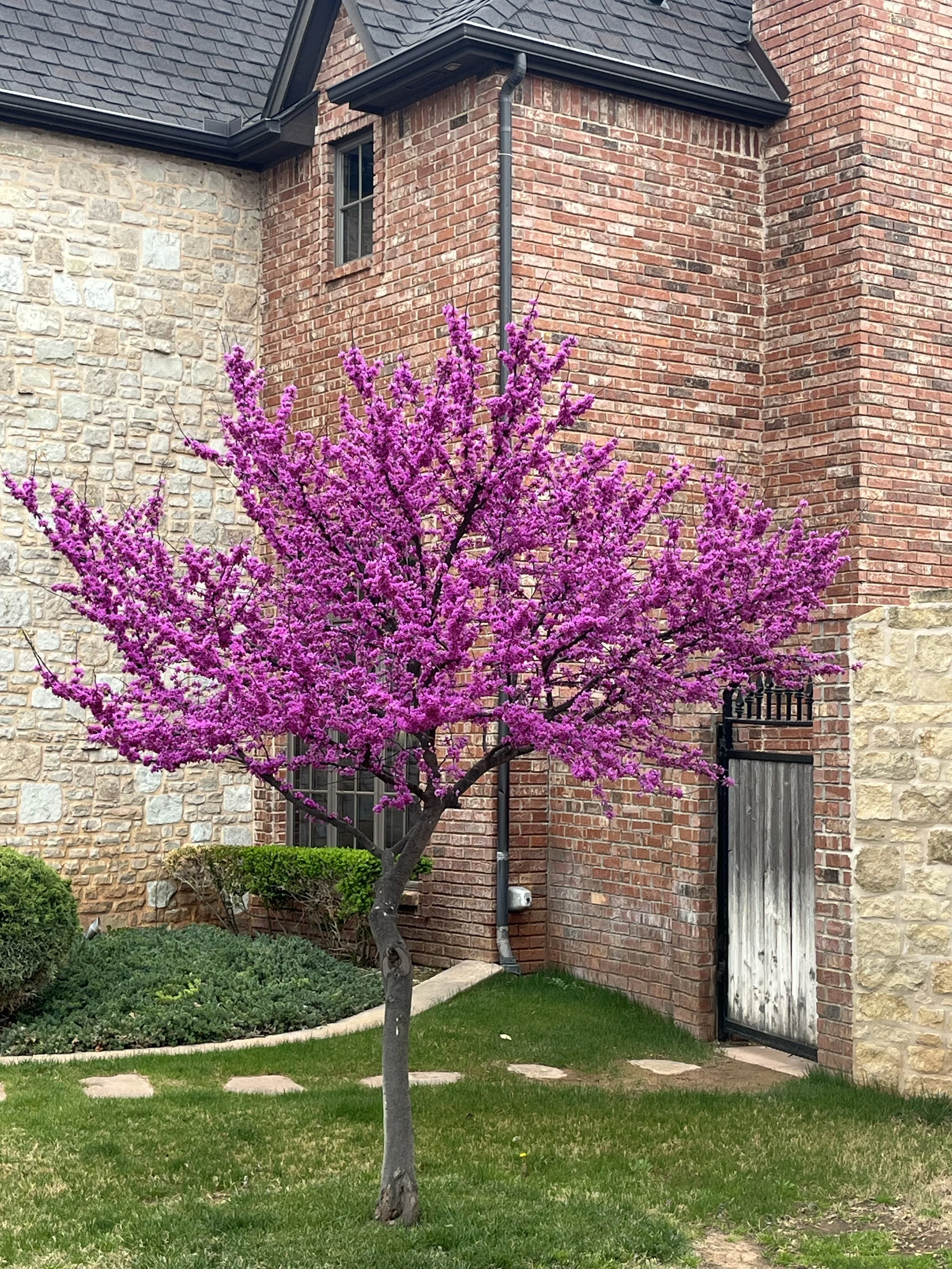
Looking to add more spring color to your landscape? Add an Oklahoma Redbud to your landscape this fall or winter.

Planting creeping phlox this fall will give you a carpet of color in the spring.
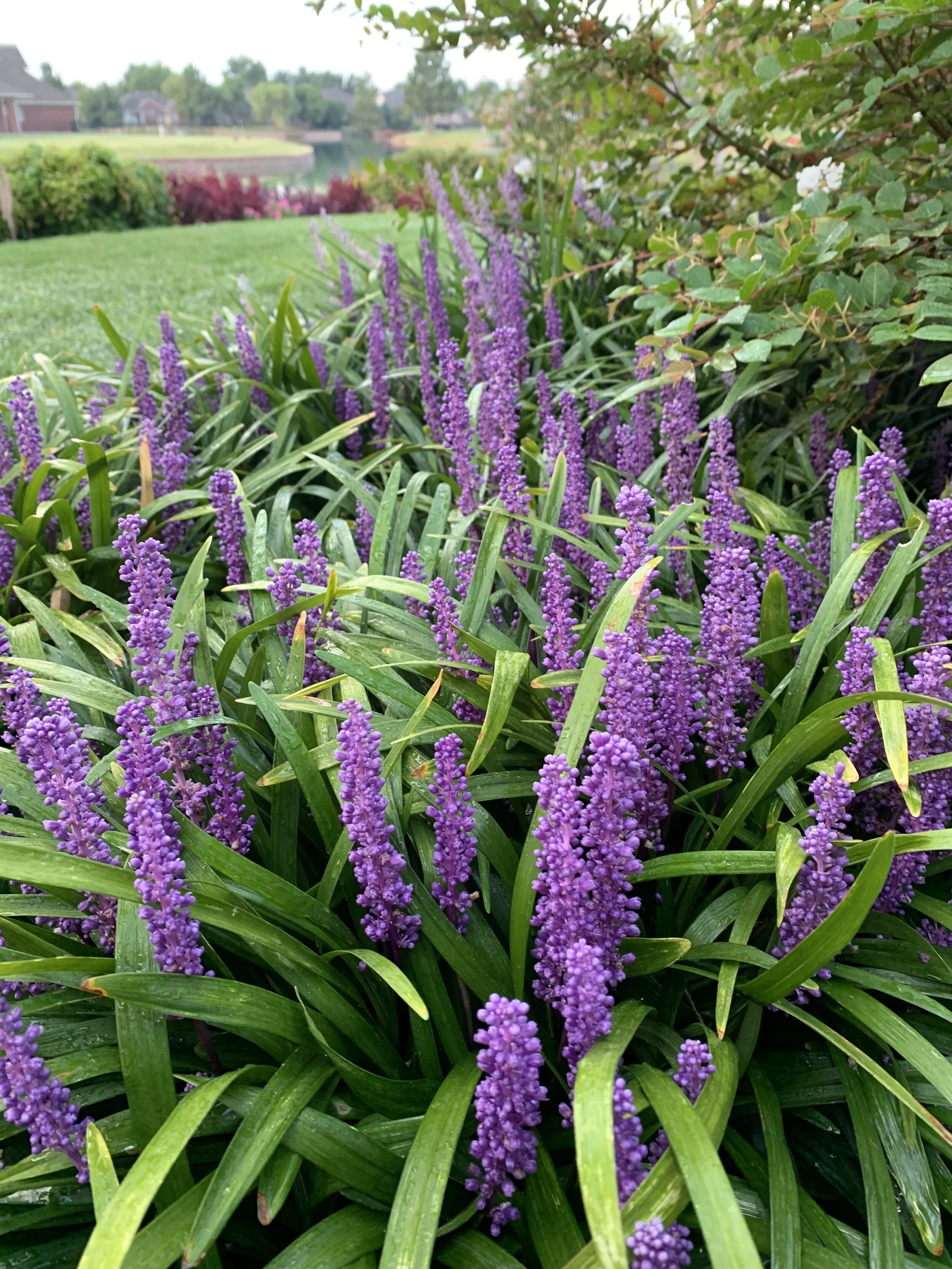
Big Blue Liriope with spikes of purple-blue flowers in the late summer is a good ground-cover for both shady and full sun landscapes.
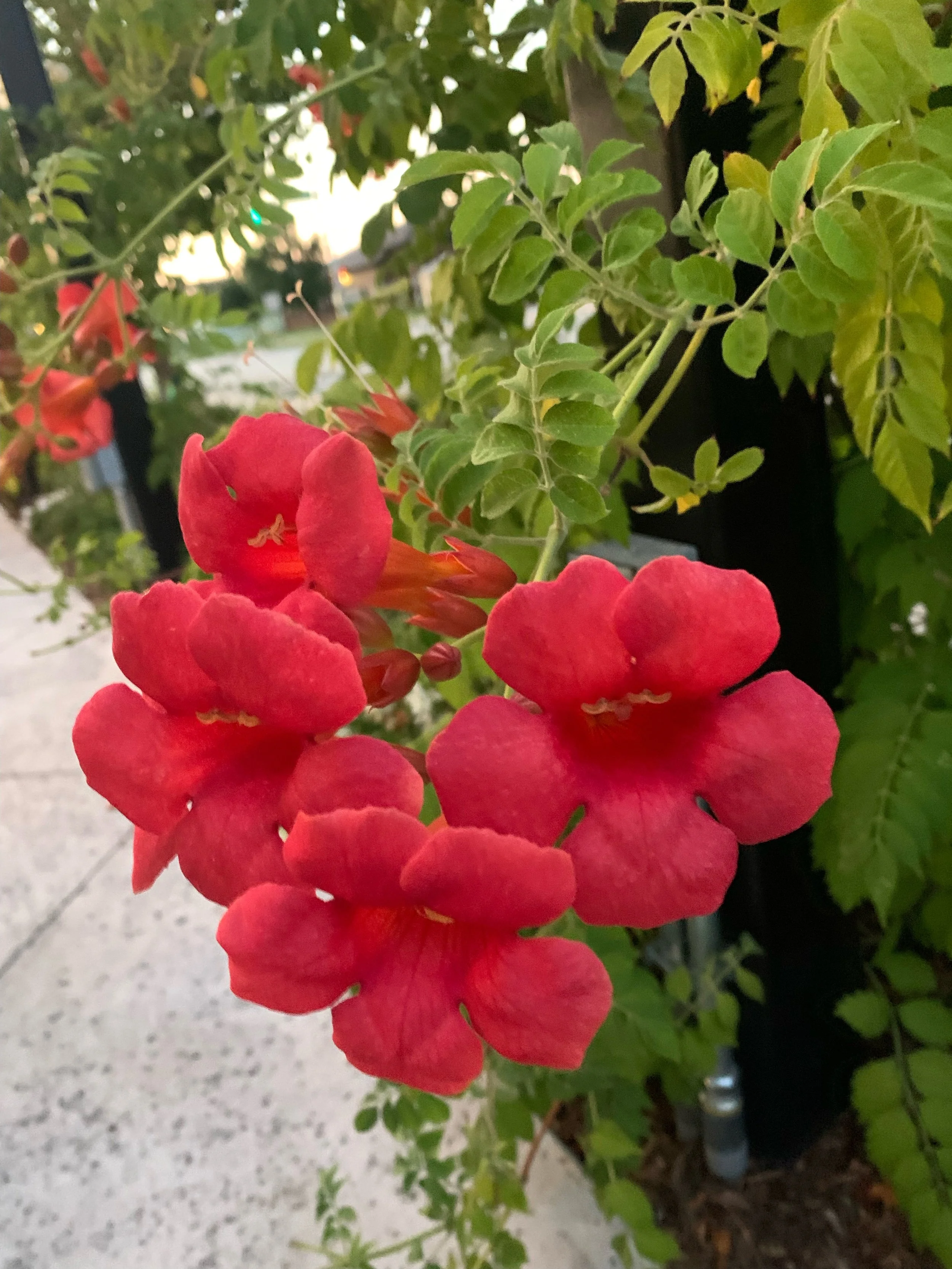
Madame Galen Trumpet Vine produces bright flowers through the summer. Great for covering fences and climbing on arbors.

Endless Summer Hydrangeas start blooming in May and rebloom through the summer.

In the fall, blooms left on Endless Summer Hydrangeas turn brilliant pinkish red.

Looking for cascade white blooms in your spring landscape? Add a Bridal Wreath Spirea this fall.
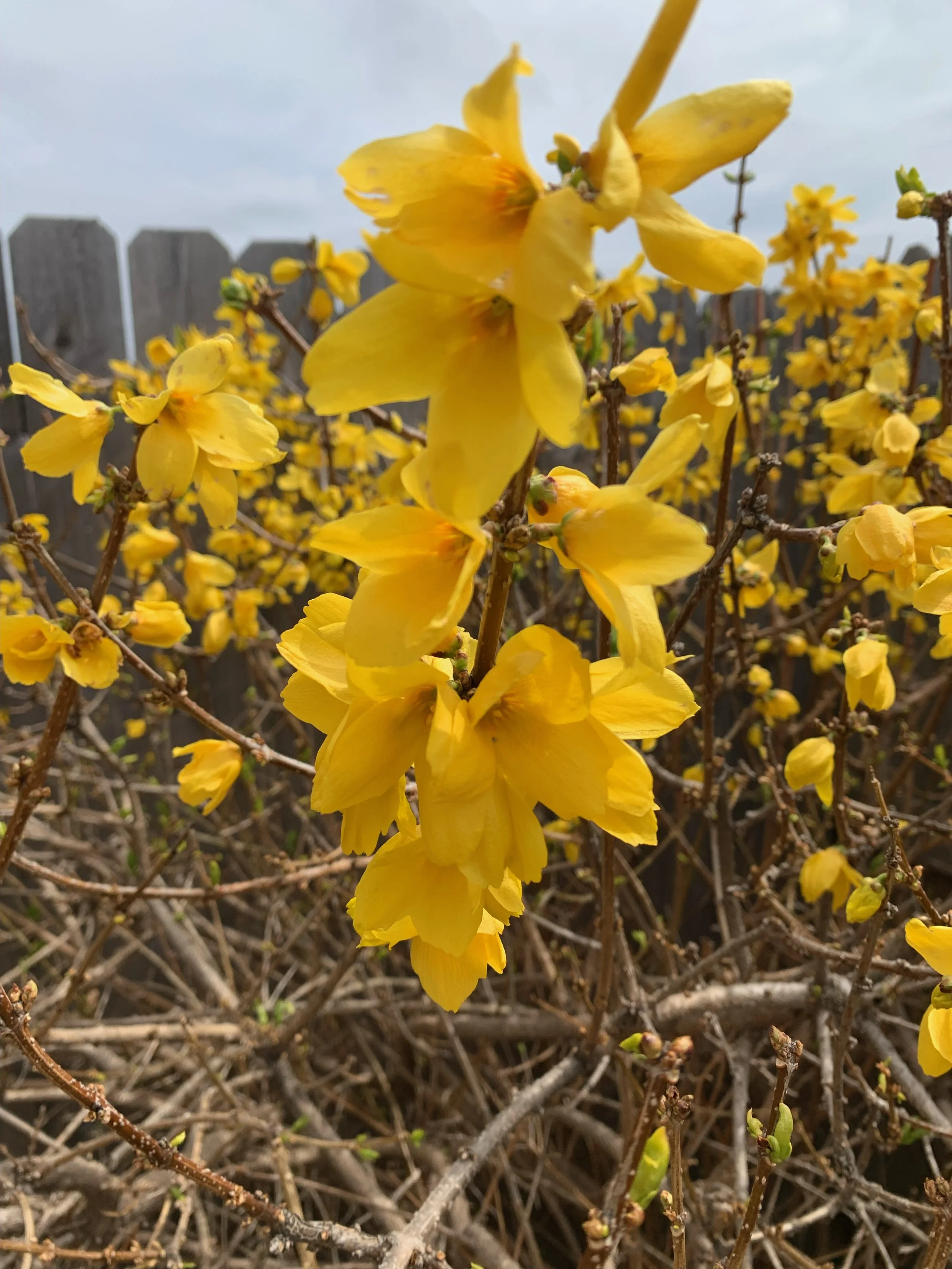

Plant a Double Play Candy Corn Spirea this fall and you will enjoy bright shades of yellow, orange and red next spring.
Yes, with good care and extra attention most shrubs and trees can be planted year-round, and because they can, it is common to plant at any time.
But, the best time to add new plants to your landscape in Oklahoma is September through December. For deciduous trees, the best time to plant is during winter dormancy, November through February.
Your landscape has a big impact on your property value and greatly impacts your curb appeal.
Plant something new this fall.
You won’t be disappointed.
Lorne Hall
Hall | Stewart Lawn + Landscape
(405)367-3873
The 4 Most Common Ways to Fail at Establishing Fescue

This week, something happened to me that in nearly 40 years of working in the lawn and landscape industry in Central Oklahoma, has never happened:
It’s the first week of September and twice I was asked: “Is it too late to overseed fescue?”
Usually, it is the exact opposite – the first week of September & Oklahomans are worried it’s too early.
The weather hasn’t been typical. Summer’s usual fight to hold on into September has been replaced with the pleasant feeling of the early days of fall.
We are just at the start of the perfect window for establishing fescue, September through October.
As we discussed on August 17th in Bermuda vs Fescue The Choice is Yours, there are two approaches to using fescue in your lawn: Fescue in shady areas only or a full fescue lawn.
After evaluating your lawn, if you decided to establish fescue for the first time or if you decided you should add more fescue to your already fescue areas, we don’t want you to fail.
What are the four most common ways to fail at establishing fescue?


Small, shady areas in your lawn where there is low air movement and shade are prime candidates for annual fall seeding with fescue.

Fescue the last week of September last fall after overseeding in early September.
Failure to Seed in the Fall
Because fescue is a cool season grass, there are two times per year you can plant fescue seed: Fall (September through October) and Spring (March and April).
But, if you wait until spring to seed fescue, you are seeding at the second-best time and there is an enormous chasm between the establishment of fescue now (the best time) and next spring (the second-best time).
Spring seeded fescue will come up great, but it rarely establishes enough root system to make it through the summer heat (fescue’s off season). As a younger, weaker plant, spring seeded fescue is also more susceptible to brown patch disease.
With abundant moisture during June and early July when nighttime temperatures were warm, brown patch was prevalent in our climate. The most susceptible fescue lawns were the ones with spring seeded fescue.
Fall seeded fescue has all fall, winter, and spring to establish a root system before enduring the heat of July and August.
Don’t fail at establishing fescue – seed now, not next spring.
Failure #1 – Seeding fescue in the spring.
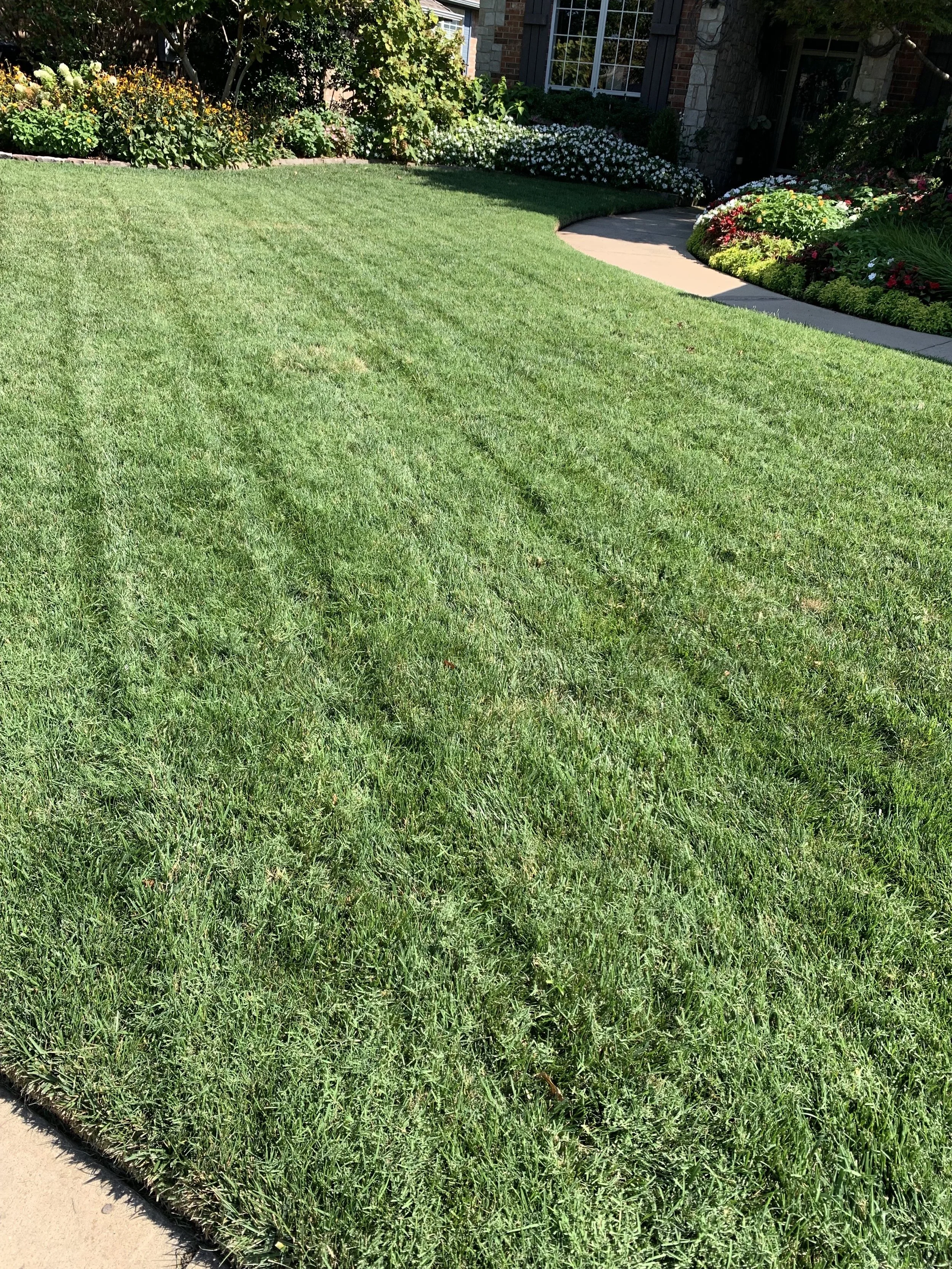
Fall seeded fescue is better prepared to withstand the heat of July and August.

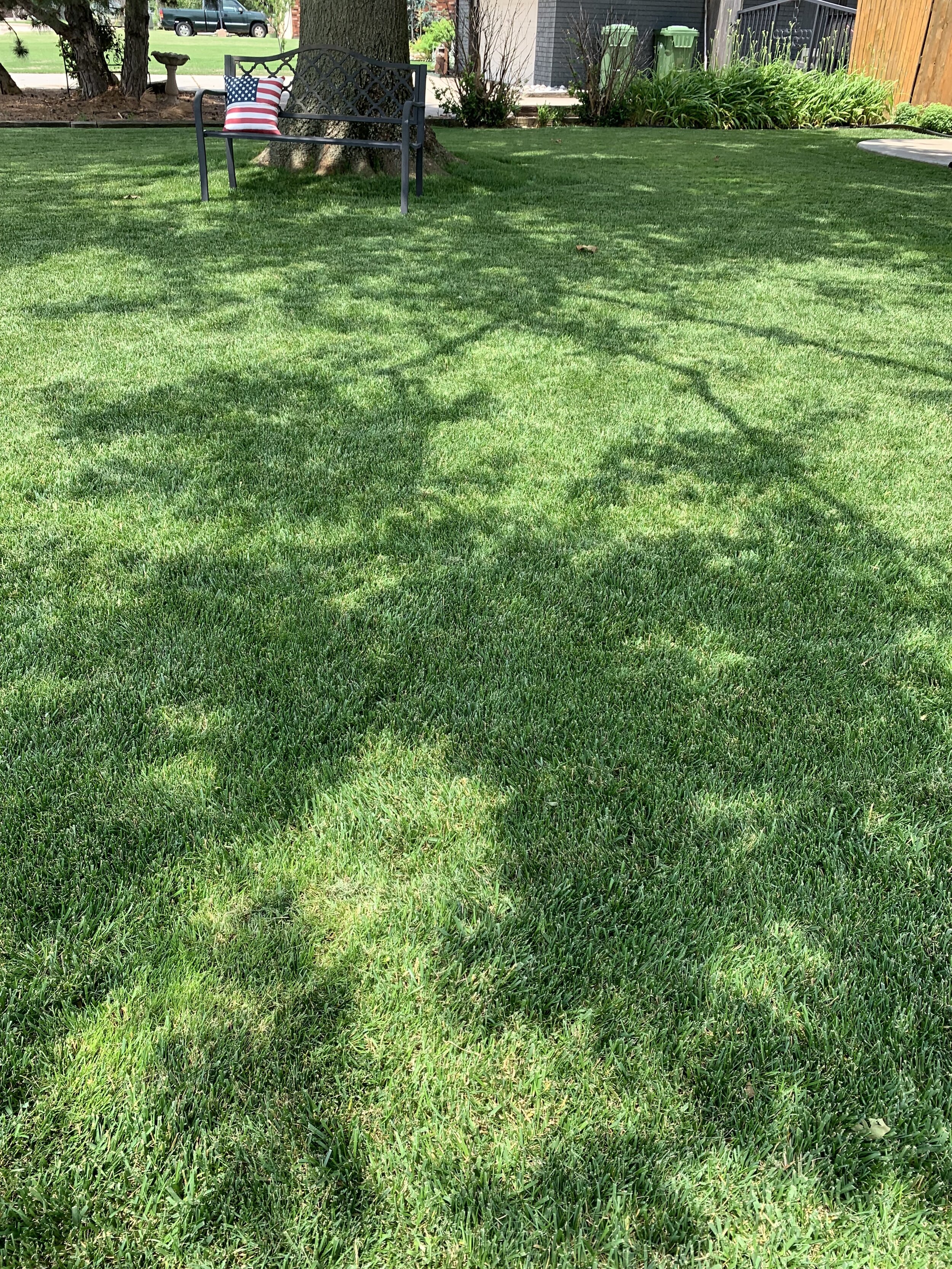
Fescue is the best turf grass for areas of your lawn that receive dappled sun. Bermuda needs at least 6 hours per day of direct sun light.
Failure to Create Good Seed to Soil Contact
Good seed to soil contact is important. If you sow seed over the existing soil without some preparation, the chance of a successful seeding is greatly reduced. Research shows the percentage of germination decreases dramatically when seed is just sewn on top of the ground.
You will have success if you start by cutting the existing turf short to remove excess grass. Then loosen the soil to create good seed to soil contact.
Aeration is the best method to loosen the soil and gain good seed to soil contact. Aerating also gives you the extra benefit of improving the soil structure, increasing water absorption, and developing deeper roots.
Give more attention to bare areas and the edges. Rough up the areas with a rake. Rototilling isn’t necessary but breaking the surface of the soil in bare areas is needed.
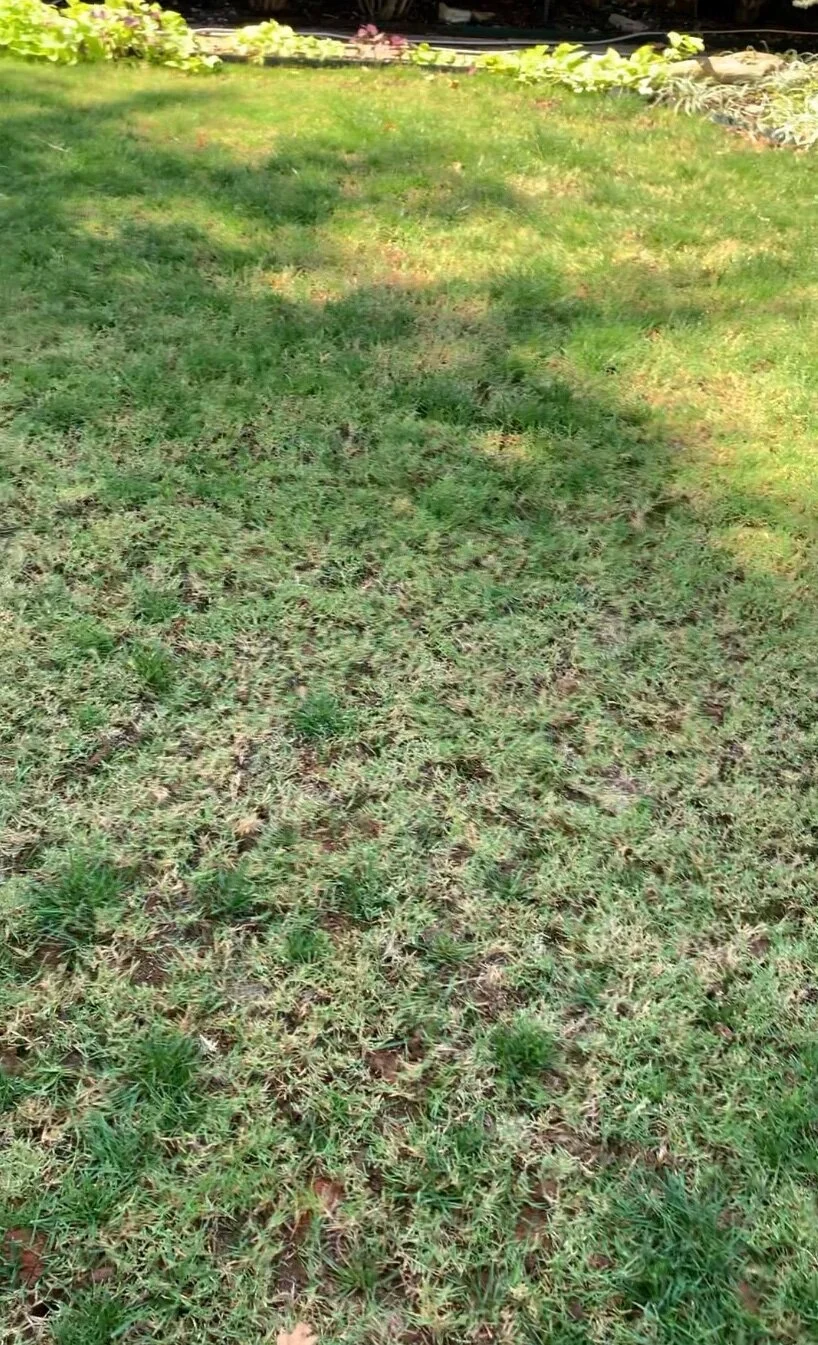
Heavy aeration is one of the best ways to create good seed to soil contact when seeding. You also get the added benefit of improved soil conditions from aeration.
In areas that are completely bare, spread a thin layer of peat moss over the surface after seeding to increase the seed to soil contact.
If overseeding an existing fescue area with a good stand of grass, spread seed at a rate of 5-8 pounds per 1,000 square feet.
If establishing a new fescue lawn, spread seed at a rate of 10-12 pounds per 1,000 square feet.
Failure #2 – Just spreading the seed over the top of the ground.

The lawn was being maintained at 3”.
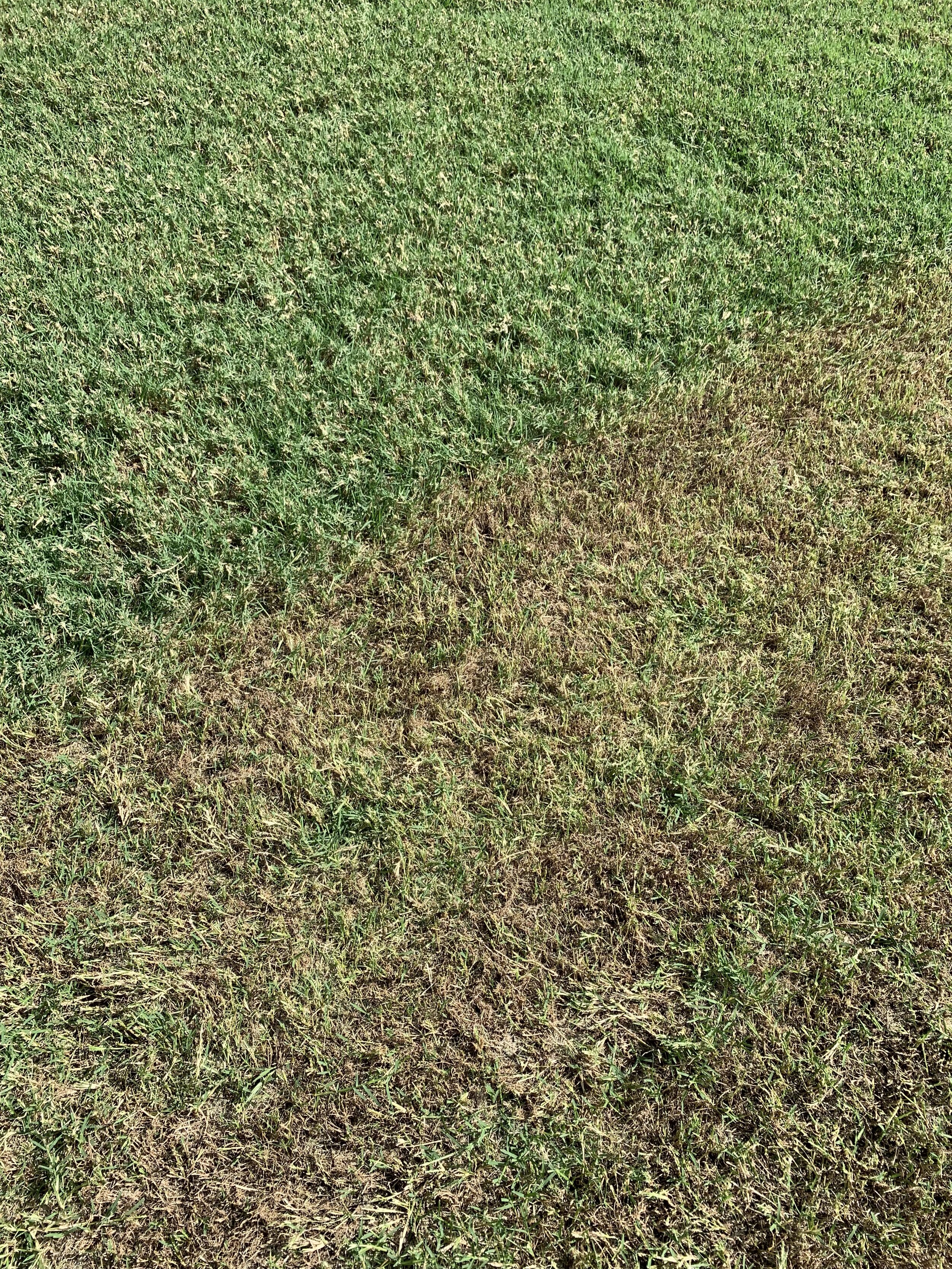
This bermuda lawn is being cut short in preparation of overseeding it with fescue for the first time.

Cutting it to 2” will improve the seed to soil contact and increase the success of the first time overseed.
Failure to Buy a Good Fescue Blend
Fescue was first introduced in the US from Europe in the 1800s as pasture grass. Kentucky-31 Tall Fescue was developed in the 1940s as an improved pasture grass and introduced to the home turf market in the 1960s by Pennington Seed.

All seed grown in Oregon is certified. Buy it when possible.

Look for a fescue blend with at least 3 varieties. Blends contain the best varieties and give you more protection against disease and are more heat and drought tolerant.

What is the point of the seed history lesson?
If you are buying Kentucky-31 Tall Fescue, you are buying an 80-year-old product when there are over 300 improved fescue varieties that offer darker green color, narrower blades, and improved tolerance to heat, cold, drought and disease. Kentucky-31 is marginally acceptable as a lawn grass that tends to become thin and clumpy.

Improved fescue varieties are very heat and drought tolerant and can successfully be grown in full sun.
No matter the name on the bag of the seed, any improved variety will outperform Kentucky-31.
We believe using a blend is best when seeding fescue. Blends are a combination of two or more varieties within the same species, such as two or more fescues in one mix. Blends are a combination of the best species, tested over time, for the best shade tolerance and disease resistance. The number one problem with fescue is brown patch disease. The best blends use fescue varieties that show strong resistance to brown patch. Also, some blends will contain bluegrass and, or rye for even more vibrant spring color.
Failure #3 – Buying cheap seed. You will get what you are pay for… a low-quality turf for years to come.
Failure to Keep the Area Tacky Moist Until Seed Germinates
The first three are very important, but the 4th one is critical for success.
Nothing will hand you a losing hand quicker than not keeping the seed moist. You can get the first three correct and have complete failure if the seeded area is not kept moist until new grass is visible in the entire area.

Even water distribution is important in keeping the seed tacky moist until it comes up. Check your system. Look for areas where there isn’t complete head to head coverage. The result will be poor germinate around the sprinkler head.

This picture 14 days after seeding demonstrates how critical moisture is to seed germination. The seed in the area where the irrigation does not reach has not germinated at all while the moist areas are nearly fully germinated.
The worst thing you can do is water the seeded area, allow it to dry completely, water again, allow it to dry completely, repeat, repeat, repeat… After a few times of drying out completely, the seed will no longer be viable.
For the best success, set your irrigation to run 3 short cycles per day. Set spray type zones to run 3-5 minutes each time. Set rotor type zones to run 7-10 minutes each time. If possible, set the system to run before dawn (4:00 AM), late morning (10:00 AM), and mid-afternoon (4:00 PM).
You don’t have to have an irrigation system to establish fescue. You only need to be diligent at watering every morning and every evening.
Failure #4 – Not keeping the seed tacky moist until it germinates.
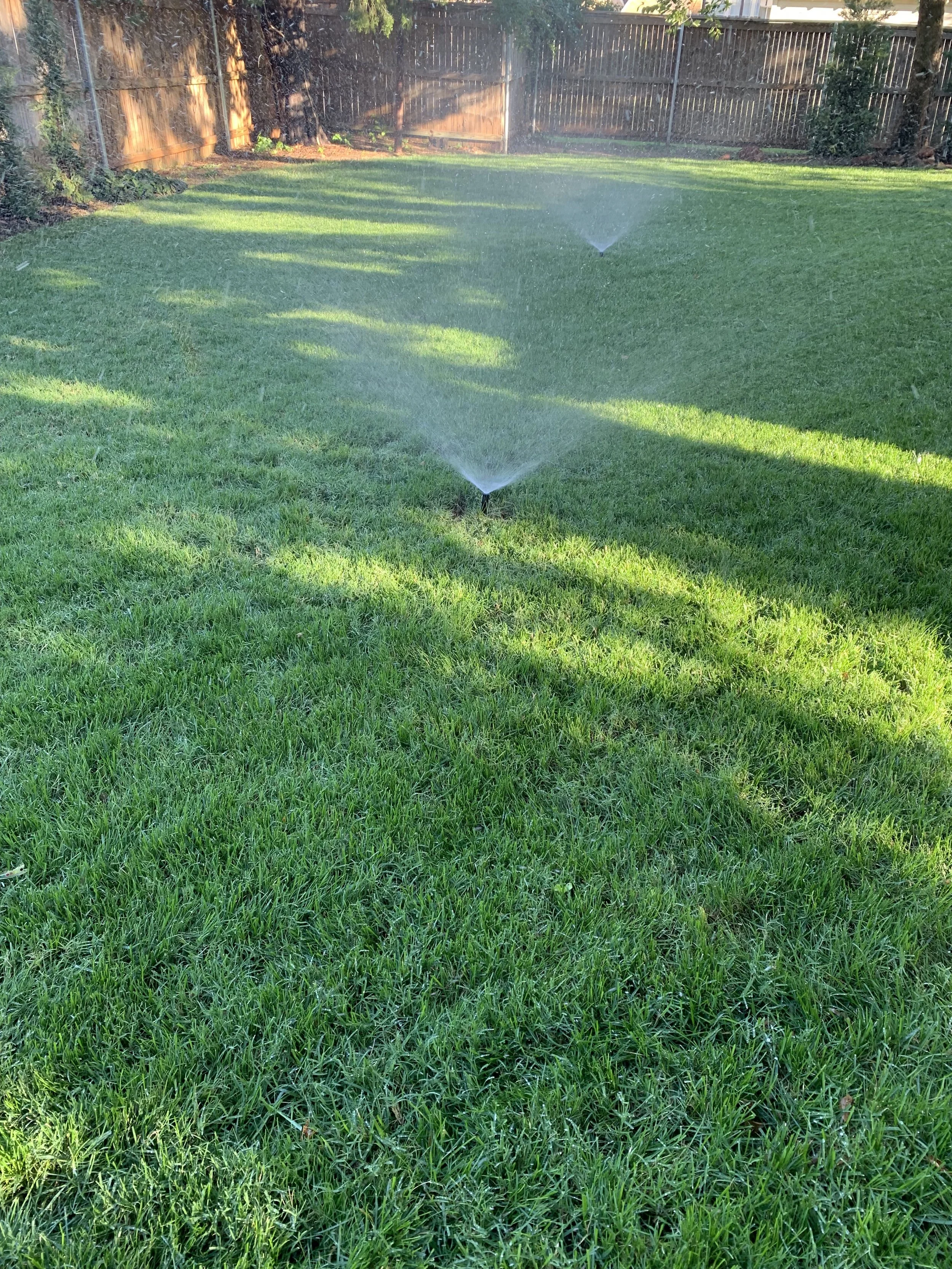
Fescue can be grown successfully in Oklahoma. There are examples of great fescue lawns in every neighborhood, and there will be more and more as our environment becomes more and more shady.
Who should overseed this fall?
If you have areas of your lawn where the bermuda has thinned because of shade, you should seed this fall. Bermuda needs at least 6 hours of direct sunlight for the best performance. Less than 6 hours of direct sunlight and bermuda starts to thin.
If you have fescue areas that have become thin because of brown patch, drought, or insect damage, you should seed this fall.
If you just want to keep your fescue thick and healthy, you should seed this fall. Fescue doesn’t spread like bermuda with runners across the top of the soil. Fescue spreads through tillering through the soil and putting up new vertical shoots. Fescue spread is slow and often rare in the transition zone in which we live. To keep a fescue lawn at its best, adding more seed is common.
If you want to have a green lawn longer into the fall and earlier in the spring, you should seed this fall. Fescue is a cool season grass and stays green and active into early December and recovers from the winter in early March. With a fescue lawn, it is common to have a green lawn 10 out of 12 months.
Myth: It is difficult to grow fescue. But, really it isn’t. Growing fescue does require a different approach to your lawn, but it isn’t difficult when you avoid some of the most common mistakes in establishing fescue.
Successful fescue lawns are the result of best seeding practices, best cool season turf maintenance practices, and persistence. But, more importantly, they are a result of different thinking.
Bonus Reason Why Fescue Seeding Fails
Applying a fall pre-emergent before seeding in the area. The same pre-emergent herbicide that prevents weeds will prevent fescue from germinating. Wait until the new fescue turf has been mowed 2-3 times before putting a pre-emergent on the lawn.
Special Note: DO NOT use pre-emergent herbicides now in areas that are going to be seeded this fall.
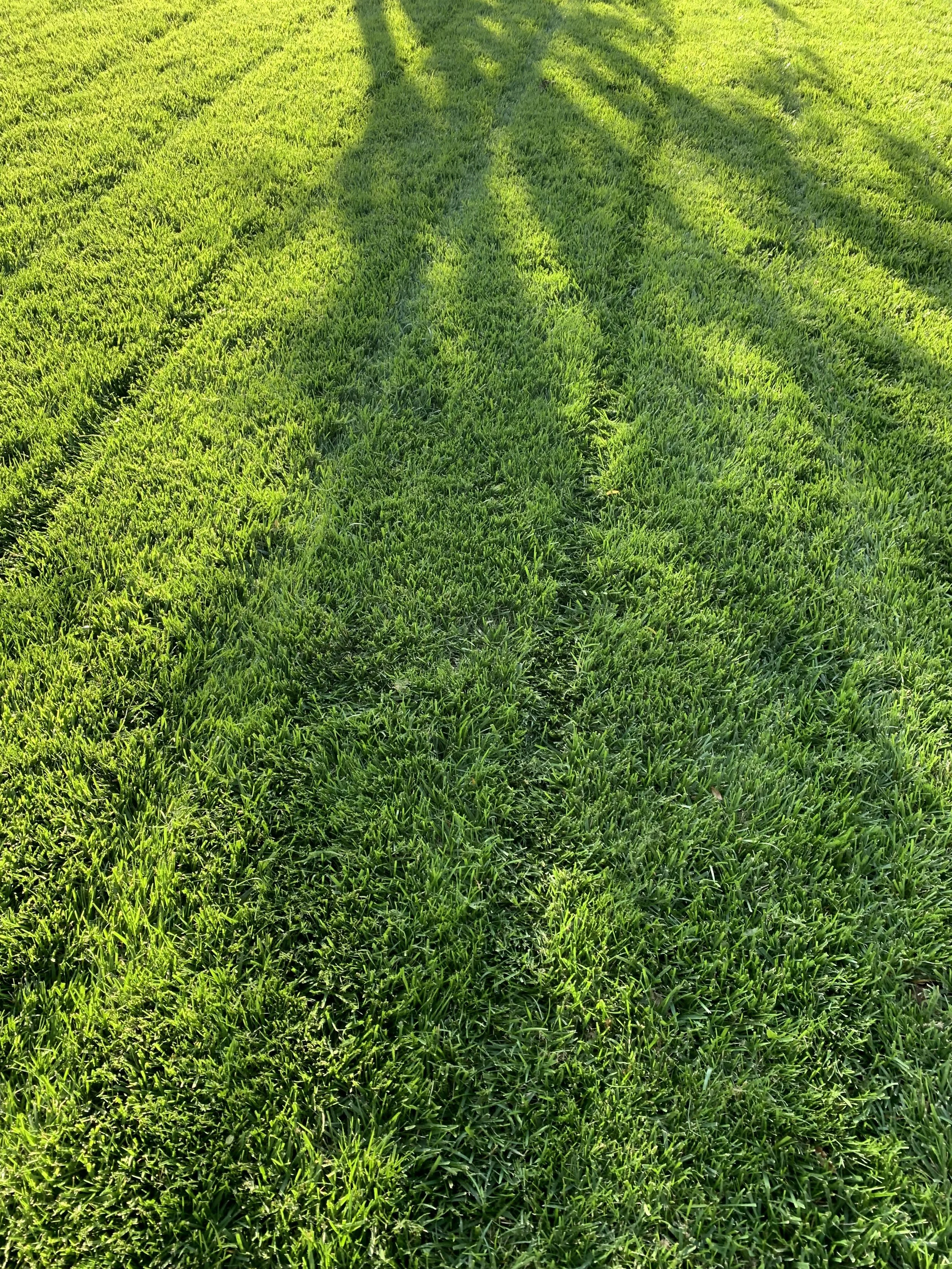
If you need assistance in establishing a fescue lawn or have questions about fescue, give us a call – (405) 367-3873.
Lorne Hall
Hall | Stewart Lawn + Landscape

(405)367-3873
September Lawn & Landscape Tips
September, the transition month from summer to fall!
Last year August went out hot and dry. Not this year. With a week full of 70-degree days and over 3” of rain, it feels like we are on the fast track toward fall this year!
You have heard me say it before, I’m sure you it won’t be the last time either, but no two seasons are the same in Oklahoma. When it comes to weather, there is not a chance you are going to get bored around here.
Weather, environmental conditions, are one of the three legs of the stool when it comes to having a great lawn and landscape.
What are the three legs? 1. Environmental conditions (weather). 2. Mechanical issues (mowing, aerating, etc.). 3. Applications (fertilizer, weed control, insect and disease control).
When the legs of a stool are off, it is hard to sit on. This summer the environmental leg was always a little off. Warm season lawns were a little slow to get going but finished strong. Fescue lawns struggled with too much rain when temperatures were warm in late June and early July resulting in more disease pressure followed by a six-week hot and dry spell that fescue lawns were not ready well prepared to handle.
Simply put, it was an ok summer for warm season turf (bermuda) and a less-than-ideal summer for cool season lawns (fescue).
Now that summer is fading away, it is time to turn our focus toward the lawn and landscape activities of fall.
September lawn and landscape activities will make a big difference in the success of your landscape not only this fall, but also next spring.
For your lawn and landscape, it is important to finish the year strong and get a head start on next year by checking off these lawn and landscape activities during September:
Overseed
If you have a cool season lawn (fescue), September through October is the time to add more seed (overseed). Fall is by far the most successful time to establish cool season turf. Fescue seeded this fall will have stronger roots next summer when the heat returns.
If you have not already, inspect your fescue in the next few days. If there are thin areas due to dense shade, brown patch damage, or areas damaged by a lack of moisture during the heat, plan on overseeding this fall.
Also, look for areas of the lawn that have become too shady for bermuda. Bermuda needs at least 6 hours of direct sunlight for the best performance. The key words are “direct sunlight.” Dappled sunlight is not “direct sunlight.” Anything less than 6 hours of full sunlight and bermuda will begin to thin.
Sooner or later, you will have to introduce fescue in your lawn if you have trees. Success is easier if you start the process before the bermuda has completely faded.
Fescue is also a good choice for the narrow side areas of houses where the turf only receives a few hours of direct sun each day.
What are the keys to successful seeding? Good seed soil contact, a quality fescue blend, and keeping the seeded area tacky moist until the seed germinates.
Need help evaluating shady areas of your lawn, schedule a lawn evaluation by responding to this email or call (405)367-3873.

If you are overseeding with fescue this fall, even water distribution is a critical step to success. If you have dry areas in your irrigation system, make repairs before seeding.
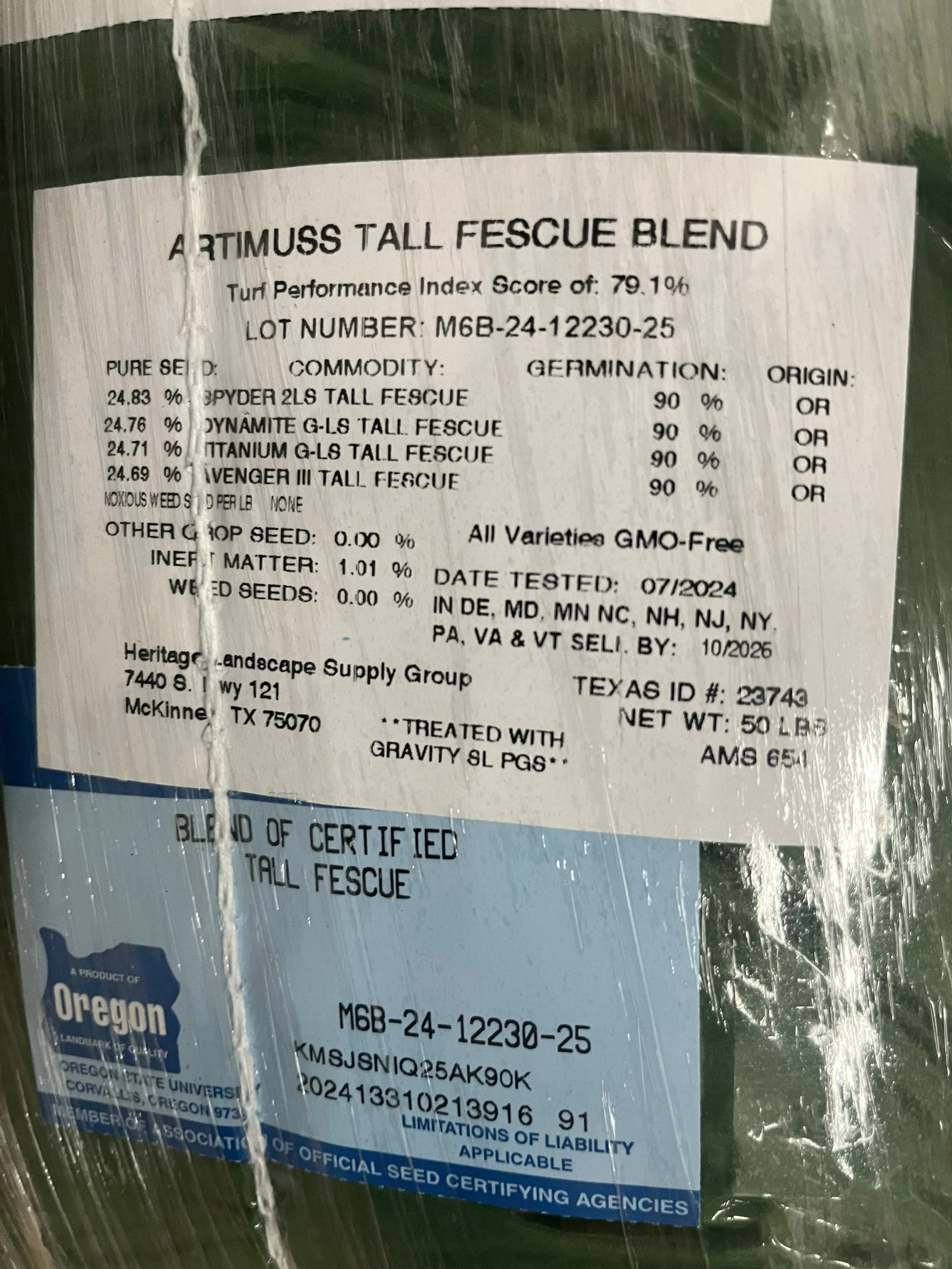
One of the keys to successfully seeding shady areas is a quality seed. We believe in using a fescue blend containing varieties that have a history of performing well in Oklahoma.
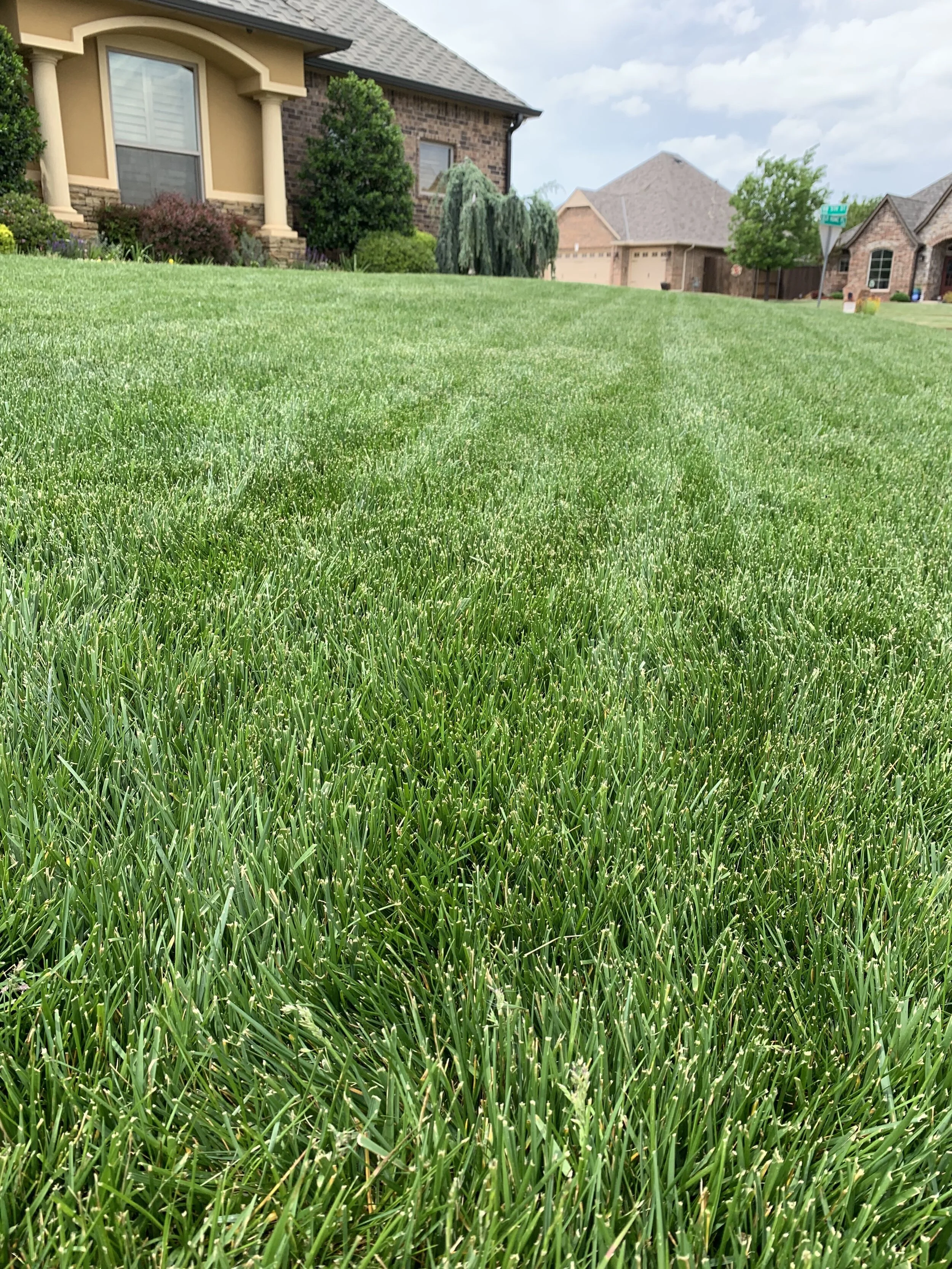
Did you know that with the right maintenance plan and lawn care applications tailored for cool seasons grasses, fescue will perform well in full sun?
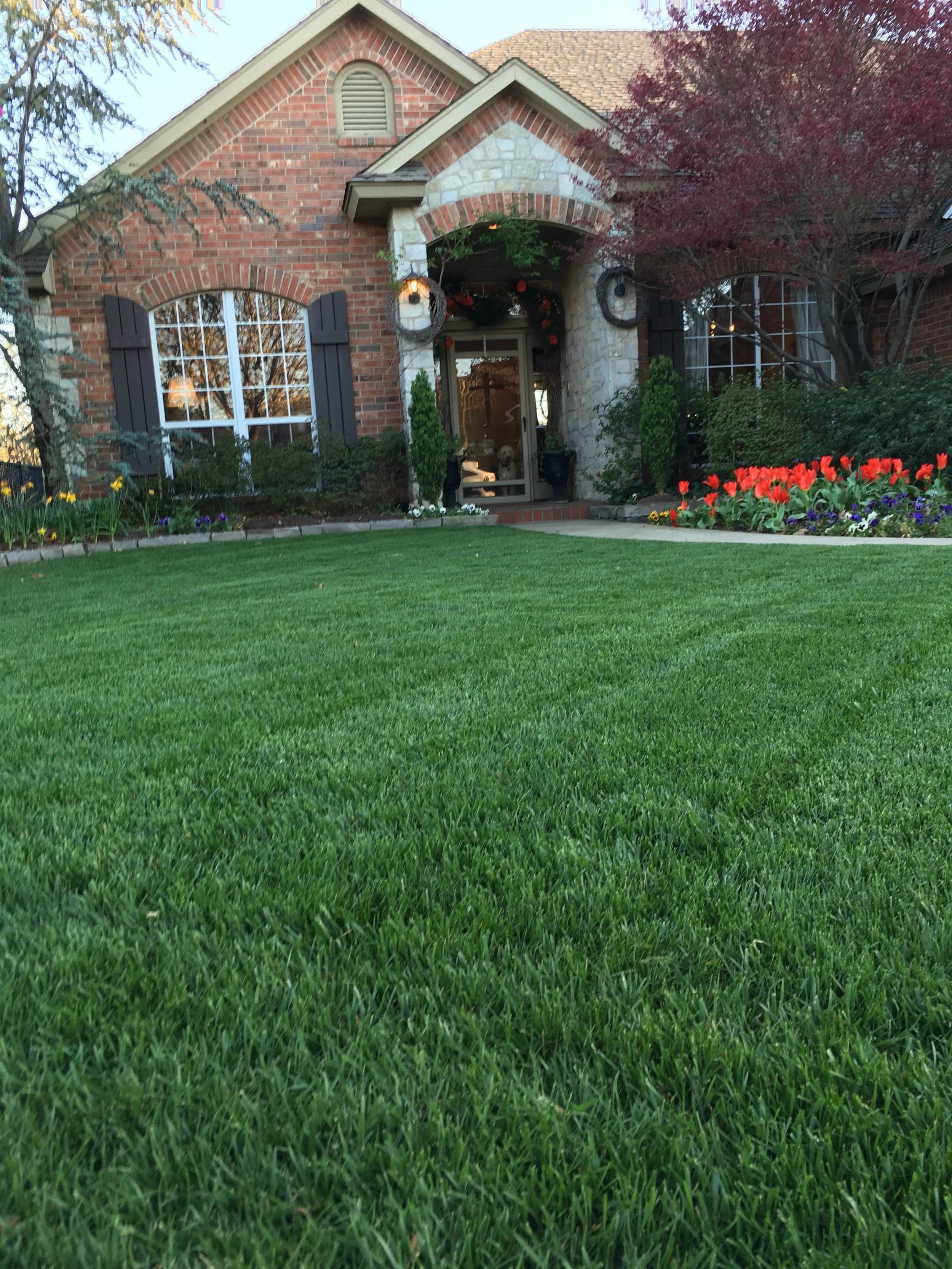
Fall seeded fescue lawns result in the best cool season lawns next spring.

Overseeded fescue 14-21 days after seeding.

Fall is the best time to seed shady areas of your lawn with fescue.
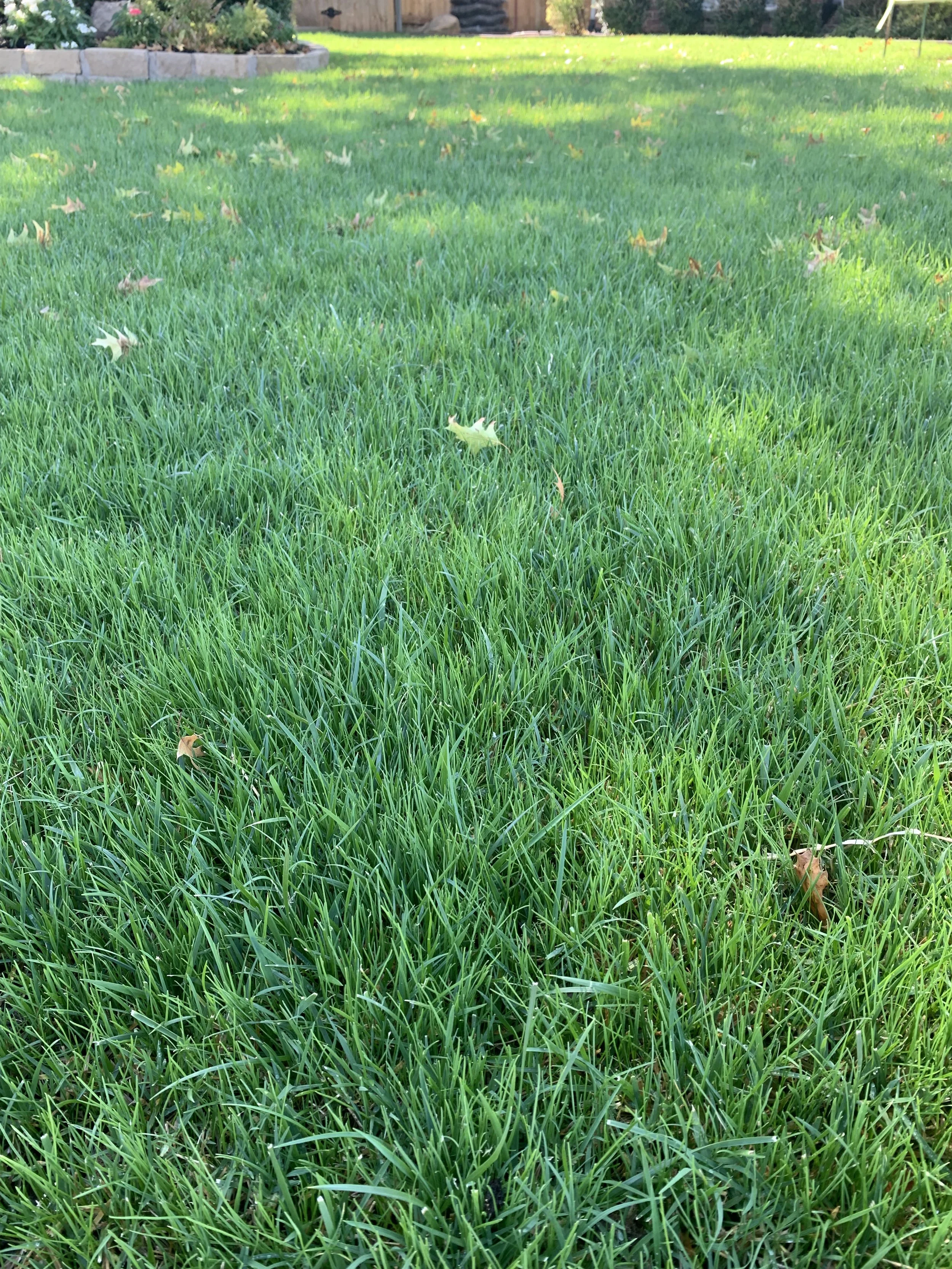
Fescue in late September last year after being overseeded in early September.
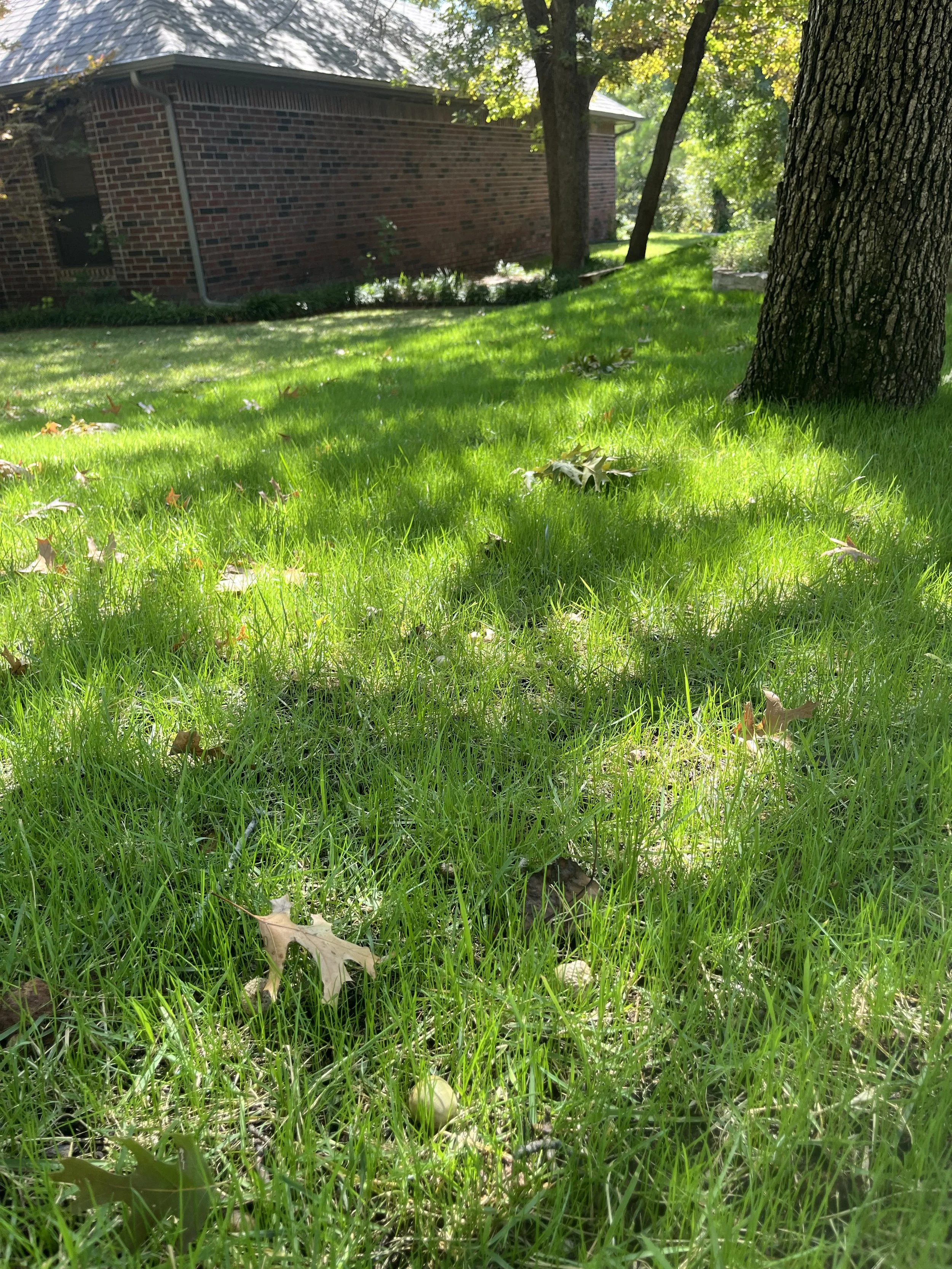
Newly seeded fescue two weeks after seeding.

If your fescue has areas that did not handle the heat and lack of rain from mid-July until this week, now is the time to overseed your fescue.
Fall Pre-emergent & Post-Emergent
Winter annual weeds germinate as temperatures cool. Poa annua, annual bluegrass, is the first to germinate, followed by henbit and chickweed. These are the weeds that will keep you from having a clean landscape next January through April. When you skip the fall pre-emergent applications, you will be forced to use harsher products next spring to clean up the turf when you should be focused on developing a lush green turf. For the best results, a fall pre-emergent should be applied to your lawn before the end of September. Also, many bi-annual weeds, such as dandelions, are easier to control in the fall.
Note: DO NOT use pre-emergent herbicides now in areas that are going to be seeded this fall.
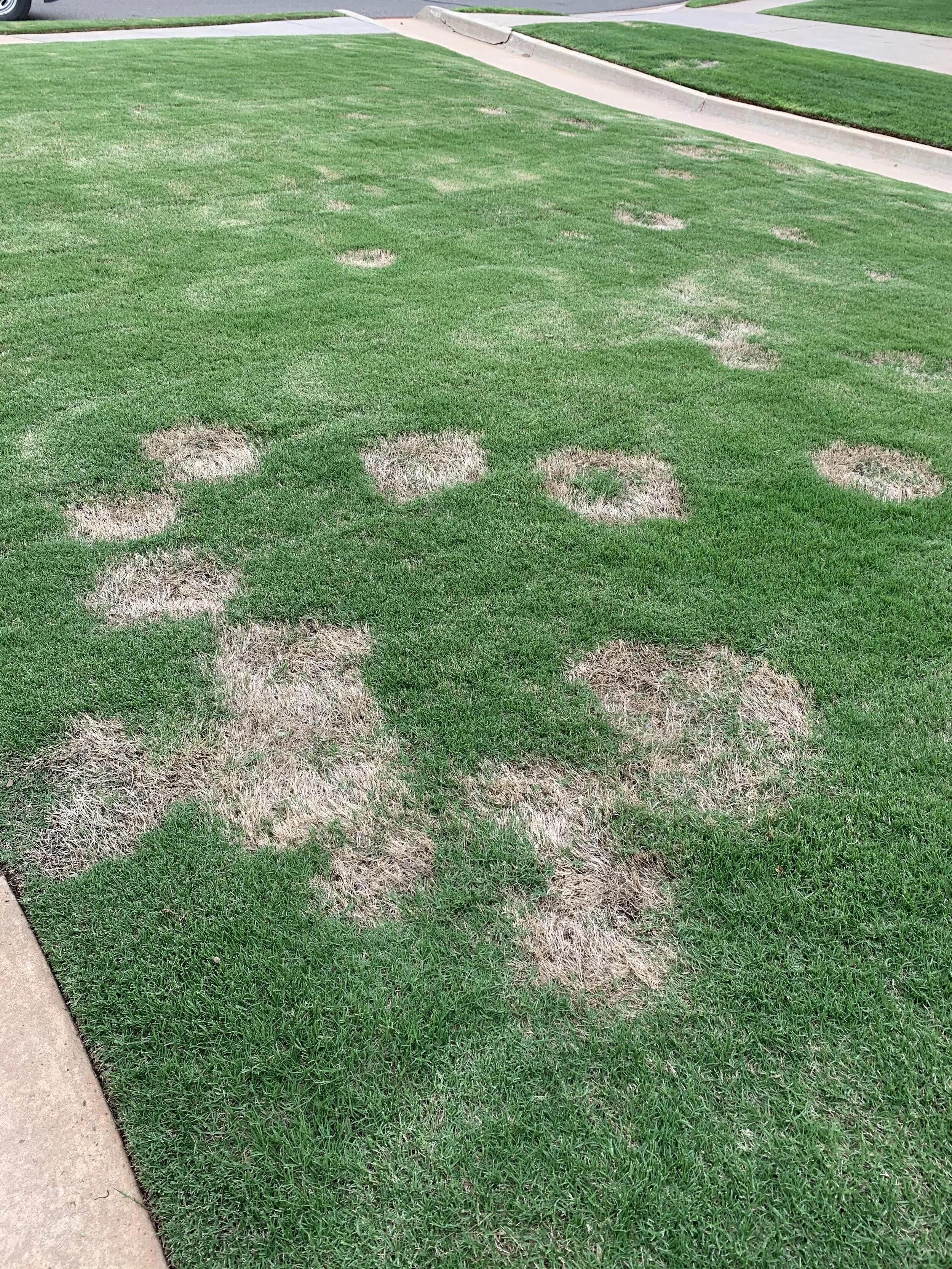
The use of nitrogen fertilizer after September 15th, often in an attempt to keep Bermuda green longer in the fall, will enhance spring dead spot disease next year.
Lawn Fertilizer
When you fertilize and what you put on your warm season (bermuda and zoysia) lawns in September is critical to the health of your lawn. High nitrogen fertilizer should not be applied to warm season turf after mid-September. Applications of high nitrogen fertilizer 6 weeks before winter dormancy reduces winter hardiness and promotes spring dead spot disease. Typically, winter dormancy for bermuda in central Oklahoma begins in early November. Potassium is important for cold tolerance and disease control, but because potassium stays in the soil longer, a soil test is recommended before applying high amounts of potassium.
During September and October, we adjust the fertilizer to match weather forecast and soil conditions to insure bermuda lawns have strong root systems, are winter hardy and are positioned to start next year strong.
Fall is the best time to apply higher nitrogen fertilizer to fescue lawns. Plan on getting the first fall feeding on fescue this month. Because fescue is a cool season grass, it benefits from more nitrogen in the fall. Even if you will be overseeding your fescue this fall, it is important to get fertilizer on the existing fescue this month.
Mowing
Continue to mow often enough that you are removing no more than 1/3 of the blade of grass with each cutting. For warm season turf, maintain the height at or near 2 – 2 1/2” going into the fall. Avoid cutting short or scalping warm season lawns at this time. Anytime you cut below the leaf space and into the stems of the plant, you are causing stress. The plant will use nutrients stored in the root system to generate new leaves. At this time of the season, you don’t want to cause any stress that would require the lawn to use nutrients stored for the winter.
For cool season, it is best to cut the lawn shorter before seeding. This will increase seed to soil contact. After the new seed starts growing, gradually increase mowing height to 3”.
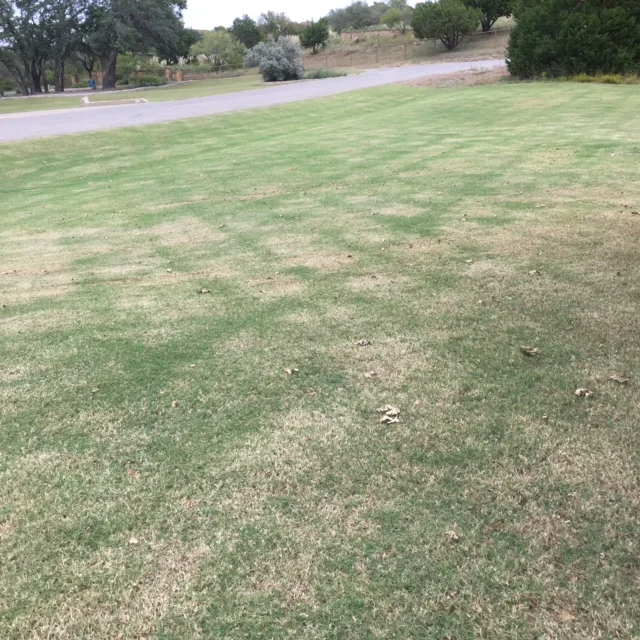
When you cut below the leaf blade into the stem your Bermuda lawn will have a scalped, brown appearance.

When you don’t mow your Bermuda too low in the fall, it will develop a stronger root system for the winter months.
Watering
With over 3” of rainfall in the past week, hopefully you turned your irrigation turned off or put it in a rain delay.
As nights and days begin to cool, and day length shortens, your landscape will need less water. Responsible watering is based on seasonal temperatures and moisture. Typically, during September, you can start reducing the number of days you water. It is always best to maintain deep soakings and reduce the frequency. At some point this month it may be best to water every 4 days rather than on the odd/even plan.
Continue to water trees planted in the last 12-18 months more than you water your lawn this month. Supplemental watering is critical for new additions to the landscape. Place a water hose at the base of the tree with the water flowing at a slow trickle for a couple of hours once per week. The goal is to get 10 gallons of water to the roots every week.

Maintain good soil moisture through September. The goal is to have moist soil 6-12” deep. If you have dry soil like the core in this picture you are allowing your lawn to go into the winter in a stressed condition.
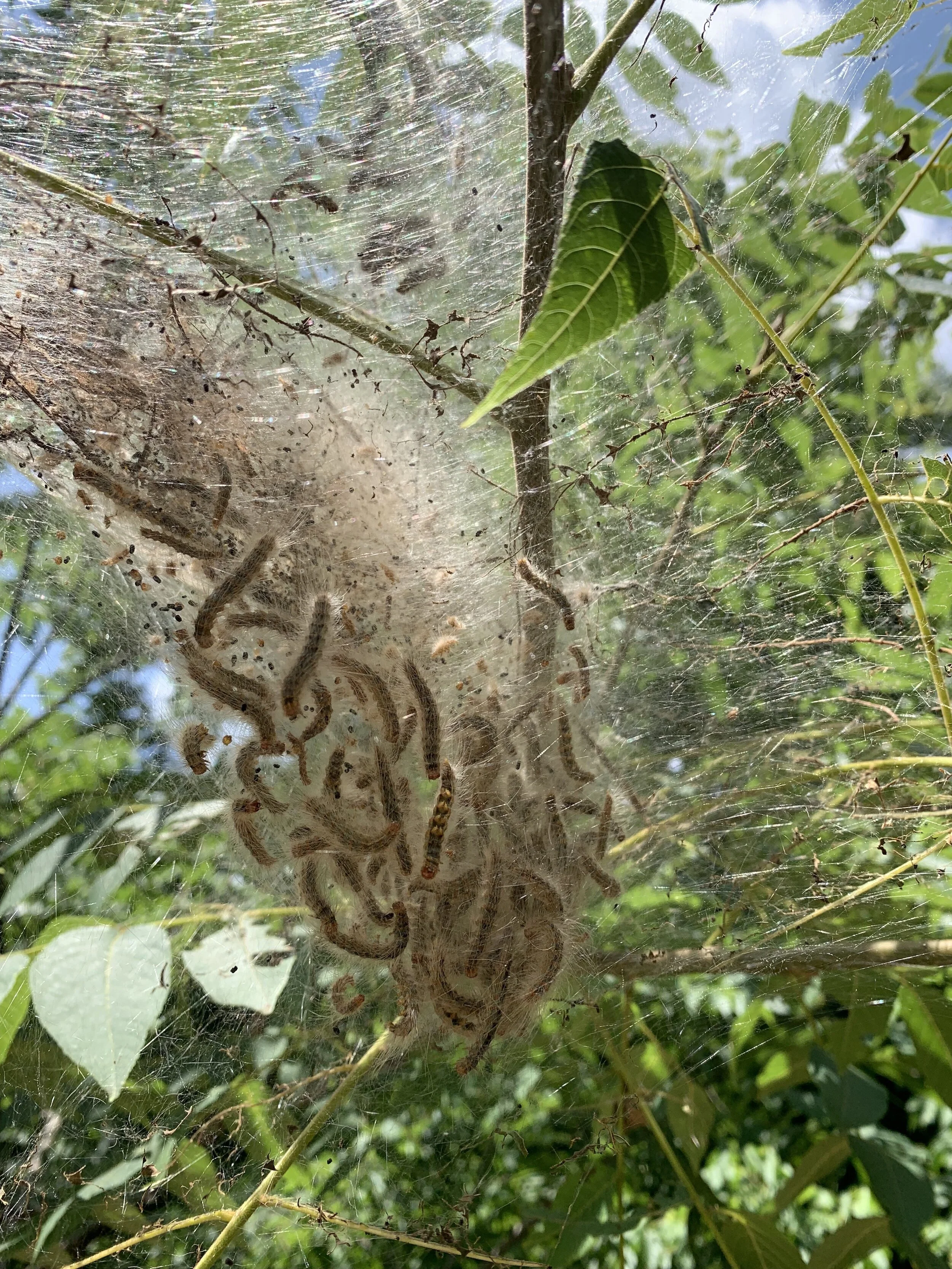
Fall webworm can cause damage. When possible, pruning out the infected area is the best method of control.
Webworm
Watch for fall webworm in your trees. Webworm create webbing on the ends of tree branches as the worm devours the leaves. Webworm can have more than one generation per season. The earlier generations do not cause lasting damage. But, the last generation can result in branch die back. To treat with an insecticide, you must penetrate the webbing. The most effective approach of control is to monitor trees and prune out the web areas while they are small. Place webbing in a plastic bag and dispose of it immediately. If you leave the branches on the ground, you will be amazed at how quickly the worms will be back in the tree.
Fall Color
As the hottest part of the summer transitions to more moderate conditions summer color typically gains vibrancy in September before it begins to fade later in the month.
If you haven’t already, create a summer landscape journal. Grab a few minutes and take pictures of your landscape while the color is still strong. Jot down a few notes about plants that did well, plants you liked, plants that were just so-so, and list a few you would like to add to your landscape next year.
Next spring you will be glad to have the information when you make summer landscape plans. Too often we get excited about a plant that looks great in May only to have it disappoint when the heat is on in July and August.
Toward the end of the month or early October, you will want to replace your summer annuals with cool season annuals. Pansies, mums, and kale are the dominate players. Use more pansies than mums and kale since pansies typically overwinter and flourish the following spring.
The Colors of September

Start making plans to replace your summer color with cold hardy annuals, such as pansies, later this month or early next month.

Hamelin Grass loads up with plums during September.
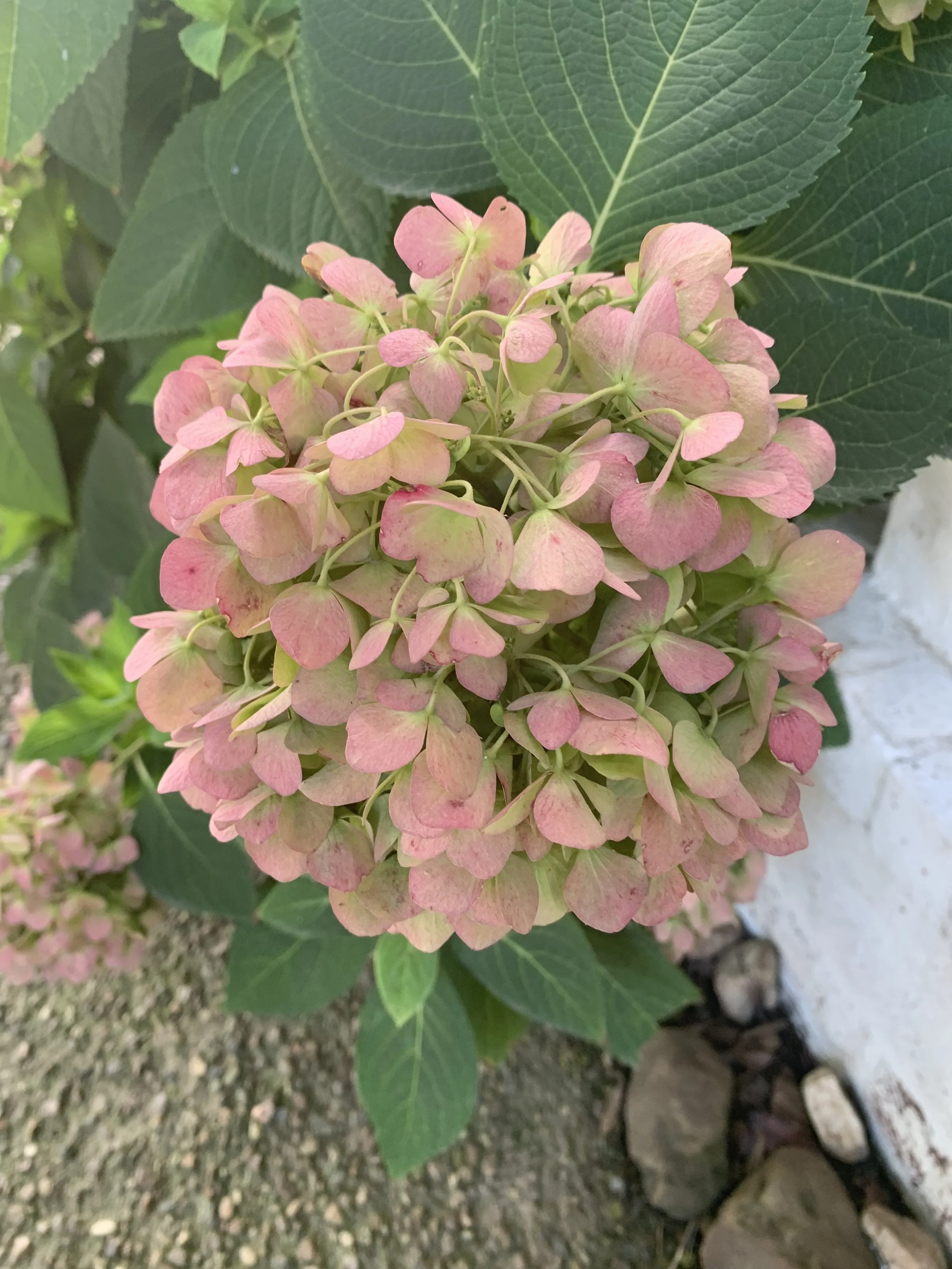
If you resisted the urge to prune what appeared spent blooms on your hydrangeas earlier in August, now you are getting to enjoy rosy pink shades late in the summer.

Crape Myrtle, our longest blooming plant, will continue to put on a show through September.
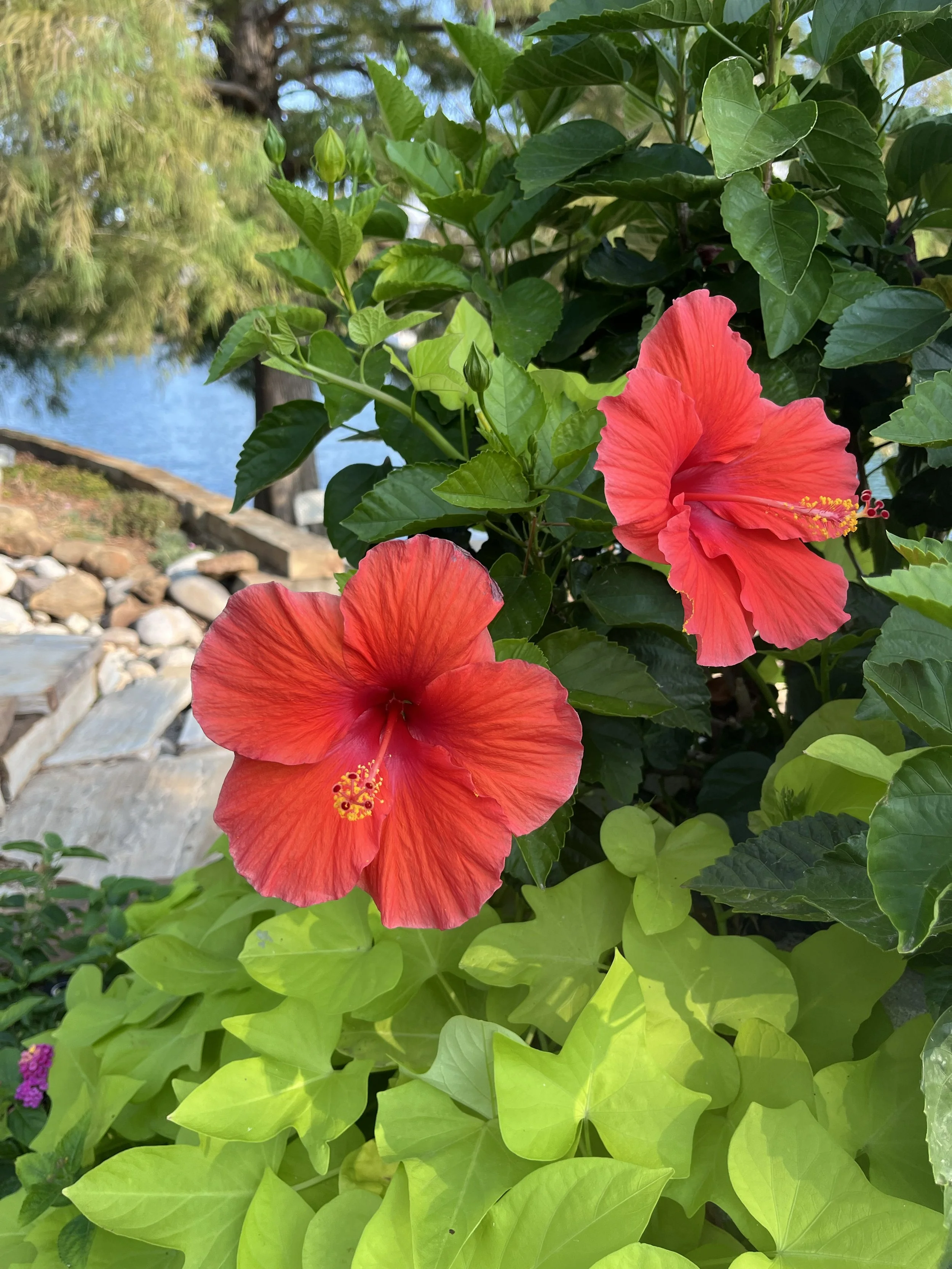
For as long as the weather stays warm, tropical hibiscus will continue to produce big bright blooms.
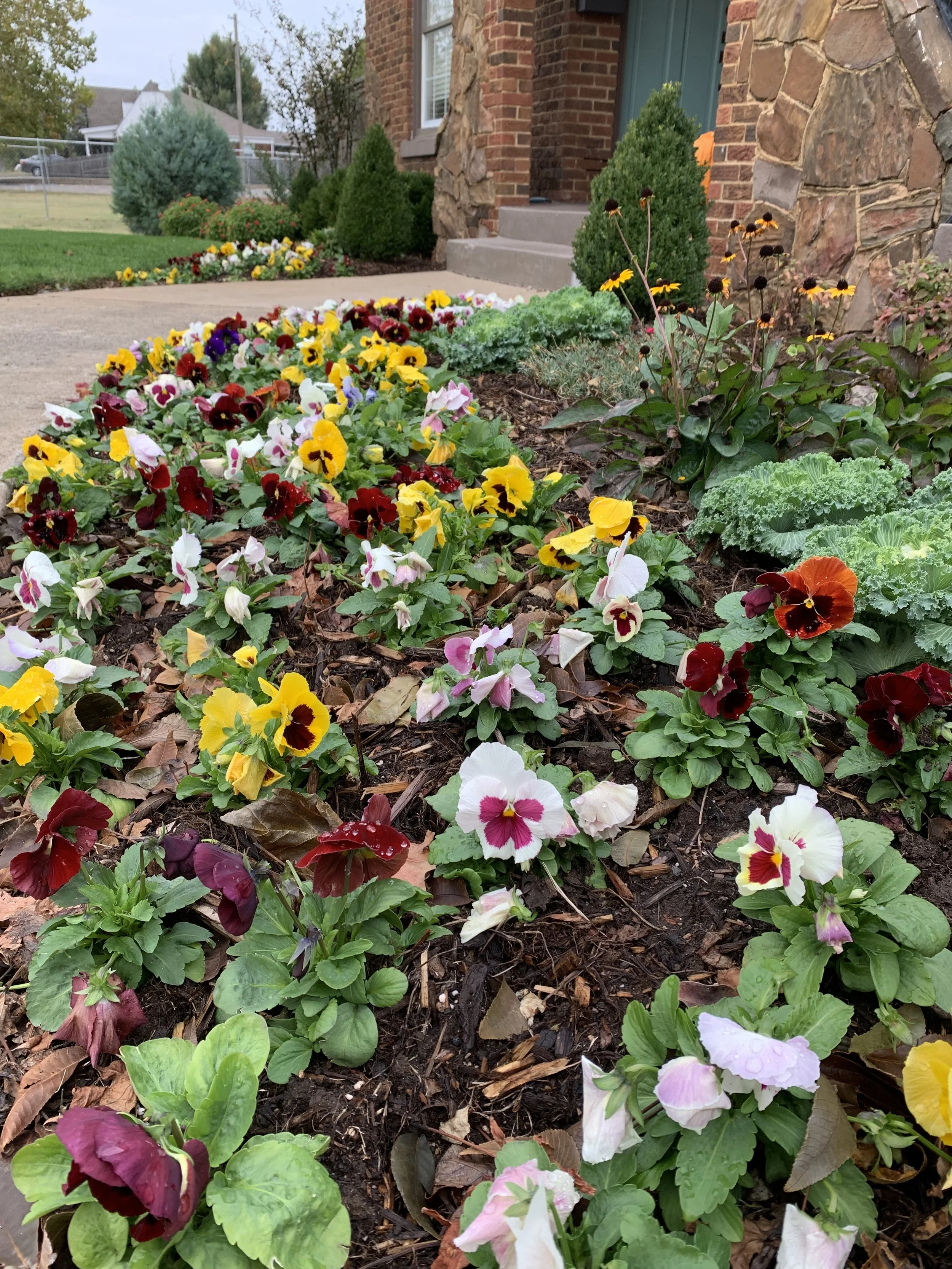
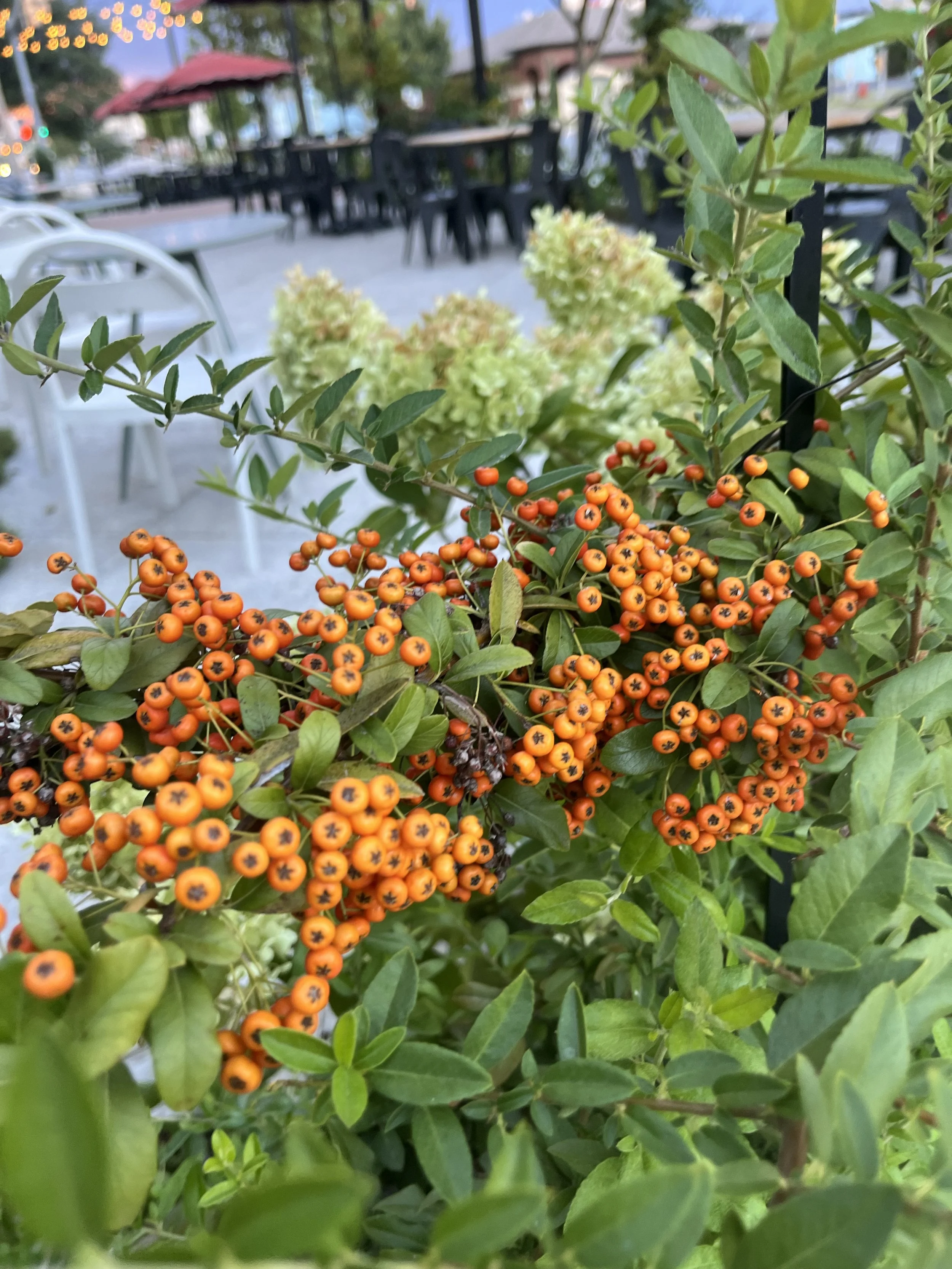
A favorite splash of color every September is the orange to red berries of pyracantha.

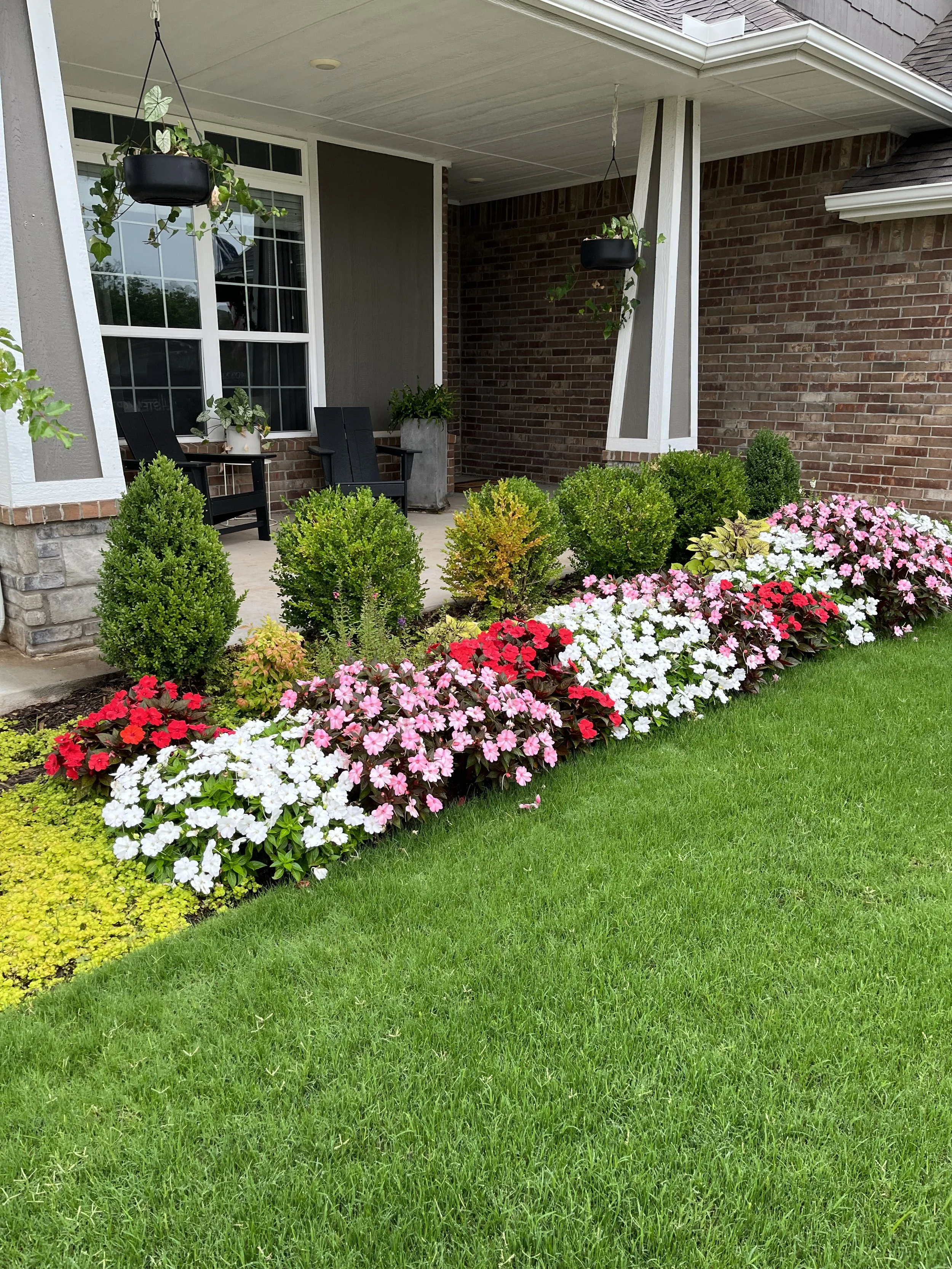
With recent rains and a break from the warm temperatures of August, summer color will become more vibrant in early September.
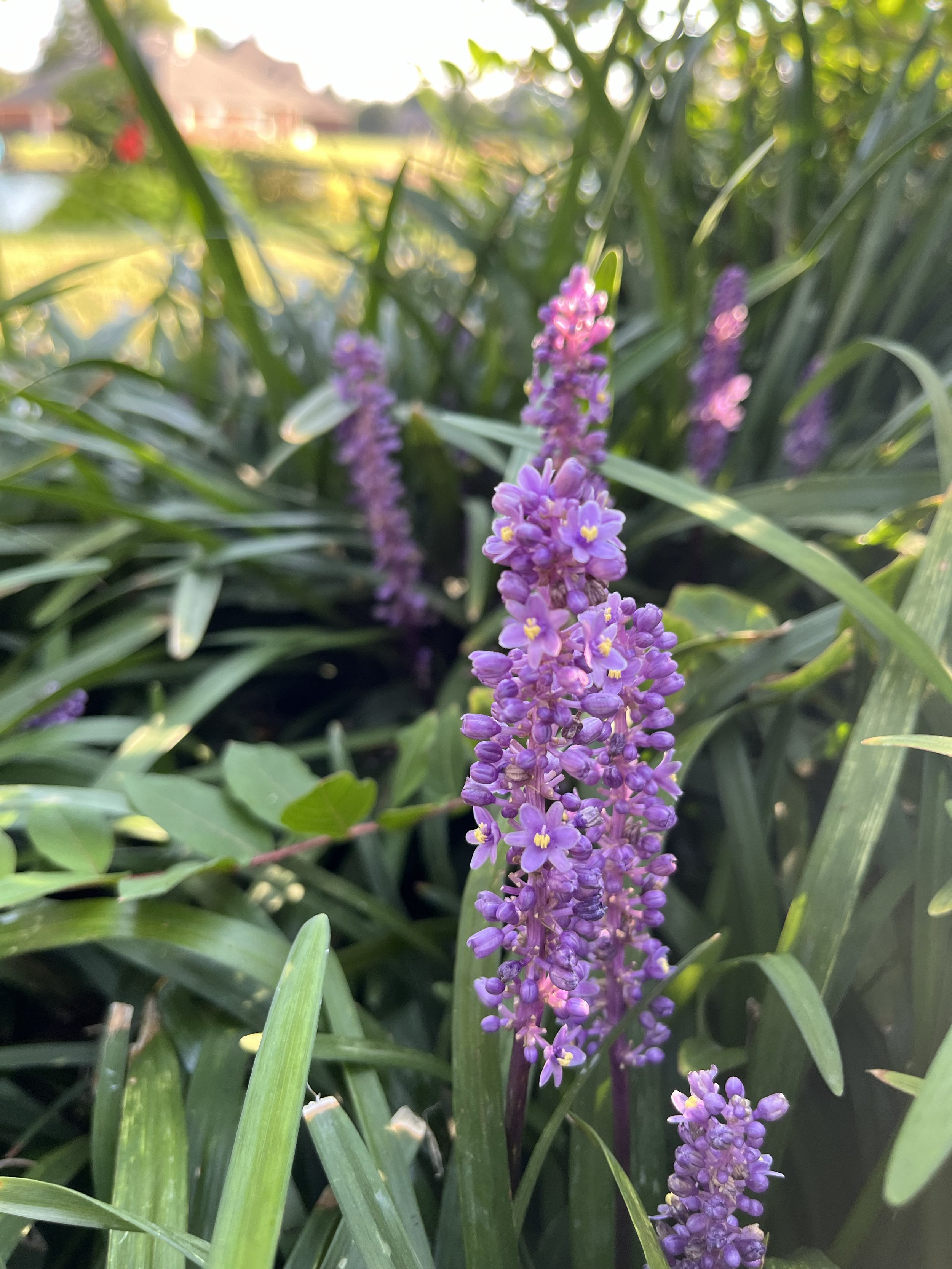
Liriope one of the easiest ground covers to grow puts on blue to purple flowers spikes in late summer.

A great late summer addition to the landscape are many of the warm season ornamental grasses.

Summer loving lantana will continue to bloom through September.

Abelia is often graces the late summer with white flowers.
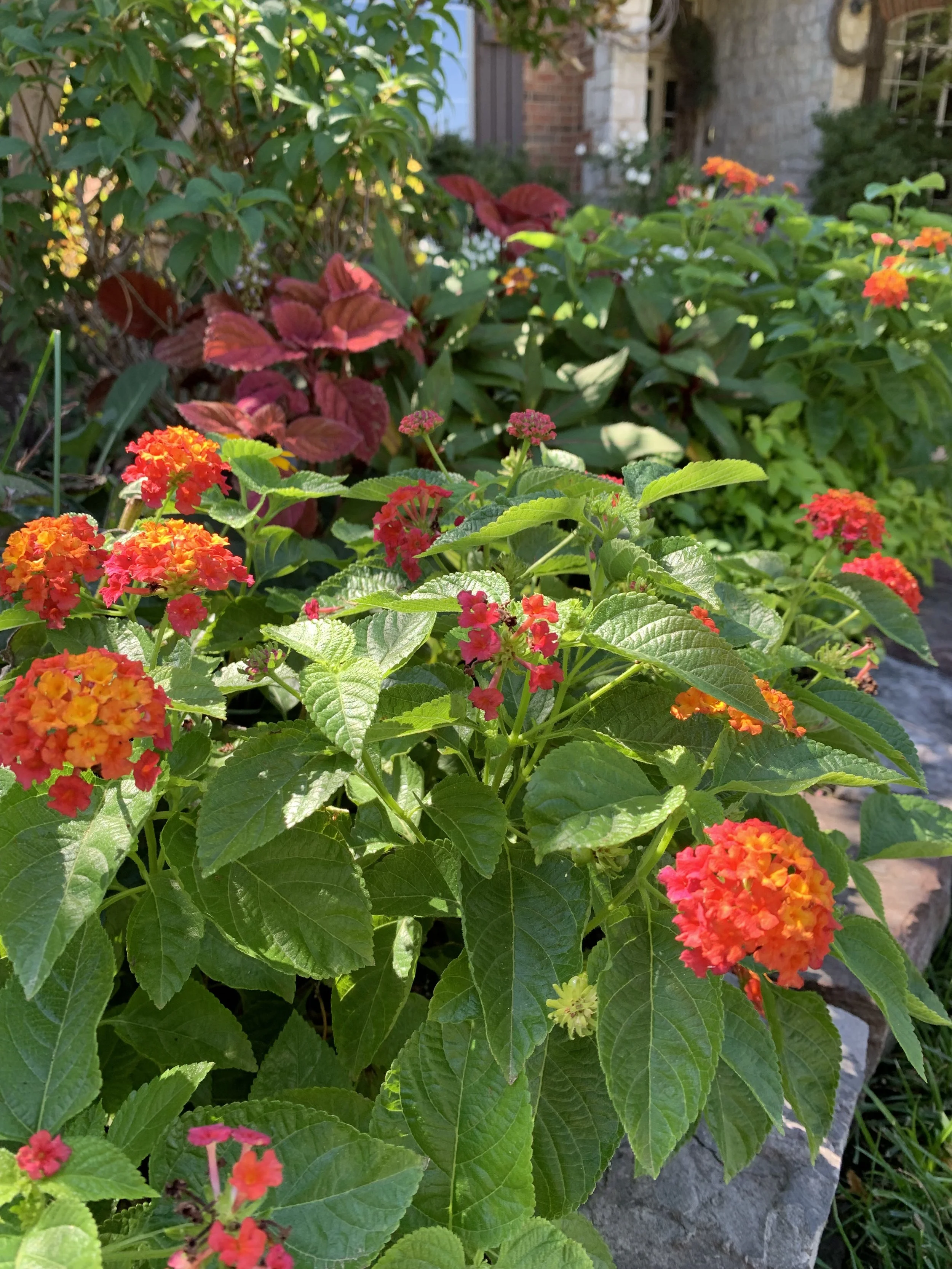
If you haven’t taken pictures and made notes of your best summer color this year, do so in the next couple of weeks.
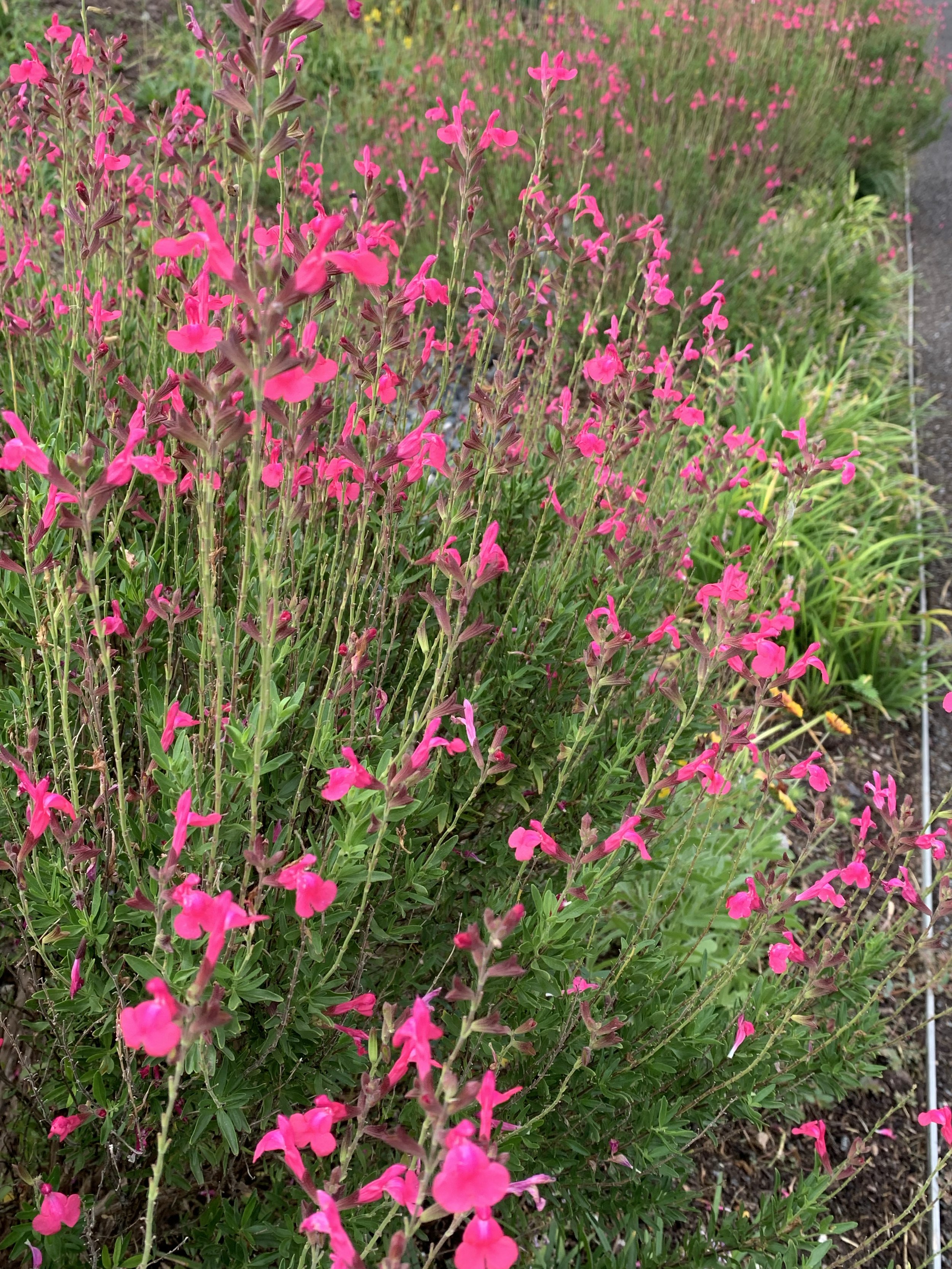
A fun September blooming perennial is Autumn Sage
Don’t you just love September? Trees, shrubs and flowers appear more vibrant, and fescue lawns return to their grander. What a wonderful time of the year!
Our goal, as always, is to help you have your best lawn and landscape.
If you need assistance with any of the September lawn and landscape tasks, or have questions concerning your lawn and landscape, give us call… (405) 367-3873.
Oh, one more thing…
Do you know what the most exciting thing about a week of rain in late August?
Who said a lower water bill? That’s good, but that isn’t the best thing.
The best thing…is better fall color!
A major ingredient for vibrant fall color is abundant moisture late in the growing season.
This week’s rain could deliver us one of the best fall color seasons central Oklahoma has ever seen.
Lorne Hall
Hall |Stewart Lawn + Landscape
(405)367-3873
The Fall Pre-Emergent – The Application That Sets Your Lawn Up For Success Next Spring

A successful lawn care program is not just what you are doing for you lawn right now, but rather it is about setting up the next season for success.
Even though it is still August with more warm days yet to come, we are focused on fall and making sure you have your best lawn next spring.
We get it. It is hard to keep up the enthusiasm for your lawn and landscape late in the summer. The dog days of summer have taken all the enjoyment out of working on your lawn and landscape. Then add on the busyness of the start of the school year and it is often hard to keep up with the best lawn and landscape practices.
When it comes to having your best lawn, the worst thing you can do is give up now. Finishing the season strong is important.

An early fall pre-emergent before fall & winter annual weeds start to germinate as temperatures cool this fall is the key to having your best lawn next spring.
Why?
Because: Nothing sets up your lawn for success next spring more than what you do now!
The most critical lawn care applications are the ones that include pre-emergent herbicides.
Everyone knows the importance of the spring applications, but did you know that the fall applications are just as critical?
Remember – it is always easier to prevent weeds than it is to kill actively growing weeds.


Why are the fall pre-emergent applications so important?
Fall pre-emergent applications are the key to having a clean lawn next spring.
Fall pre-emergent applications prevent poa annua, rescuegrass, cheat, brome, chickweed, and henbit. These are the weeds that clutter your lawn in the spring.

Bermuda lawns that do not receive the early fall pre-emergent soon run the risk of being very weedy next March and April as the green up.

Henbit is a broadleaf winter annual weed with greenish to purplish square stems, green scallop edged leaves, and reddish purple flower in the spring. Seeds germinate in the fall but the weed often goes unnoticed until we have periods of warm winter weather when henbit grows best. Henbit is easily prevented with fall pre-emergent applications but can be difficult to control in late spring when it is mature, flowering and littering your lawn. As with most weeds, a dense turf is the best prevention against the development of henbit.
Henbit

How a Bermuda lawn looks in April when no fall pre-emergent applications were made.

Poa Annua is a winter annual grassy weed that will germinate this fall. Without a fall pre-emergent application there is a good chance your lawn will be full of poa annua next spring.

Poa Annua is a low growing winter annual weed that will have white seed heads next spring. A pre-emergent between now and the end of September is a critical step in not having a lawn full of weeds next spring.

Poa Annua germinates and thrives in thin areas of fescue during the fall, winter and spring. Poa Annua does not have a competitive advantage over fescue when it is thick, healthy and actively growing. Overseeding thin fescue in the fall is a great way to prevent poa annua.

Poa Annua is an annual grassy weed that invades lawns in the fall and winter. It is a lighter green clumping grass with small white flowers (seed heads) in the spring. Germination occurs in moist soil starting in the fall when night temperatures drop into the 60s and continues through the winter and spring. Poa Annua has a competitive advantage over bermuda in the winter when it is activity growing and the bermuda is dormant.

The goal with a warm season bermuda lawn is for it to be clean of winter weeds this winter and coming spring. Fall pre-emergent applications are the key.
Weeds are easier to prevent in the fall than they are to control in the spring.
Poa annua, also known as annual bluegrass, is the fall’s equivalent to spring’s crabgrass. Without a fall pre-emergent, your lawn will not be clean next spring. And, just like crabgrass, when it is mature, poa annua is hard to control without causing turf injury.
Next spring, we want your lawn to be focused on emerging from dormancy without the harmful effects of harsh post-emergent herbicide applications. Lawns that do not receive the early fall pre-emergent application will be filled with weeds next February through April. While lawns that receive fall applications, will start next year clean and healthy.
Nothing will make a bigger difference in the way your lawn looks next spring than applying both fall pre-emergent applications this year.
Timing of the fall pre-emergent applications is critical. As temperatures cool in the fall, cool season annual weeds will germinate.
The first application for the fall needs to be made sometime between now and the next 6 weeks.
A second application should be put on your lawn 6-10 weeks after the first fall application to ensure full control until the lawn emerges from dormancy next spring. Research shows that poa annua has developed resistance to pre-emergent applications. A second fall pre-emergent increases control of poa annua.
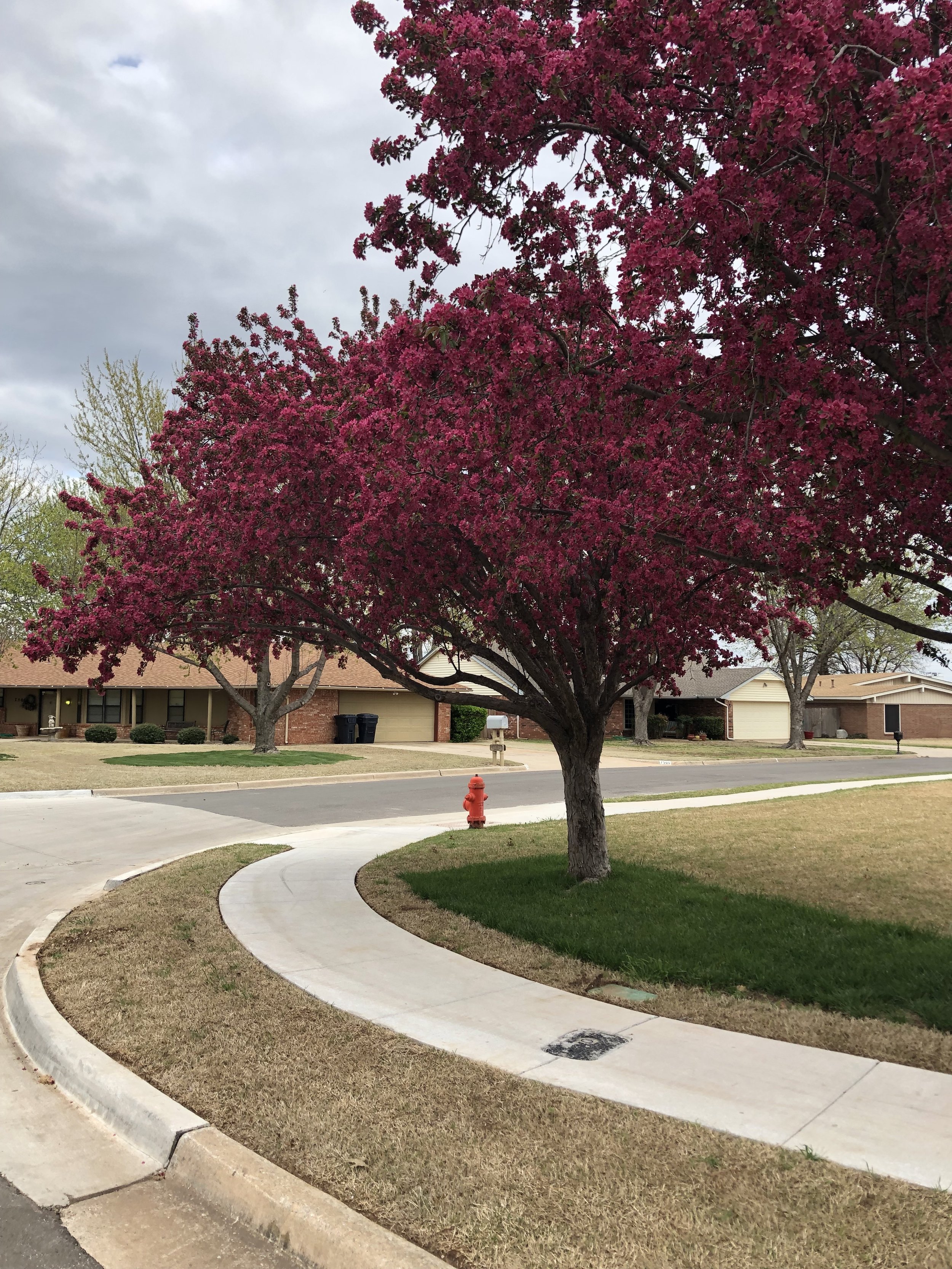
Next spring when the crabapples are in bloom and fescue is green, Bermuda lawns should be weed free. This is only possible if a fall pre-emergent is applied between late August and early October with a second application 4-6 weeks later.
There is only one reason to NOT put the first fall pre-emergent application on your lawn: SEEDING FESCUE.
The same pre-emergent herbicide that prevents annual weeds from germinating WILL PREVENT new grass seed from coming up. Because developing a thick turf is so critical to good weed control, and because September through October is by far the best time to establish a cool season lawn, not applying a pre-emergent herbicide to the areas you are seeding is the right thing to do. Once the new seed is up, actively growing, and has been mowed 3-4 times, you can apply a fall pre-emergent application.
Note: If you are only seeding a portion of your lawn, you should have a pre-emergent applied to the areas you are not seeding.
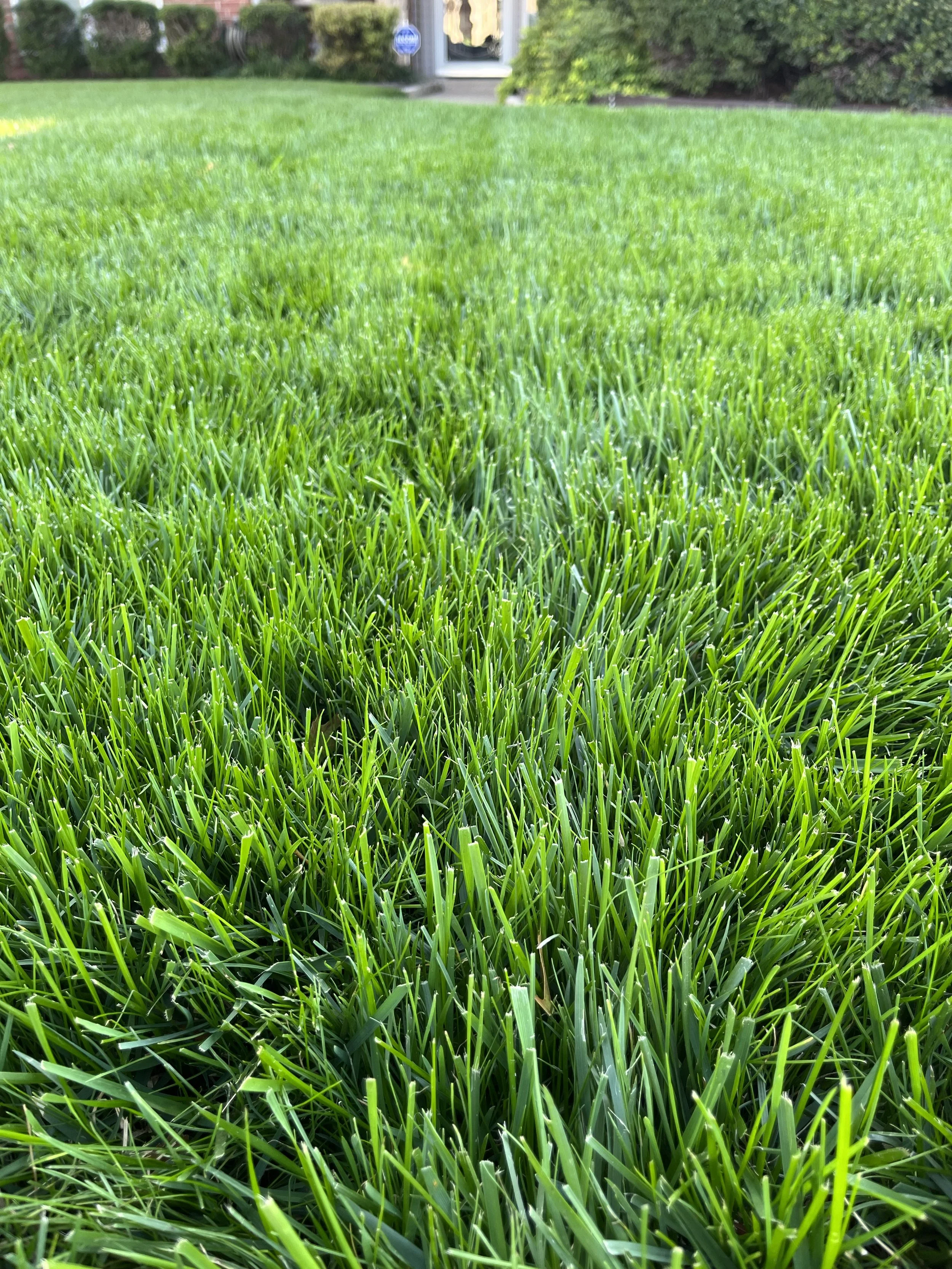
The only exception to the early fall pre-emergent being a must for your best lawn next spring is if you are overseeding with fescue this fall. If overseeding, skip the early pre-emergent, seed with fescue, then apply the late fall pre-emergent after the newly seeded area has been mowed a few times.
Important – If you are planning on seeding all or part of your lawn this fall, please let us know so we can adjust your applications accordingly.
Need help deciding if you need to overseed all or parts of your lawn with fescue this fall? Check out last week’s email: Bermuda vs Fescue. The Choice is Yours!

Dormant Bermuda will be weed free in February and March when both fall pre-emergent applications are on schedule.
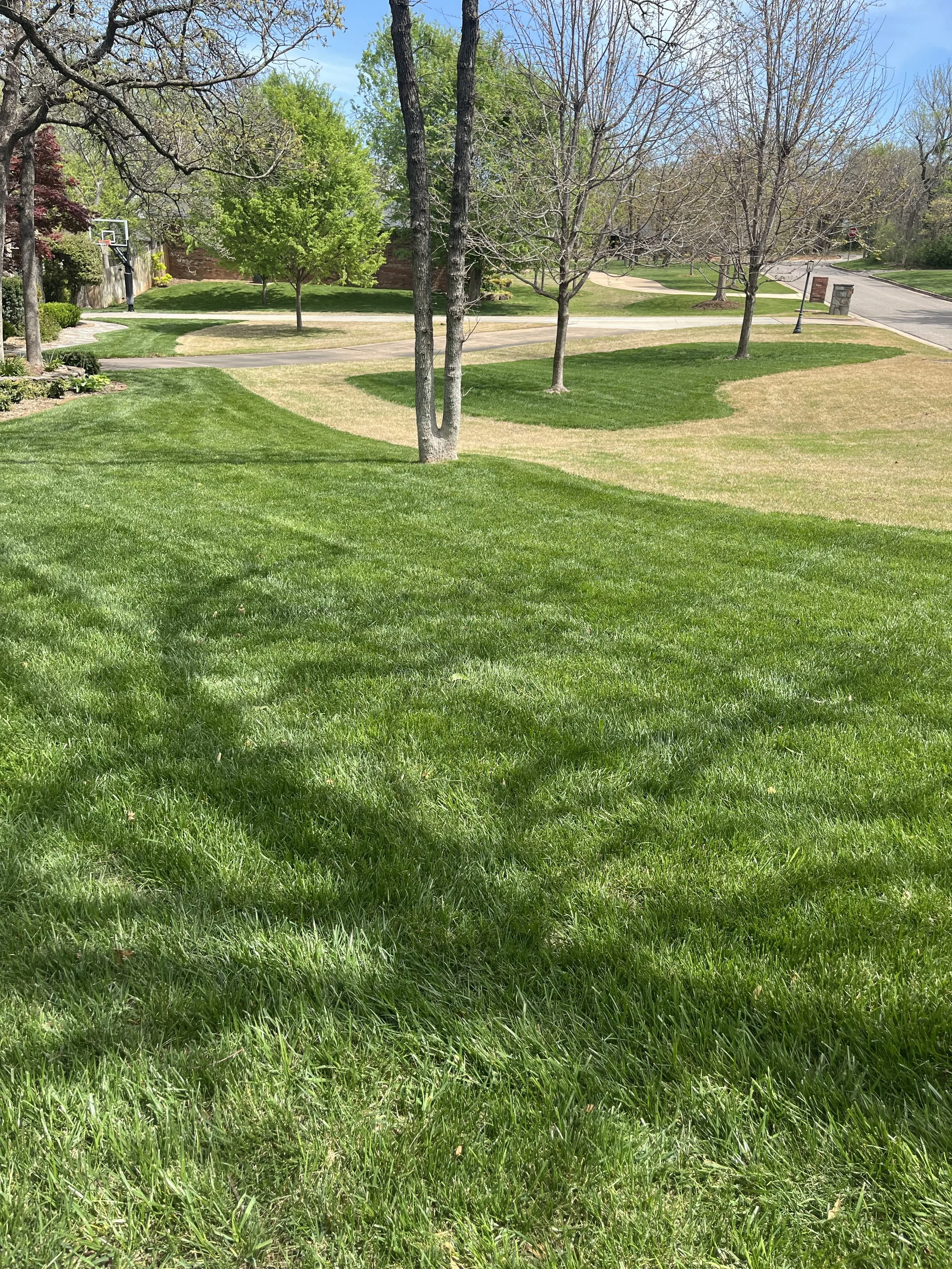
If you are not overseeding all your lawn with fescue this fall, it is important to not skip the early fall pre-emergent. All the areas you are not seeding need the early application to look their best next spring.

Fall pre-emergent applications will ensure your lawn is not full of annual winter weeds next March.

DO NOT apply the early fall pre-emergent on your lawn if you are planning on seeding with fescue this fall.

Please contact us if you plan to overseed with fescue this fall so we can adjust our application plans for your lawn.
There are 4 types of lawn care customers:
Customers who subscribe to the Hall | Stewart 7-step program and enjoy having a clean, healthy and growing turf. If you are on the 7-step program, you will receive both fall pre-emergent applications.
Customers who want to make sure their lawn receives timely pre-emergent herbicides but enjoy applying their own fertilizer. If this defines you, you are receiving the Hall | Stewart 4-step weed control only program and will receive the 2 fall pre-emergent applications.
The occasional application customer who takes a few applications, often the early spring applications. If this defines you, please don’t skip the fall pre-emergent steps this year. You will not regret the fall applications next spring when your lawn starts the year weed free.
Customers who have “thrown in the towel” on this season and plan on starting again next spring. If this defines you, a great lawn next spring doesn’t start next spring. A great lawn next season starts this fall.
Remember – it is always easier to prevent weeds than it is to kill actively growing weeds.
Nothing will make a bigger difference in the way your lawn looks next spring than applying both fall pre-emergent applications this year.
If you have any questions about fall pre-emergent herbicides, please give us a call at (405)367-3873.
Lorne Hall
Hall | Stewart Lawn + Landscape
(405)367-3873

Time For A Summer Landscape Color Check

It’s hot! As, it should be. The last week of July and the first week of August are traditionally the hottest two weeks of the year in central Oklahoma. But, there is some good news…from here on out we should see daytime temperatures gradually decline!
So, how is your landscape doing in the heat?
Too often we get excited about a plant that looks great in April and May only to have it disappoint us when the heat is on in July and August.
Great landscapes should include plants that add color and interest in every season, even when temperatures are pushing triple digits.
A good activity for August is to create a summer landscape journal. Grab a few minutes and take pictures of your landscape while it is hot. Jot down a few notes about plants that are doing well and the ones that are struggling.
Next spring you will be glad to have the information when you are planning your summer landscape.
Here are a few things we have found to be tried and true when it comes to landscape plants that do well in the heat of July and August:
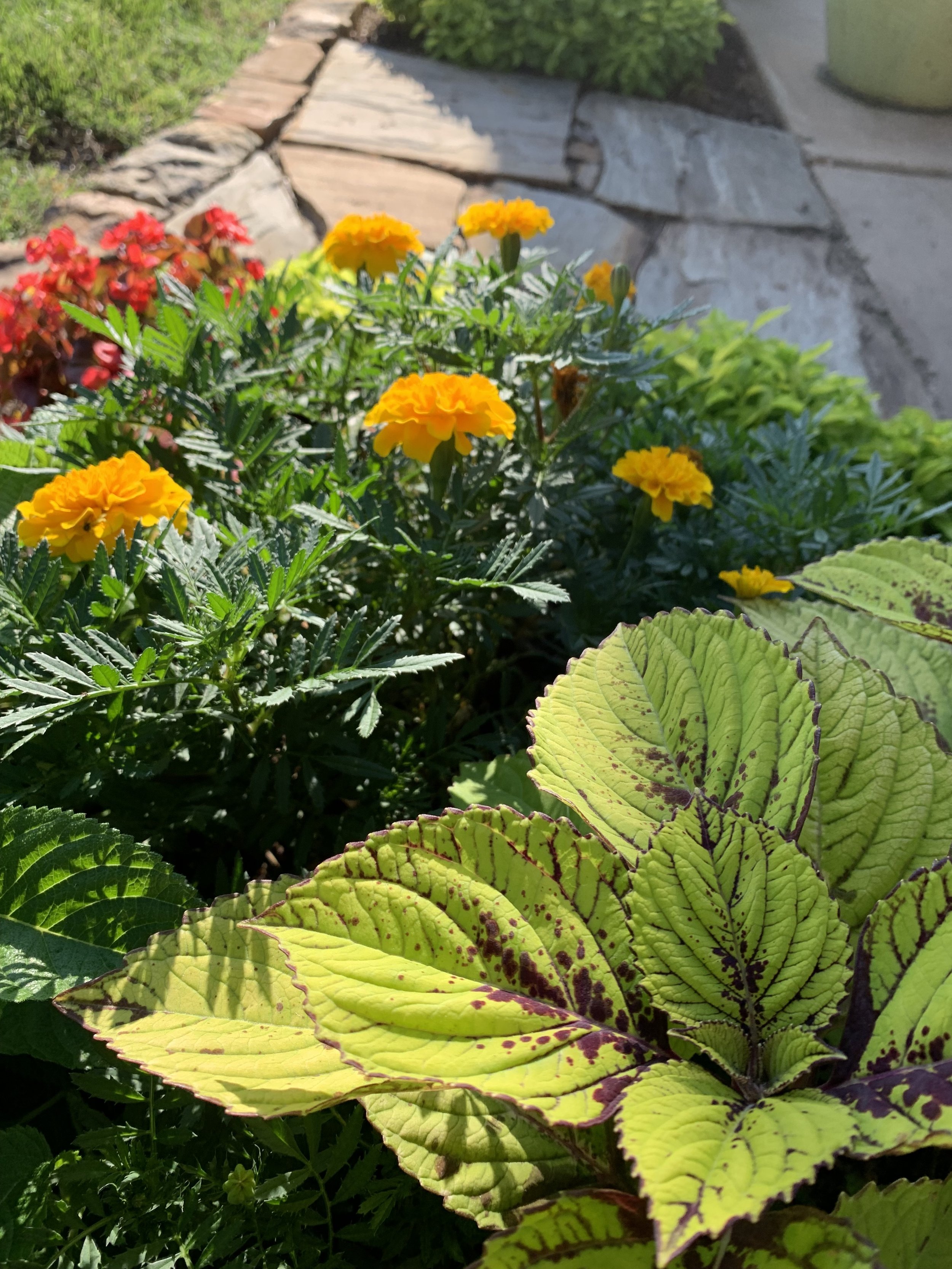
The limes and red speckled leaves of Coleus make a nice accent to the yellow flower of Marigolds.
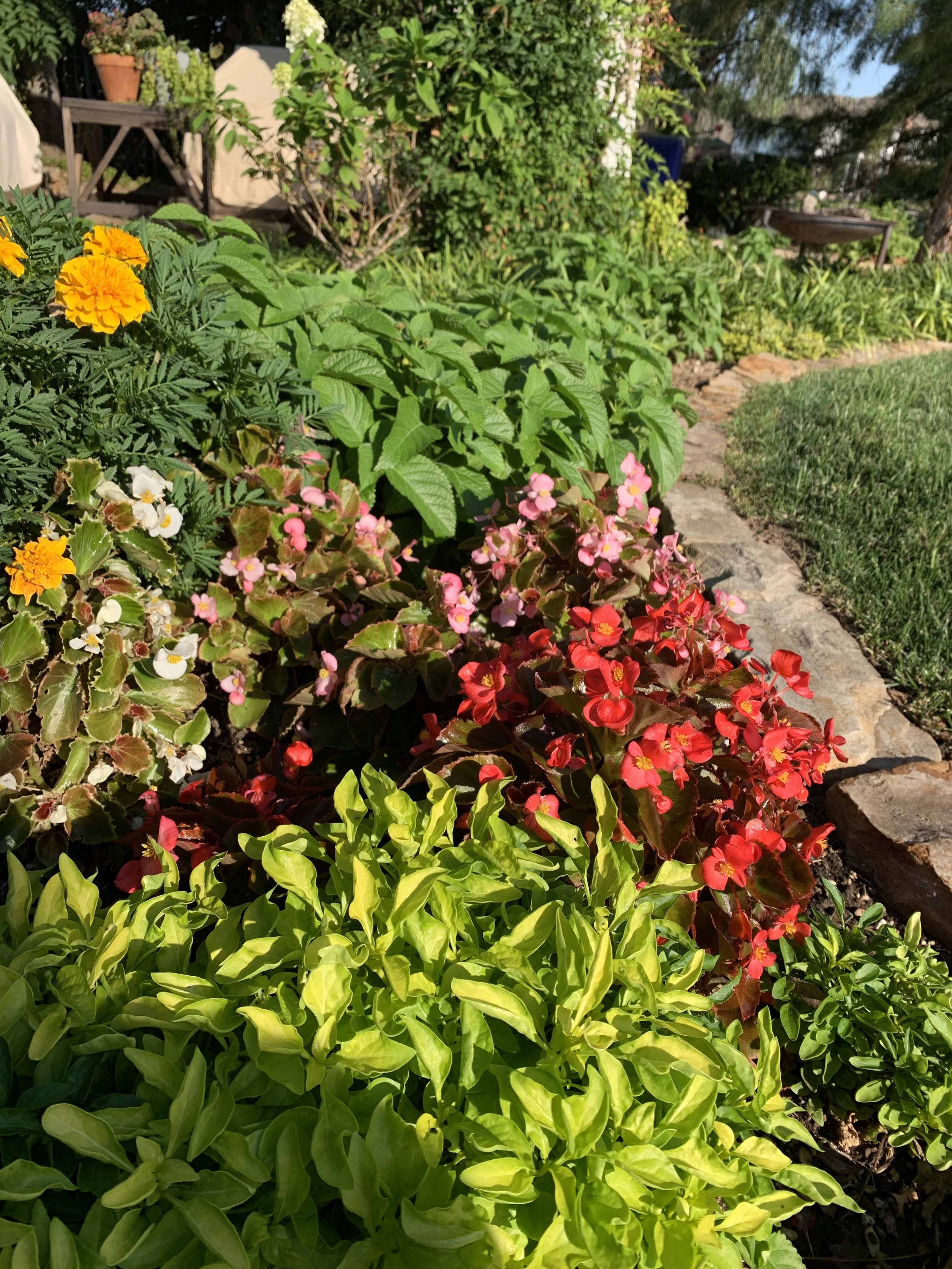
Joseph Coat is a great compliment for the reds of Bronze-Leaf Begonias.

Caladiums behind Impatiens is the perfect combination for shady areas of your landscape.
Annual Summer Seasonal Color
Coleus – Planted for the colorful foliage, it is available in both shade and sun varieties and many colors. Colors range from limy yellow to red with many that have speckled leaves of yellow, green, and red.
Joseph Coat – This low growing, bright yellow-green annual is a great border in full to partial sun areas. It is also available in dark red but is not near as dramatic as the brightness of the lighter variety.
Lantana – You can’t beat lantana in the heat in full sun. Some of the more common varieties are New Gold, Dallas Red, and Confetti. Known for having a bushy growth habit, but there are varieties that are more compact and mounding.

Lantana, one of the best lovers of summer heat, comes in so many colors that there has to be one perfect for your summer landscape.

The dark reds and lime-red of these Coleus varieties make a great combination.
Penta – Another annual plant that thrives in full sun. Bright clusters of star-shaped flowers in red, pink, and white look great planted behind Joseph Coat.
Periwinkle – An old traditional annual plant that just keeps performing. Periwinkle thrives in full sun. White with red center is most common, but it is also available in vibrant pinks, reds, and violets. A good look I have noticed the past two summers is to plant a mixture of periwinkles in varying shades of pinks and reds.

Strawberry Periwinkle, red Penta, Lemon Zest Lantana, Stain Glass Coleus in front of Black-eyed Susan make for a showy mid-summer landscape.

A great combination for shady areas in the heat of summer is Caladiums and Impatiens.

Periwinkle is a summer loving annual that brightens landscapes with vibrant pinks, reds and whites.

Strawberry Periwinkle with a compliment of Black-Eye Susan

Penta will continue to bloom in full sun to partial shade through the hottest days of summer.

The lime color of Joseph Coat is a great compliment to the rosy pink of Strawberry Periwinkle

Lantana, Angelonia, Penta, and Sunpatiens.
Sunpatiens – All the color burst you would expect from impatiens, but they love sun and heat. They come in a wide range of colors. One word of caution: When planted in areas of hot late afternoon sun they do need plenty of moisture to make it through July and August.
Angelonia – It is available in whites, pinks, purples, and blues and very often you will find it mixed. Plant in full to partial sun.

Sunpatiens and Lantana adding color in the summer sun.

Sunpatiens have become a staple for a splash of color in my summer landscape.

Orange Sunpatiens planted with Joseph Coat and yellow Marigolds.
Caladiums – The large colorful leaves make a great show in full or dappled shade. You will find them in red, white, and pink. Caladiums are great at adding a burst of color to shady areas of the landscape.
Impatiens – Another old favorite that is hard to beat in the full shade areas of your landscape. It is available in many colors.
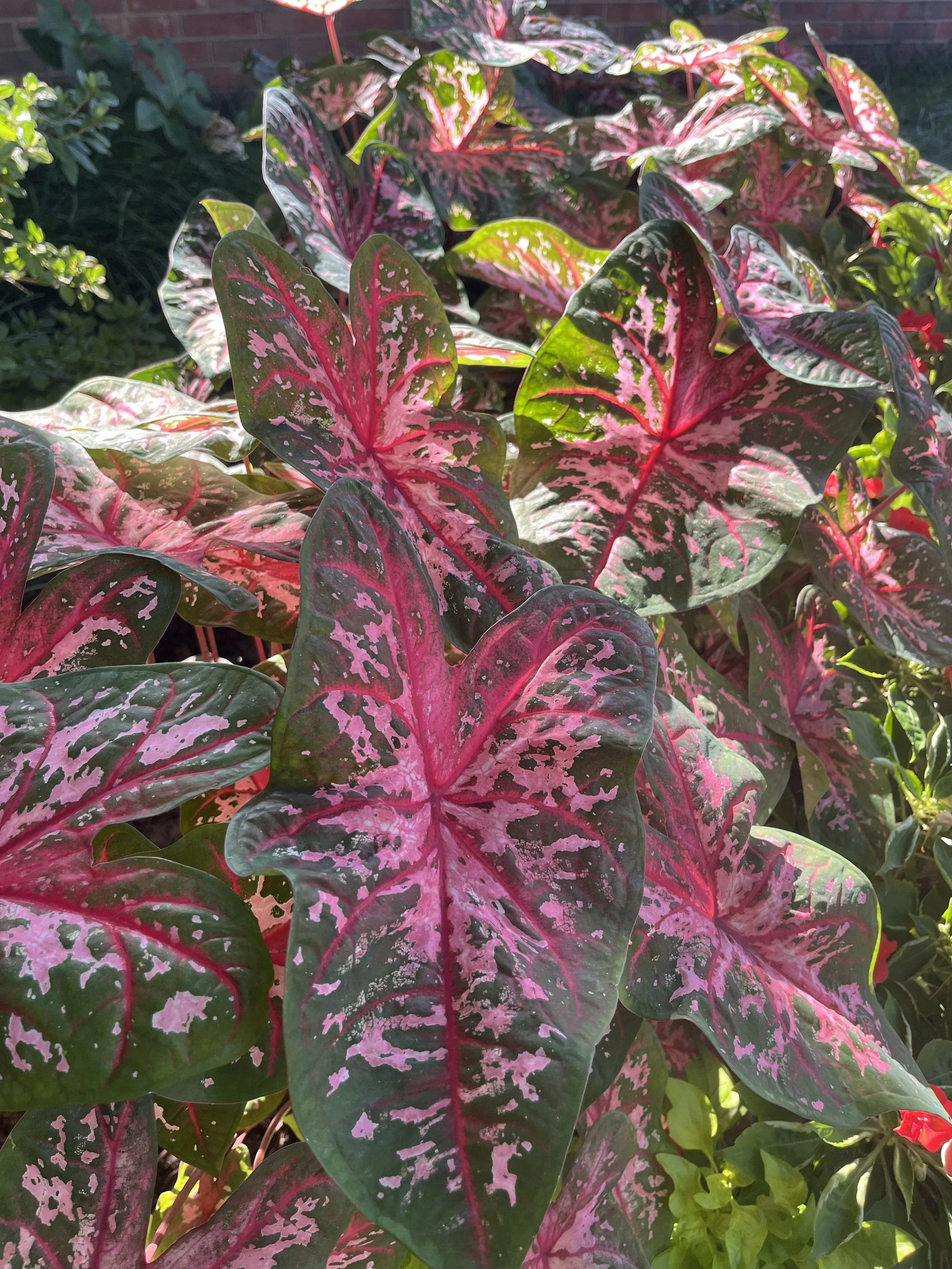
Caladiums, a shade loving summer annual, thrives during the summer.

Lantana, Penta, Angelonia and Sunpatiens adding bright color in the heat of August.
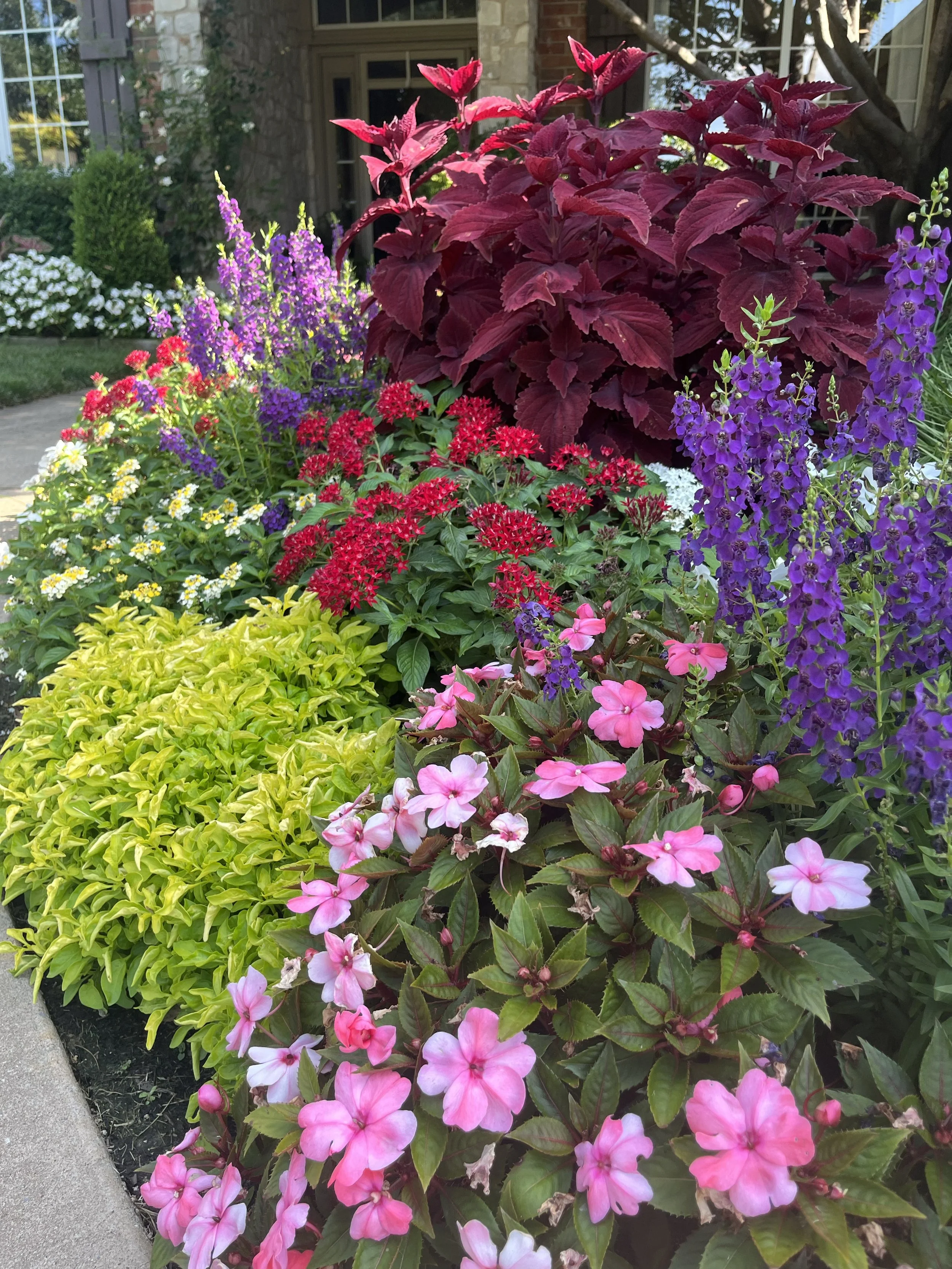
Sunpatiens, Joseph Coat, Angelonia, Penta, and Coleus brighten even the hottest of summer days.
Perennials
Black-eyed Susan – Grows 2-3’ tall with dark green foliage and vibrant golden-yellow daisy type flowers with a dark brown center. Blooming starts in late June and continues into August. Their show in the summer heat is second to no other perennial.
Coneflower – A native prairie plant that puts on a great show through the summer. Each plant will produce several clusters of 2-4” blooms. They are available in several colors, but the purple varieties are my favorite.
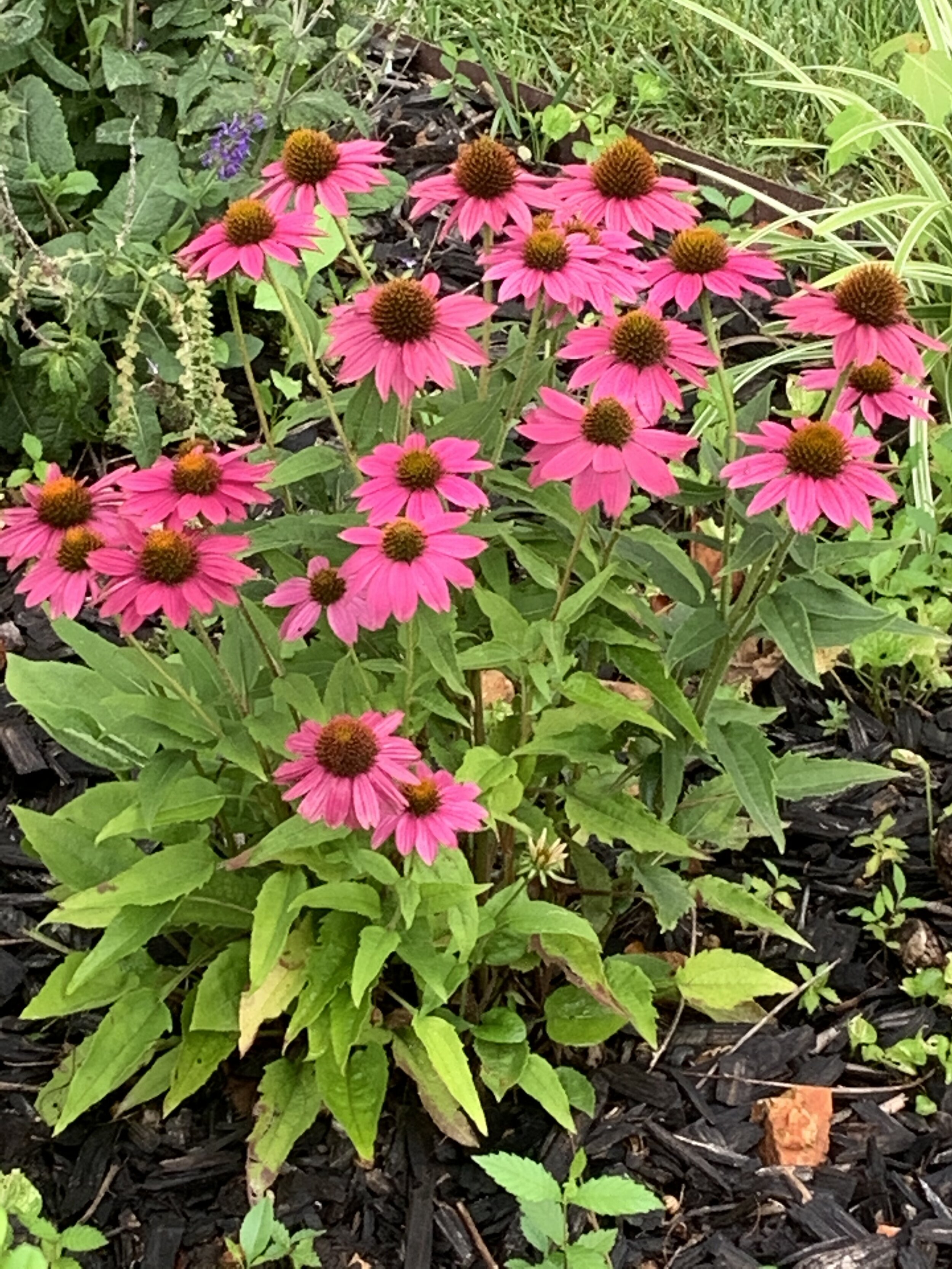
Coneflower add color to the landscape through the hottest times of the summer.

Using the perennial Black-eyed Susan in your landscape will add a splash of yellow through July and into August.
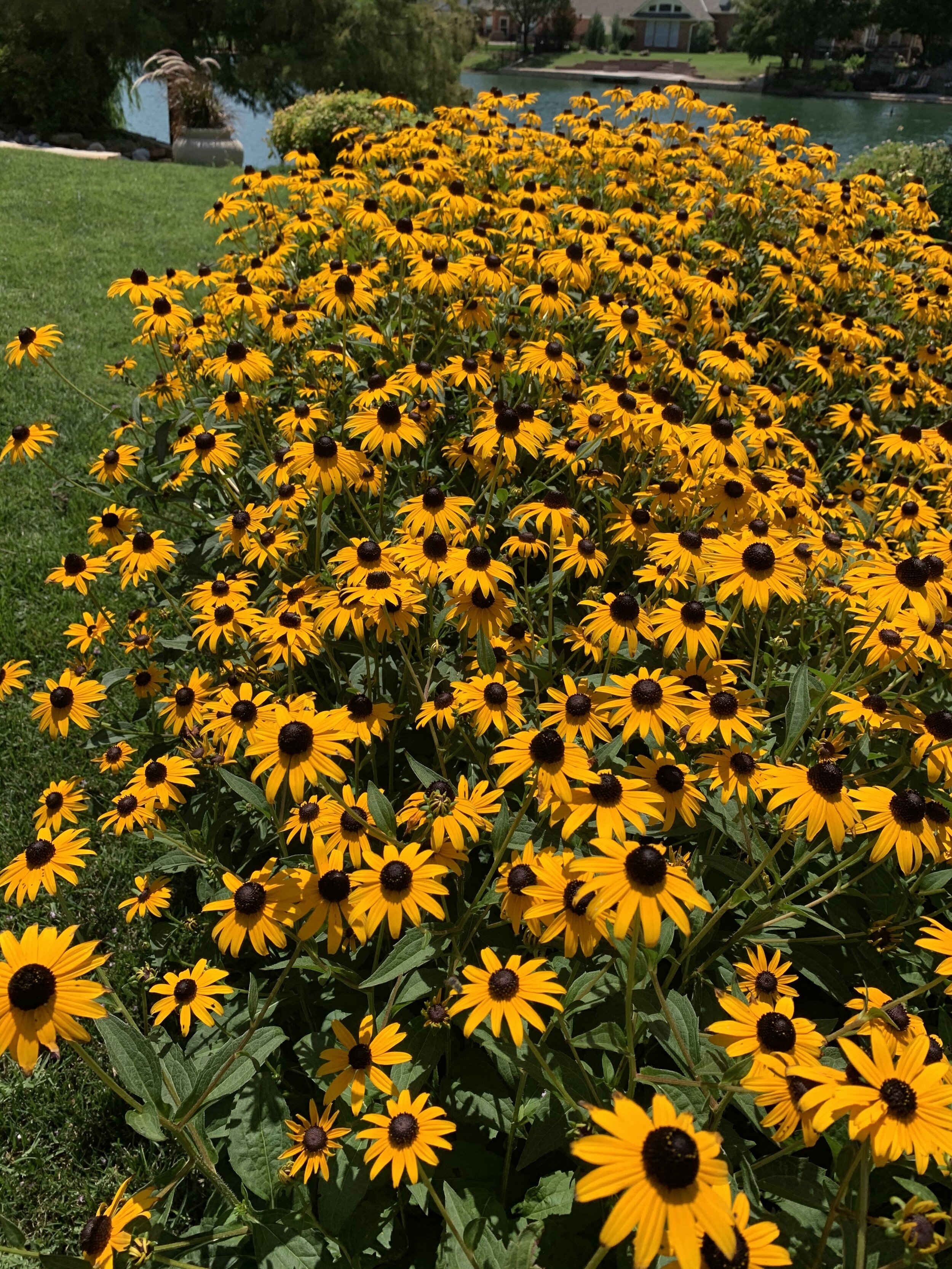
Black-eyed Susans add bold brilliant flowers in mid-summer to our landscapes.

Coneflower is a perennial that blooms in midsummer.

Crape Myrtle, the longest summer blooming plant become more brilliant as the summer gets hotter.

Maybe the hardiest Hydrangea, Limelight, blooms during the heat of midsummer and they do well in full sun. These are planted around a parking lot on the west side of a building.

The large flowers of Hardy Hibiscus are an eye catcher throughout the summer.

Bobo Hydrangea is a dwarf hydrangea that is known for having stronger stems so the blooms don’t flop over as much as typical panicle hydrangea.
Shrubs
Crape Myrtle – I have a tendency to mention them often, but as our longest blooming summer shrub and/or tree they are a must have for your landscape. Varieties come in dwarf (2-4’), semi-dwarf (up to 8’), and standard (up to 25’). Colors range from white, pink, purple and red. It seems that the hotter the summer, the more brilliantly they bloom.
Limelight Hydrangea – A very hardy hydrangea with unique mid-summer white blooms and a slight hint of green. They look great planted in mass, as a hedge or as a single specimen. Also, they do well planted in full sun.
Hardy Hibiscus – A spectacular summer bloomer that will quickly make a dramatic impact to any landscape. Look for newer varieties as they have larger flowers. For most flowers, they need full sun. They are a great addition in a perennial garden or in front of an evergreen hedge.
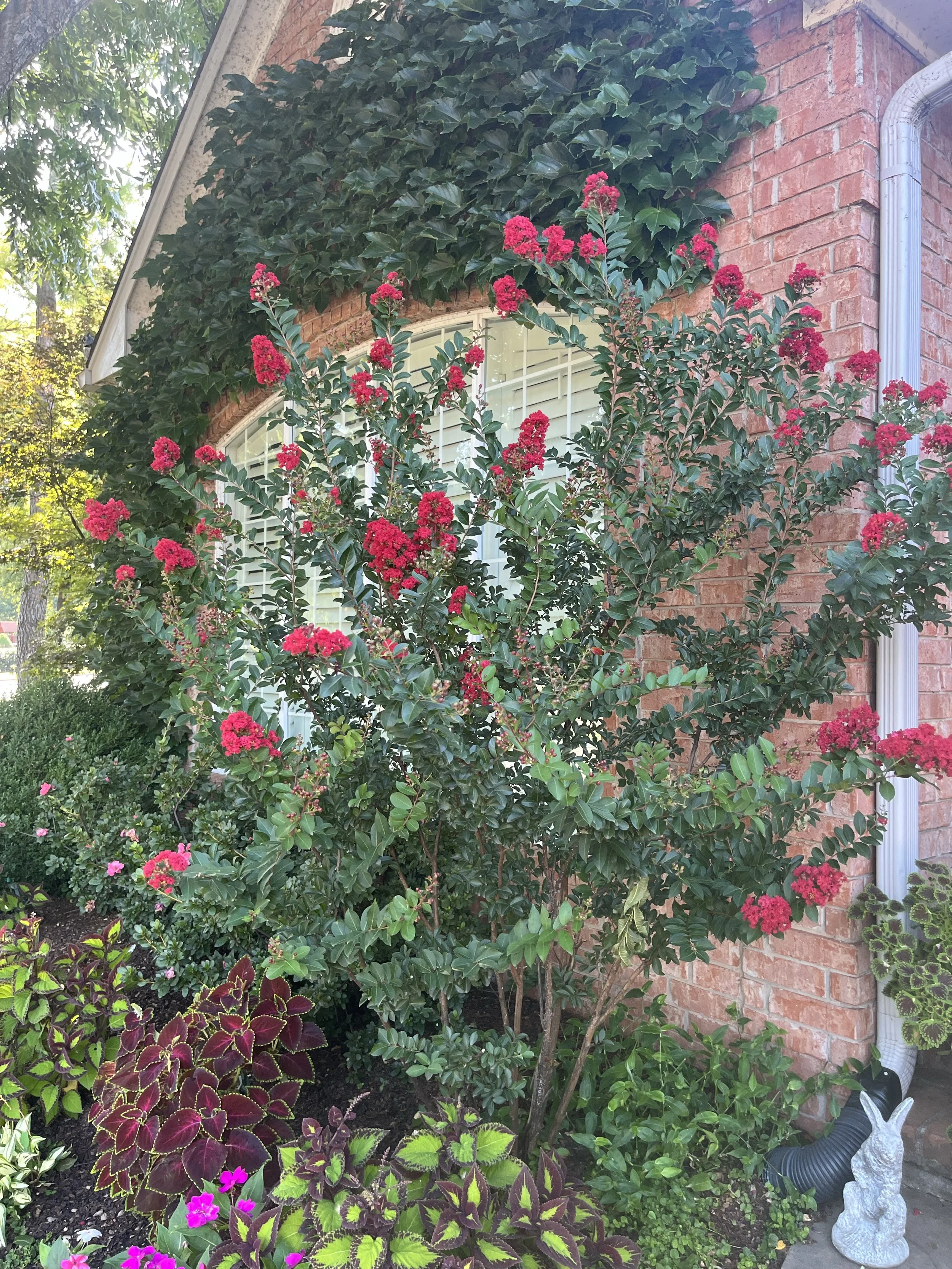
We think of Crape Myrtles as full sun plants, but when planted in dappled sun they add splashes of bright color to shady areas.

Bobo Hydrangeas and Black-eyed Susan both thrive in the summer heat.
Vines
Trumpet Vine – A favorite is the ‘Madame Galen’ variety. Trumpet shaped salmon-red flowers throughout the summer for an extra-long blooming season. Great for covering up fences and climbing arbors.

Madame Galen Trumpet Vine have an extra long summer blooming season.
These are just a few that we have found consistently do well through the hottest summer heat. The fun thing is there are many, many more.
Visit public gardens during the hottest times of the summer to see what is doing great in their landscapes for fresh ideas. The Myriad Gardens, Will Rogers Horticulture Gardens, and OSU’s Botanical Garden are just a few in the area. A favorite of mine is to make an annual visit to the Dallas Arboretum and Botanical Garden to see what is doing well in the heat of north Texas.
Don’t be shy. Stop at that house with the best summer color in your neighborhood and ask what they are growing!
Experiment. Try something new and different. Who knows, maybe you will stumble onto something that is just perfect for your landscape.
Share what is doing the best in your landscape. We want to know what is putting on a show this summer in your landscape. And, I’m sure everyone else wants to know too.
Lorne Hall
Hall | Stewart Lawn + Landscape LLC
(405)367-3873
Fescue’s Summer Off Season

Question: What is one of the best things about living in Oklahoma?
Did anyone say: Living in the transition zone?
I’m guessing that was no one’s answer.
What is the transition zone? It is the area across the middle of the US between where warm season turf grows in the south and cool season grasses grow in the north.
The Transition Zone is the area of the country you can choose to grow either warm season or cool season grasses.
Bermuda is the common warm season turfgrass in our region. The advantage bermuda has is it loves the summer heat and as long as it receives moisture, it will be at its best in July and August.
Fescue is the cool season option. Fescue tolerates more shade and stays green nearly year-round. You can’t beat the deep rich color in the spring and fall. Fescue stays green well into December, often keeps some color through the winter, and as soon as the winter starts to break in early March, fescue bursts back to life.
Both have their off seasons.
Bermuda’s off season starts in November and continues until April. During this time, it goes fully dormant and turns straw-brown for months.
When is fescue’s off season?
Yes, fescue loses its green color in the winter and stops growing. So, yes, fescue has an off season in the winter, but much shorter than bermuda. Fescue goes through another slump in July through August when temperatures above 95 degrees are common. During fescue’s summer off season, growth slows and the color isn’t as intense. But, when a fescue lawn is healthy and growing under the best conditions, the summer off season is barely noticeable.
In April, customers with bermuda lawns often ask why their lawn isn’t as green as the fescue lawns on their block.
And, right now with 10 consecutive 90+ degree days, customers with fescue lawns are asking questions about why their fescue isn’t looking as good as it did in June.

Fescue lawn with dappled sunshine.
July through August is fescue’s second off season while bermuda is at peak season!
Bermuda will always have more color than fescue in July and August, but March through June and again October into December, fescue will always win the color battle.

Fescue when watered and mowed properly in full sun in the heat of the summer.
How do you keep a fescue lawn looking its best in the summer heat?
Let’s run through a list of best and worst practices for fescue during its summer off season.
Best practices for keeping fescue looking good during July and August:
Mow fescue at 3” – 3 ½”. The more leaf space the better color and the more drought tolerant the lawn will be.
Water deep. Water infrequent. Water in the early morning. Fescue lawns that are receiving 1 ½” of moisture per week, on an every other day schedule, only in the morning, look the best in the heat of summer.
Fescue lawns that receive at least some dappled sunlight and are in areas of good air circulation look the best during the summer heat.
Fescue lawns that are aerated in the fall have stronger root systems and can better withstand hot, dry days.
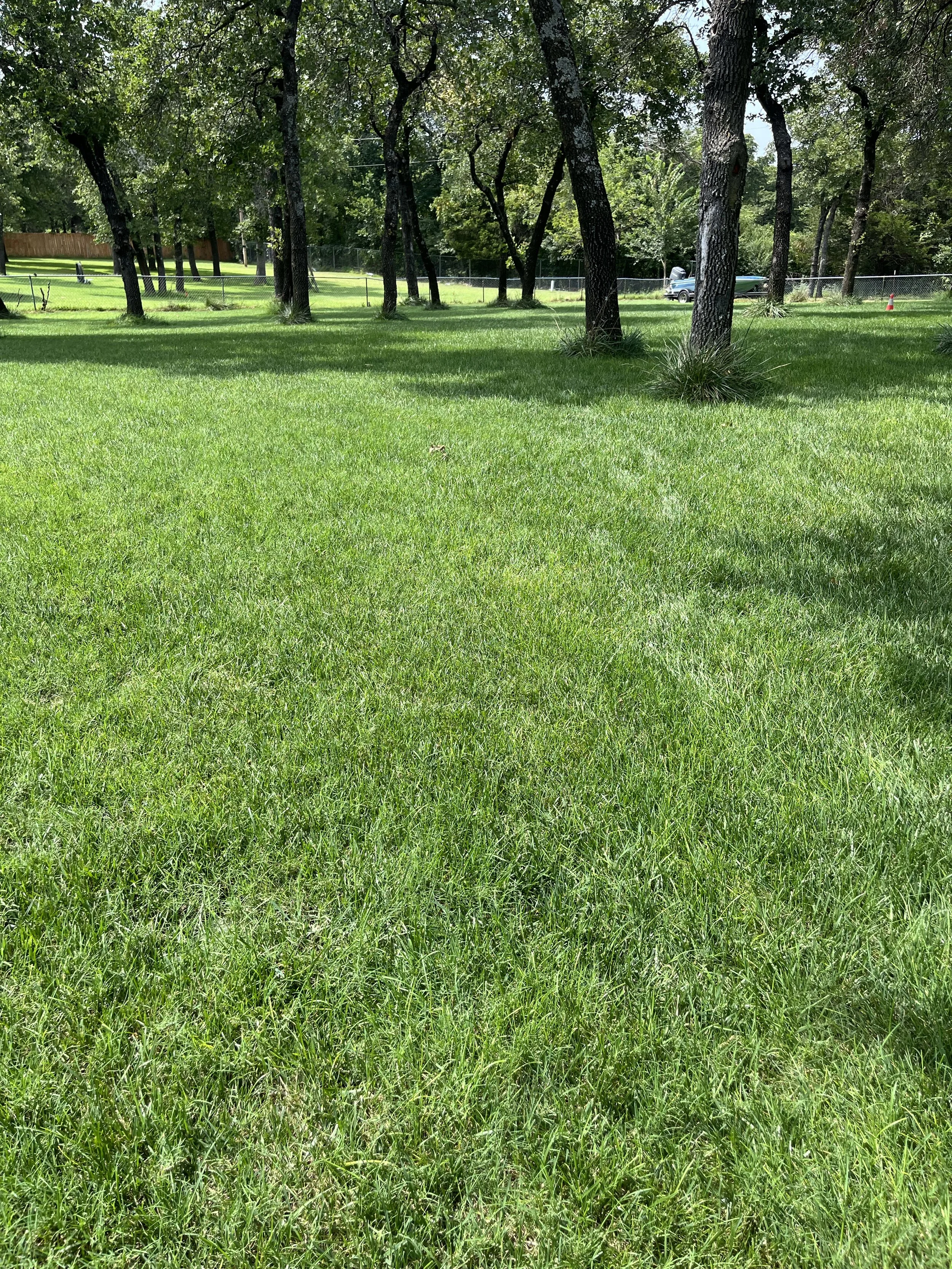
A properly watered and mowed fescue lawn last year during the first week of August.
Worst practices for fescue during the summer heat:
Don’t over water. Short, frequent watering does far more harm than good. It is a myth that fescue needs watered daily during the heat of July and August. When temperatures are hot and fescue stays wet for more than 6 hours at a time, brown patch will damage the turf. When brown patch starts spreading in a fescue lawn, it looks like the lawn needs more water. The natural response is to water more which makes the problem worse. It is common when making site visits where customers are concerned about their fescue to discover brown patch is the problem. Often the homeowner has increased watering to two times per day, morning and evening, every day trying to keep the fescue alive, all the while making it worse.


Brown patch in fescue.

Fescue with a mild case of brown patch.
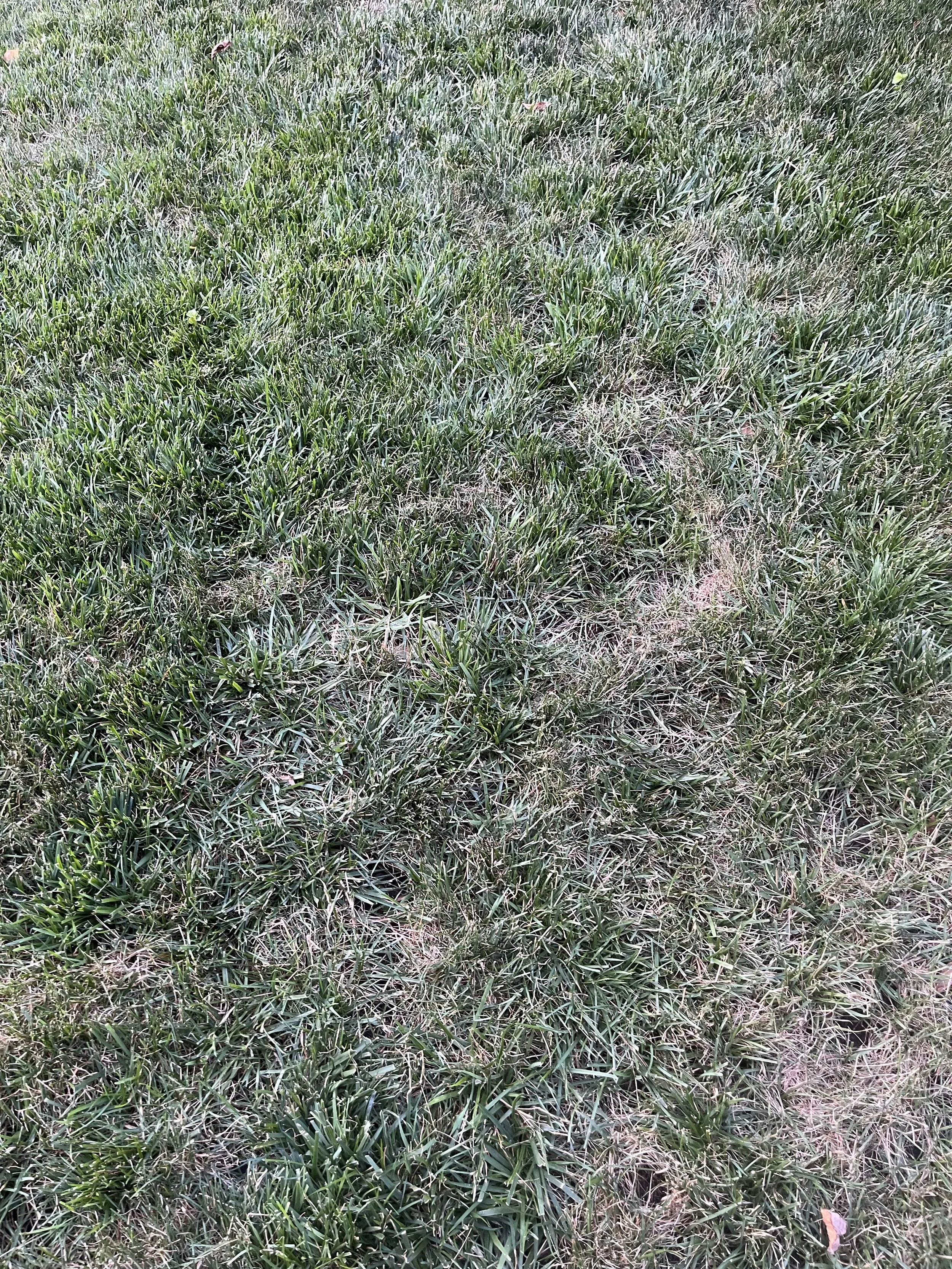
Brown Patch is a result of fescue staying too wet when temperatures are warm. This year has been a perfect season for brown patch to flourish. Now that we have received two weeks of 95+ degree weather, areas weakened by brown patch in June are starting to show stress.
Heavy shade and low air circulation. Fescue performs best if it receives some sunlight every day. Fescue will tolerate more sun than most realize and does well in full sun when it is watered and mowed properly. Air circulation plays the important role of drying the leaf blades between watering cycles. Small backyards, privacy fences, and heavy shade are the hardest on fescue in July and August. This week Hall | Stewart Lawn Care Specialists have visited several fescue lawns with good air flow and dappled sun resulting in healthy fescue with good summer color while in the same lawn there is thinning/fading fescue in areas with low air circulation and deep shade.
Fescue cut too short. Remember leaf blades store moisture the plant needs to withstand the summer heat. Fescue survives through July and August best when it is cut at 3” to 3 1/2”. Every fescue lawn I have seen this week that is being maintained below 3” is struggling. If your fescue is less than 3” tall, don’t mow again until it reaches 4”, then remove only ½” to 1”.
Tight clay soil that has never been aerated resulting in shallow rooted fescue that will struggle in the heat.

Drought stressed fescue.

If your fescue is losing a lot of color check the soil. If it is dry, increase water by deep soaking in the morning every other day. If the soil is moist, then the problem is brown patch.

Fescue seeded over Bermuda in full sun in the heat of the year.

Fescue in full to dappled sun in July.
During fescue’s offseason, take a stroll around your lawn and start planning for the fall. The cooler days of September will be here soon.
Do you need to make some changes to how you are mowing and watering your fescue?
Are you trying to grow fescue in full shade, in a location where there is little wind movement?
If so, can you improve the conditions, or should you consider transitioning to a shade tolerant ground cover?
Or, are you OK with knowing the area needs to be overseeded with fescue every fall, will look wonderful for 9-10 months, fade for a couple of months, and then repeat the cycle again after fall overseeding?
If your fescue didn’t perform well due to the excessive moisture and high humidity of the early summer, or if it has struggled with brown patch in the heat, start making plans to overseed this fall.
Do you have areas of the lawn that are becoming too shady for bermuda? Bermuda starts to thin anywhere it does not get at least 6 hours of direct sunlight every day. Is this the fall to start establishing fescue in those areas?
Whether you have a full fescue lawn, or just some fescue in shady areas, don’t fret, fescue’s best season is just a few weeks away!
Lorne Hall
Hall | Stewart Lawn + Landscape
(405)367-3873
Good Mowing Practices Make a Big Difference!

Great lawns are the result of well-timed lawn care applications, perfect weather conditions, and proper maintenance practices.
As we approach the midpoint of the summer growing season, mowing practices are often the determining factor on the difference between a good lawn and a great lawn.
Unfortunately, as the summer routines wear on, good mowing practices are often overlooked as we slip into a routine of just getting it done.
When it comes to a great lawn, mowing practices are more important than the fertilizer you use, the weed control applications that are made, and the amount of water used.
Getting mowing right comes down to three critical practices: mowing height, mowing frequency, and managing the clippings.

Fescue is at its best when it is cut between 2.5” to 3.5”.
Mowing Height
Grasses adapt well to various mowing heights, but there is a direct relationship between mowing height and a healthy turf. As the height of the grass is increased, the root system increases. As the height is lowered, the root system decreases. A taller turf yields a healthier root system and a lawn that will withstand more stress. And, as the height and density increase there is less room available for weeds to germinate and grow.
Optimal cutting heights vary based on the type of grass and the time of year. All turf grass should start the season low and gradually increase in height over the course of the summer. The goal is to have your lawn at its thickest and tallest height during the heat of summer.
Fescue is at its best when it is cut between 2.5” to 3.5”.
Bermuda is best maintained between 1.5” to 2.5”, but Tiff Type Bermuda should be maintained shorter, .5” to 1.5”.
Areas of shade need to be mowed at the maximum height. The increase in leaf space will allow the plant the best possible chance to survive in the lower light.
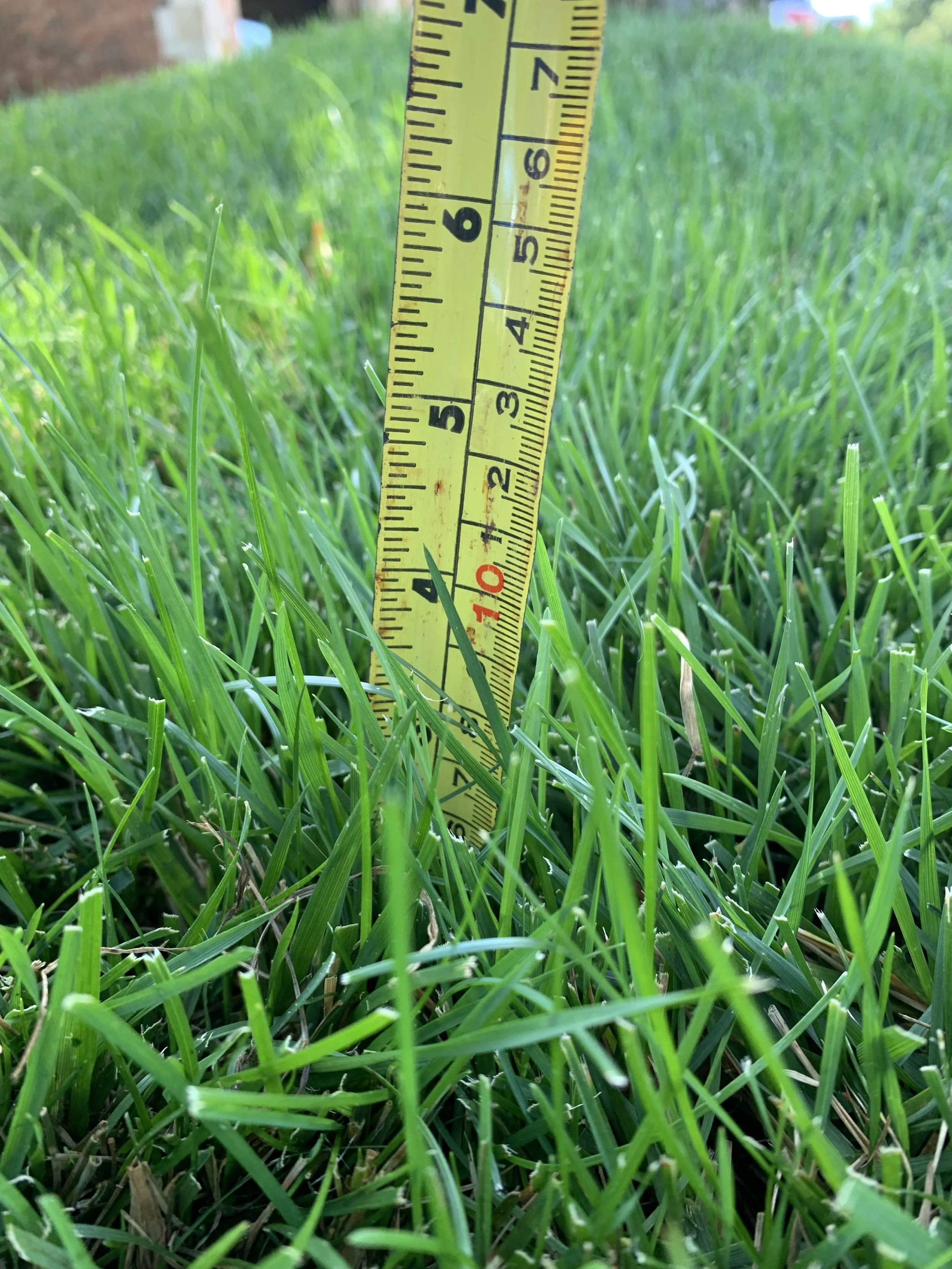
A best lawn maintenance practice is to not remove more than 1/3 of the leaf blade when mowing.
Currently I’m trying to maintain my fescue lawn at 3”.
Yesterday with the fescue reaching over 4” it was time to cut it back to 3”.

Bermuda is best maintained between 1.5” to 2.5”.

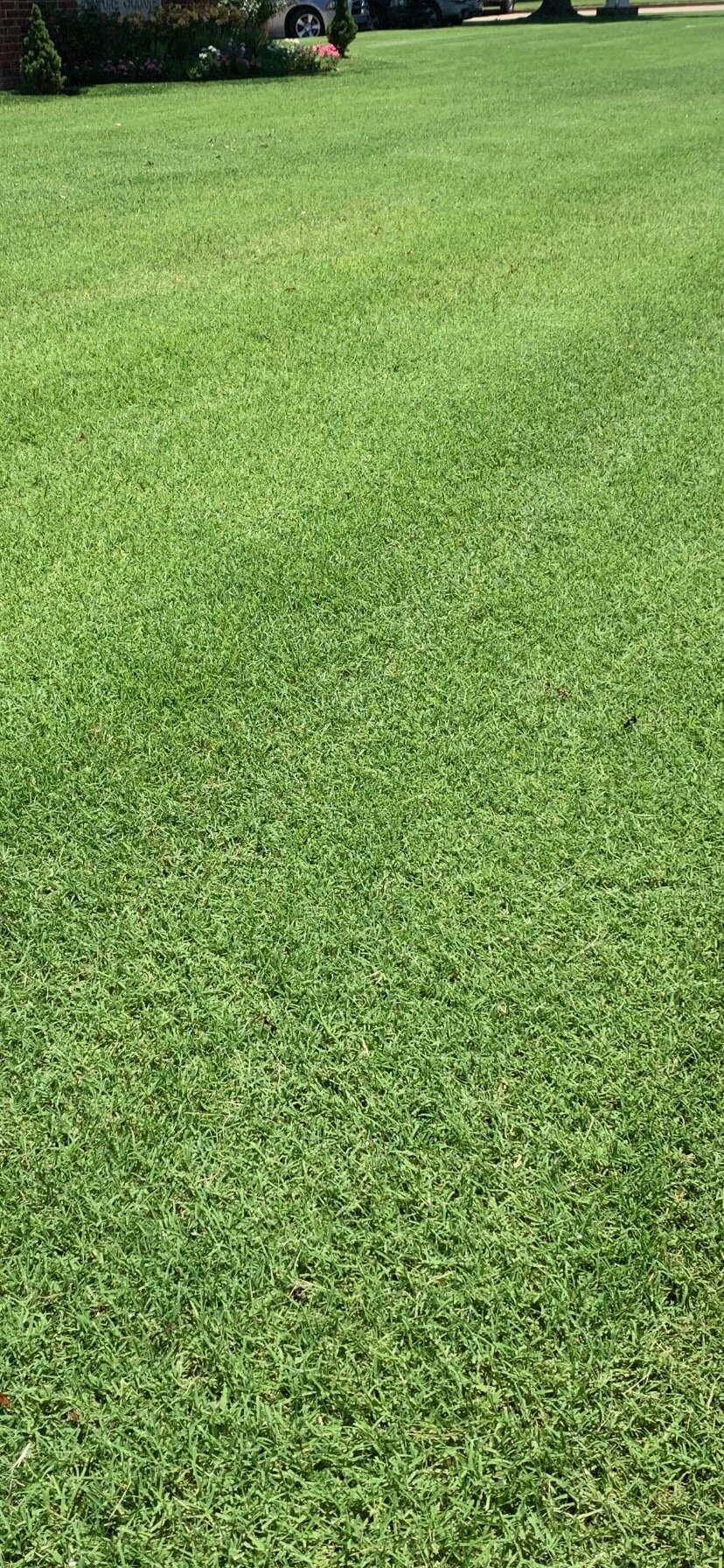
Mowing Frequency
Probably the biggest hindrance to having a great lawn is mowing on a schedule, not on need. Most people mow their lawns once a week during the growing season. We all understand why. We are busy and our only opportunity to mow is on our day off. Or, you may have a landscape management company that mows the lawn once per week.
But, for the absolute best lawn, mow based on the 1/3 rule rather than a set schedule. For example: If you desire to maintain your fescue at 3”, you should never let your lawn grow over 4.5”. If you want to keep your Bermuda lawn at 2”, then you need to mow before it exceeds 3”, not just because it’s Saturday and you always mow on Saturday.
Whenever you remove more than 1/3 of the grass in a single mowing, you are cutting below the plant leaf and into the stem. If you see yellow or brown areas after you mow, you are cutting more than 1/3.
Turf grass research shows when you cut into the stems the plant responds by using nutrients stored in the root system to regenerate leaves. This reduces the strength, health and density of the root system and results in a weaker turf.
What should you do when your lawn becomes too tall, and you need to cut off 50% or more to get back to the desired height? Cut 1/3 off, wait a couple of days and then cut another 1/3 off. Repeat until you reclaim the height you desire.
There is no doubt that frequent mowing at a uniform height, whether short or tall, is one of the most important aspects of having a great lawn.

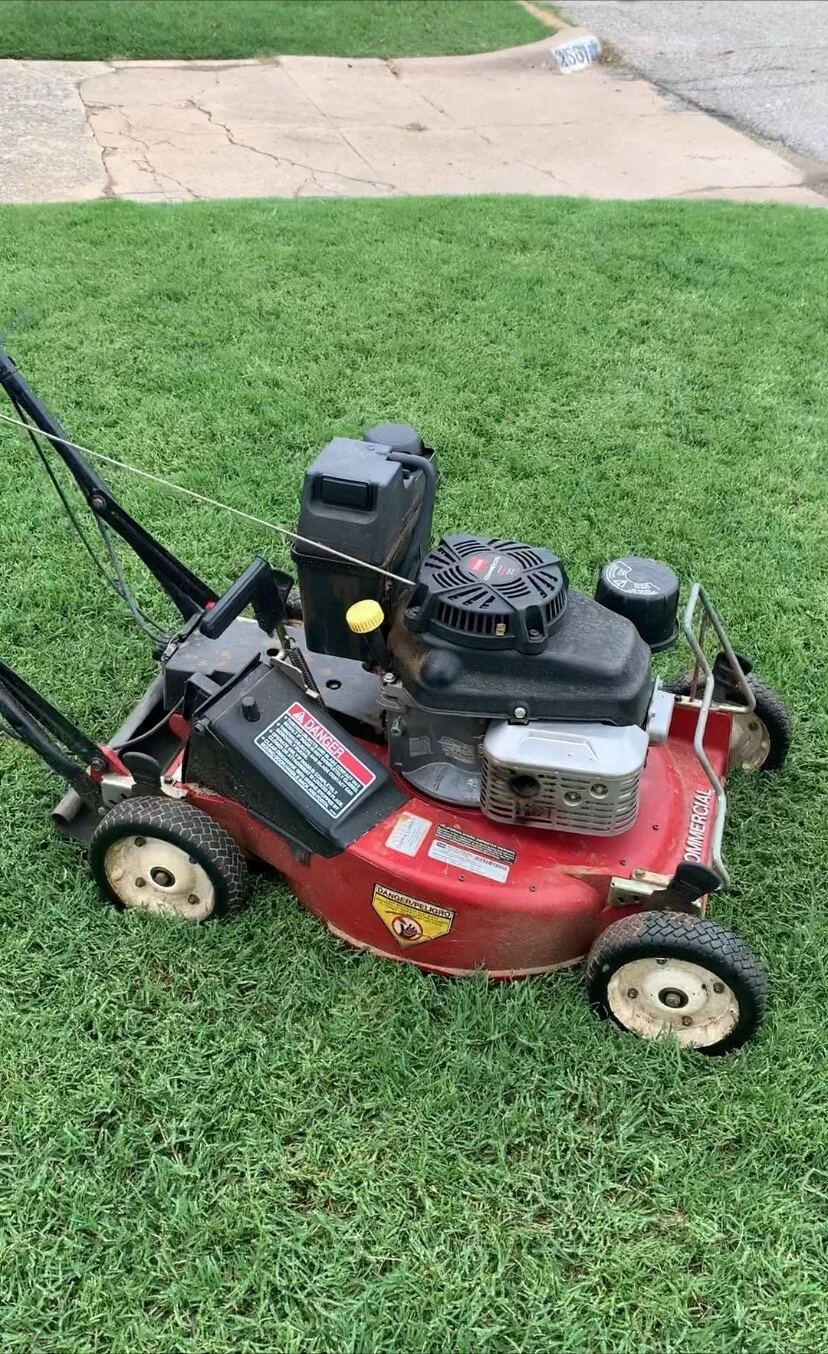
Mowing with a mulching mower will return valuable clippings to the lawn. Grass clippings are mostly water and nitrogen.
Managing the Clippings
When you are able to mow frequently using the 1/3 rule, I recommend not catching the clippings. Turf grass leaves are 80-90% water and nitrogen. Grass clippings decompose very quickly and add nutrients back to the turf.
Not bagging your clippings is a major step in improving your lawn’s quality.
When you bag your clippings, you throw a little of your fertilizer away every time you cut the lawn.
Most years, I bag my fescue lawn a couple of times per year, the first time each spring and September when I cut the lawn short in preparation of overseeding. So far this season I have managed to dodge the rain interruptions, stay on my typical 4-to-5-day mowing habit and my mower’s grass bag has remained in the garage since the first cut of the season.
A common belief is that when you don’t bag your clippings you are increasing thatch buildup. As long as you are only cutting the leaves and not the stems, thatch will not become a problem.


Mulch mowing will not only return nutrients to your lawn, it will also return moisture. This picture was taken during a heat wave and drought. At this point the lawn was being watered deeply every 4 days, cut at 3”, and mulch mowed.

Two Important Bonus Practices:
1. Mower blades should always be kept sharp. Dull blades bruise the leaf resulting in frayed leaves and a duller lawn appearance.
2. Vary your mowing pattern throughout the season to reduce soil compaction. Changing your mowing pattern will also improve turf appearance. I recommend rotating through at least three different mowing patterns. For example: mow parallel to the street, the next time mow at a 45-degree angle, followed by mowing perpendicular to the street or at the opposite 45-degree angle.
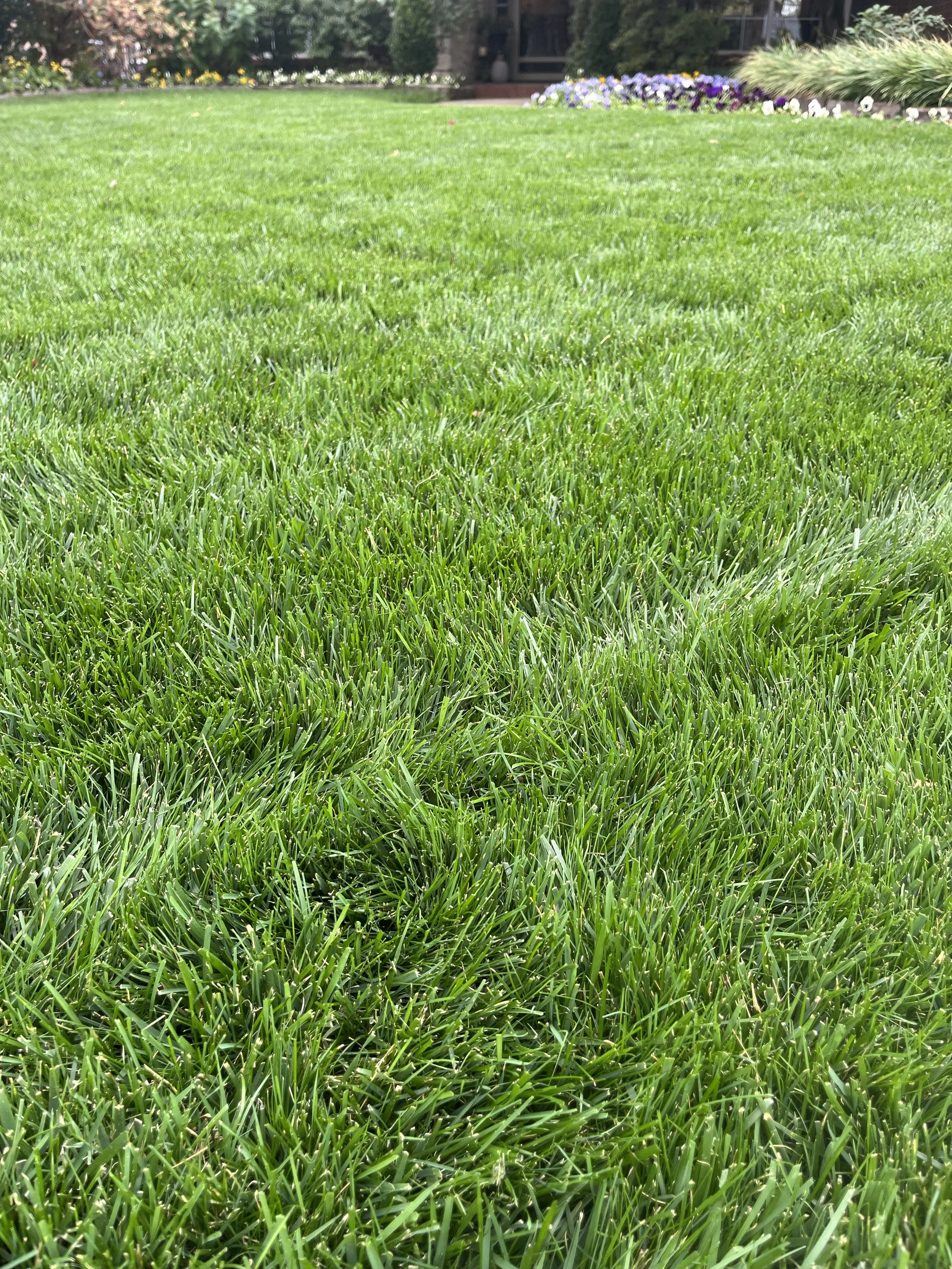

Changing the mowing pattern will reduce soil compaction and improve turf appearance.
Lawn mowing is the most time-consuming landscape practice.
It has to be performed more frequently than fertilizing, weed control, bed weeding, shrub trimming, and flower planting.
It is easy to allow mowing to become just another task that has to be done. But, a properly maintained lawn is well worth the time and effort.
Nothing adds more curb appeal to a property than a well-groomed lawn.
Lorne Hall
Hall | Stewart Lawn + Landscape
(405)367-3873
The Return of the March of the Army Worms

This week has us feeling as though we are living in a sequel of 2021’s March of the Army Worms.
We mentioned army worms last week in our post “What’s Bugging Your Landscape”, as a turf damaging insect you should always be on the lookout for this time of the year.
You can always find a few army worms in the summer and fall. And like most insects, when populations are at normal levels, they are not a problem, and you may never notice them. But, when conditions are just right, you can see an explosion to turf damaging levels in a matter of days.
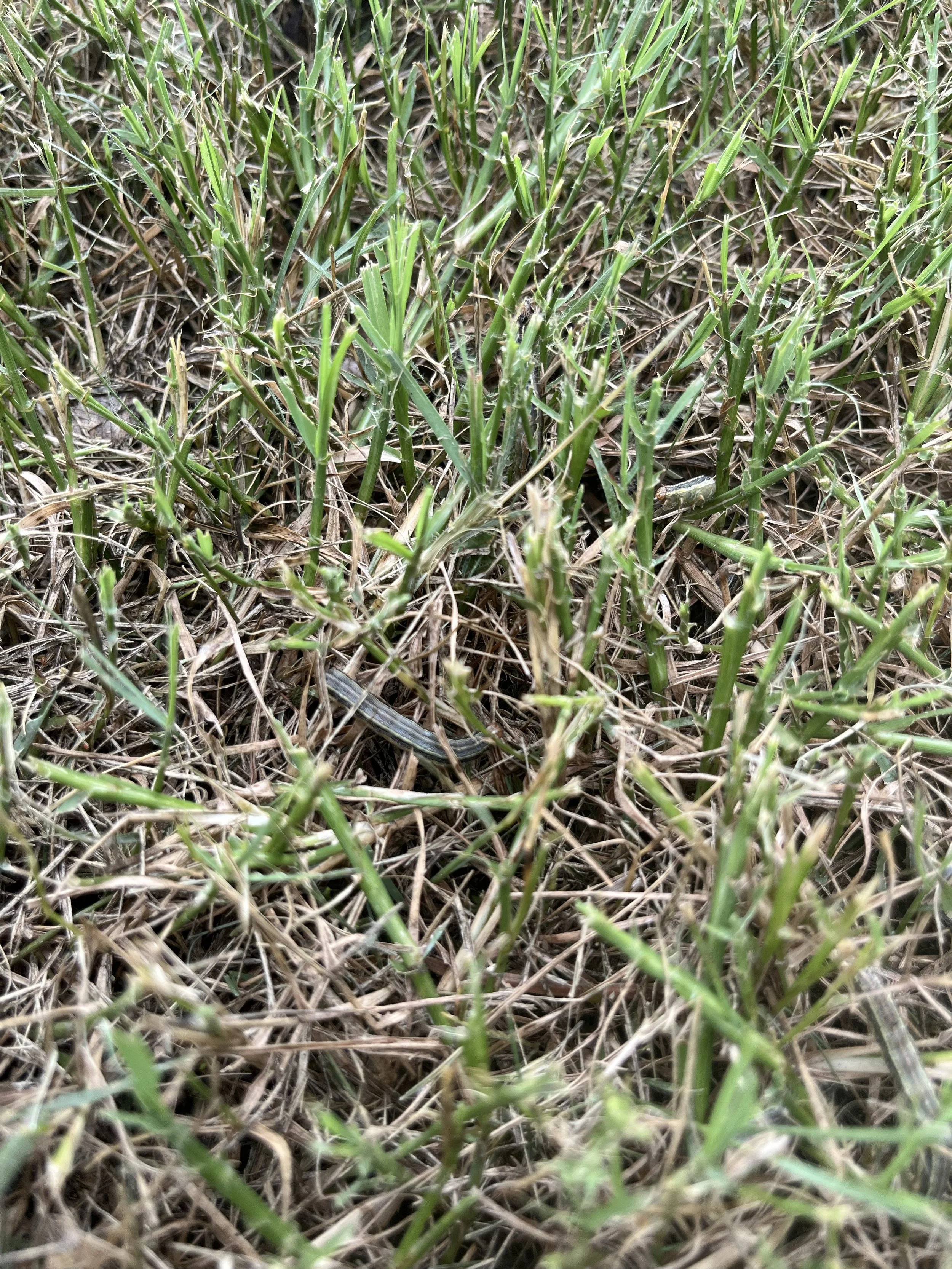
An army worm discovered Saturday feeding on a rural Edmond lawn.
What are the conditions that make us feel as though we are living in 2021 again?
Army worm eggs and worms have a higher survival rate when there is abundant moisture. Over the last 30 days, we have received 7” of rain. In 2021, during the same period, we also received an abundance of rainfall.
The first sightings of damaging army worm populations in 2021 were on the perimeters of the metro. With each generation of army worms in the summer of 2021, populations increased and lawn damage increased deeper into urban areas. This week, army worm activity was heavy around the perimeter of the metro area.

The mature Army Worm is 1 1/2” long, green to brown in color, with stripes down each side.
What is an army worm?
The adult form of an army worm is a light gray-white moth with mottled wings with a 1 ½” wingspan. Because army worms do not overwinter in our climate, the moths migrate from the Gulf Coast and Mexico each year arriving in our area in late June.
Each moth can lay over 1,000 eggs.
By early July the first generation of eggs have hatched, and the caterpillars go on a feeding frenzy that lasts 2-3 weeks.
Early caterpillars are green and very small and don’t cause any damage until they reach 1”. Quickly, they grow into a brown, almost black, 1 ½” long caterpillar with black and reddish-brown stripes on each side of the body and small black spots on the top. Their distinctive mark is an inverted “Y” on the front of the head.
At the end of the 2-3 week feeding period, the worm burrows 1” into the soil and enter the pupal stage. 7-10 days later they emerge from the soil as a moth and the life cycle starts all over.
The average entire life cycle lasts about 28 days. There can be 4 to 5 overlapping generations from July through early November, or until we have our first hard freeze.
Again, army worms are always present in our summer lawns and landscapes. When populations are normal, you may never know they are there. But, with the right conditions we can see an explosion to turf damaging levels in a matter of days.

How many Army Worms can you see in this picture? Their green to brown color makes them hard to spot.

While standing in this area while Army Worms were actively feasting, I had the sensation that the lawn was moving moving.
What is the typical host plant?
The army worm feeds on a wide variety of plants. They prefer any leafy, soft plant with plenty of moisture in the leaf. They love alfalfa and bermuda hay fields and all turf grass varieties.
For home lawns in our area, typically by the time we get to July, bermuda lawns are looking their best and fescue lawns are starting to enter their summer off season. So, it is common for army worms to prefer bermuda lawns over fescue lawns. In 2021, fescue lawns were thriving in July due to the abundance of moisture and cooler than normal temperatures. At the same time bermuda lawns were lagging behind. The result was lawns where army worms wiped out the fescue and skipped the bermuda completely in favor of moving to another lawn with fescue. So far this summer with both bermuda and fescue both doing well, army worms are feeding on both types of turf.
If you have a healthy, growing, green turf of any variety, your lawn may be a host location for army worms.
Will army worms kill a lawn?
Army worms are primarily surface feeders. Small to moderate infestations will consume the leaves of the plant and the lawn will recover over time with sufficient moisture and fertilizer. In large numbers, the worms will consume the crown of the plant and are capable of killing a lawn.
How do you know if you have army worms?
Because of how widespread and large the current population is, daily or at least every other day, inspection of the lawn is important. Early detection is the best control.
When army worm population are high, you may only have to look at your sidewalks to see them marching to the next blade of grass.
Early signs of army worm damage will appear as drought stress. Don’t dismiss areas that you think may just not be getting enough water.
Stand in the area that looks stressed. If the population is heavy enough, you will have the sensation that the grass is moving.
Still not sure? Get down on your knees and inspect the area. Because of their green to brown color, the worms can be hard to spot while standing.
Still don’t see any worms? Test the area with a soap flush. Mix 1 teaspoon of a lemon scented dish soap in 1 gallon of water. Pour over the area. If you have army worms, they will come to the surface. 2 to 3 worms per square foot, you need to treat.
Army worms feed heaviest in the evening, night, and early morning. They often are hard to find in the middle of the day.
Another clue you may have an army worm problem - Have you noticed an abundance of moths while walking across your lawn?

Take a stroll around your lawn today. If you see an abundance of moths you need to treat your lawn for army worms.

Check leaf blades in areas where the turf is browning. If your blades look like this one with jagged edges, you have Army Worms.

How important is frequent inspection? I mowed my lawn on Thursday. This area of the lawn always struggles with brown patch in the heat of the year because of low air circulation. Yesterday afternoon I walked the lawn checking for declining areas When I got to this area it looked a little worse than it did two days ago. Then I saw something move. Being late afternoon I couldn’t find any army worms even on my hands and knees.

I decided to do a soil drench with soapy water. I mixed a teaspoon of scented dish soap in one gallon of water.

I slowly poured the water in a one to two square foot area.

If there are army worms in the area, they will begin to move after the soapy water solution is poured over the area.
How do you control army worms?
A quick response is important. Army worms can wipe out a football sized lawn in 2 days.
Treatment when worms are small before they become heavy feeders is best. The army worm consumes 80% of their total consumption in the last two days of their worm stage.
Any insecticide labeled for caterpillar control in turf will be effective.
When making any application remember, the label is the law. Always read and follow all label instructions.
After treatment, keep up regular inspections. With a 4-week life cycle and overlapping generations, they continue to be proactive in watching for increasing populations of army worms.
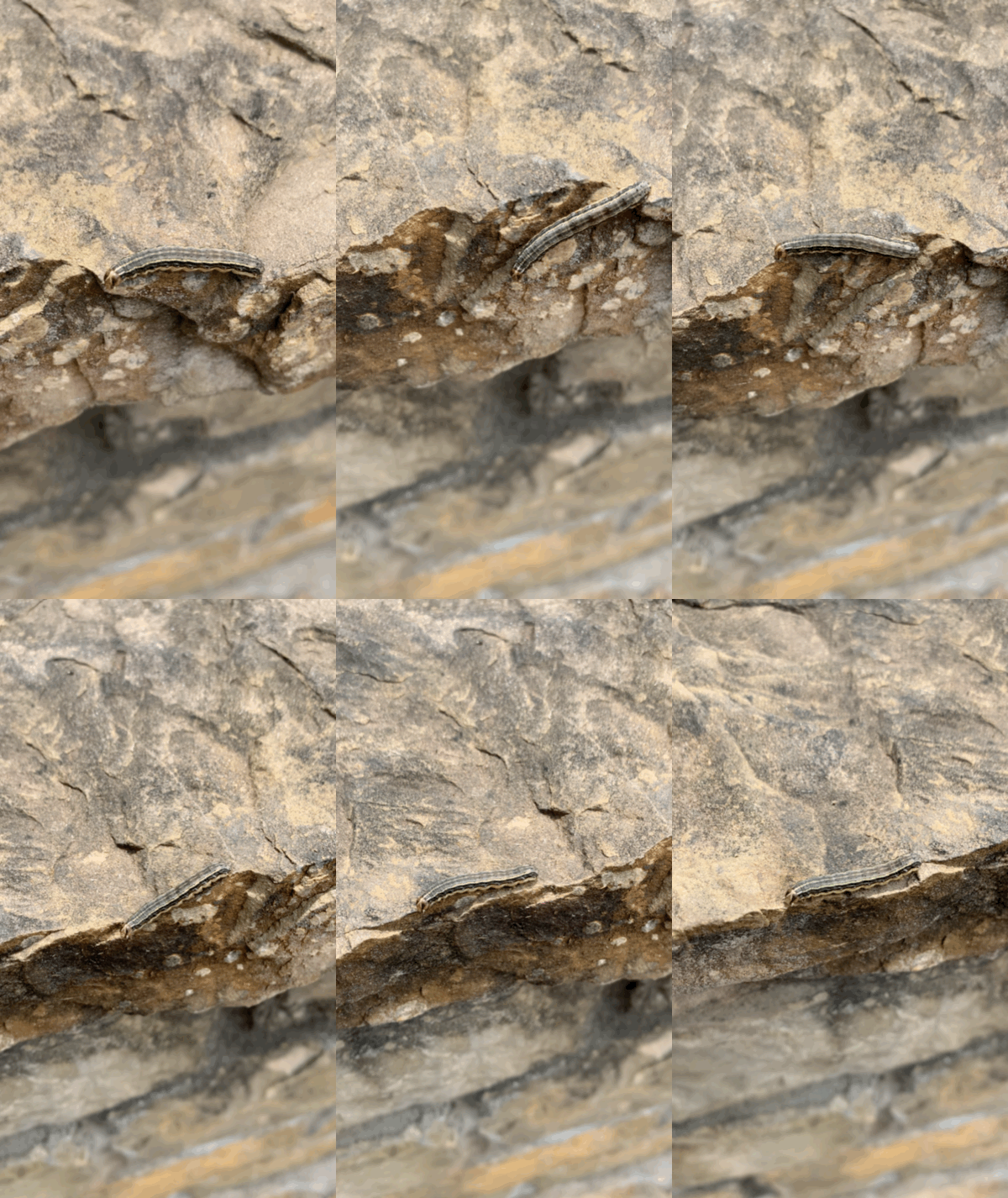
Army Worms are fast movers.

This spot in a bermuda lawn appeared to be lack of water, but while inspecting the area I discovered army worms.

This bermuda lawn had a similar browning area as the last lawn. But after not finding any worms, I checked the irrigation and discover a head that was not working and the discoloration was a watering issue.
Will your lawn recover?
If the worms only eat the leaves, the lawn will recover. If they destroyed the crown, there is a possibility the lawn will not recover.
If you have a bermuda lawn, continue normal watering and fertilizing. There is still time for the lawn to return to a healthy condition before the end of the growing season.
For fescue lawns, recovery will be slower and will be delayed until we see cooler temperatures. This is already the most stressful time of the year for fescue. The best time to reseed fescue is September through October. If you experience army worm damage on your fescue lawn, plan on overseeding this fall.
Inspect your lawn today!
If you see any signs of army worms or turf damage, call (405)367-3873 or respond to this email.
Lorne Hall
Hall | Stewart Lawn + Landscape
(405)367-3873
One Easy Way To Make A Big Difference In Your Lawn - Don’t Bag Your Clippings!

You may have heard me tell this story before, but it is worth telling again:
The Tale of Two Very Similar but Very Different Lawns
In the late 1980’s, the full-service landscape management company that I started while in college provided landscape maintenance for two homeowner associations located directly across the street from each other in NW Oklahoma City.
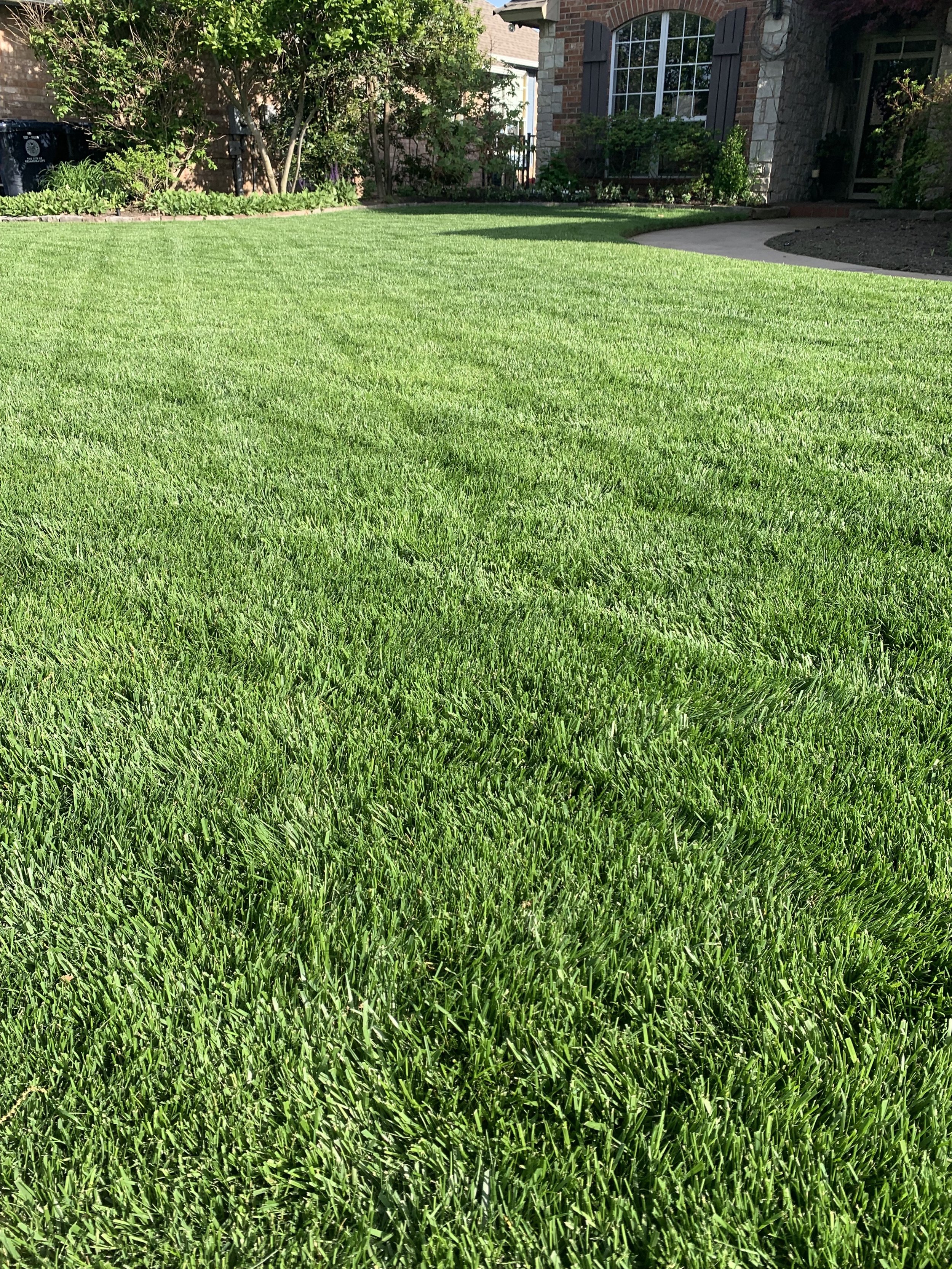
The economics of the two HOAs were very different — resulting in a big difference in services:
The HOA on the south side of the street had a contract with two less fertilizer applications than the one on the north side of the street.
The one on the northside also required us to bag and remove the lawn clippings. The southside HOA’s budget couldn’t afford the extra expense for bagging and waste disposal.
The HOA on the north side had an irrigation system with nearly perfect coverage that ran every other day while the one on the other side of the street had an old inadequate system that we struggled to keep operating during dry spells.
Which HOA do you think always had the greenest grass?
Not the one with more fertilizer applications and more water.
The one with the greenest grass was the one that couldn’t afford to have their grass clippings bagged and removed!

NW OKC Bermuda lawn that is mowed regularly without clippings being bagged & removed.
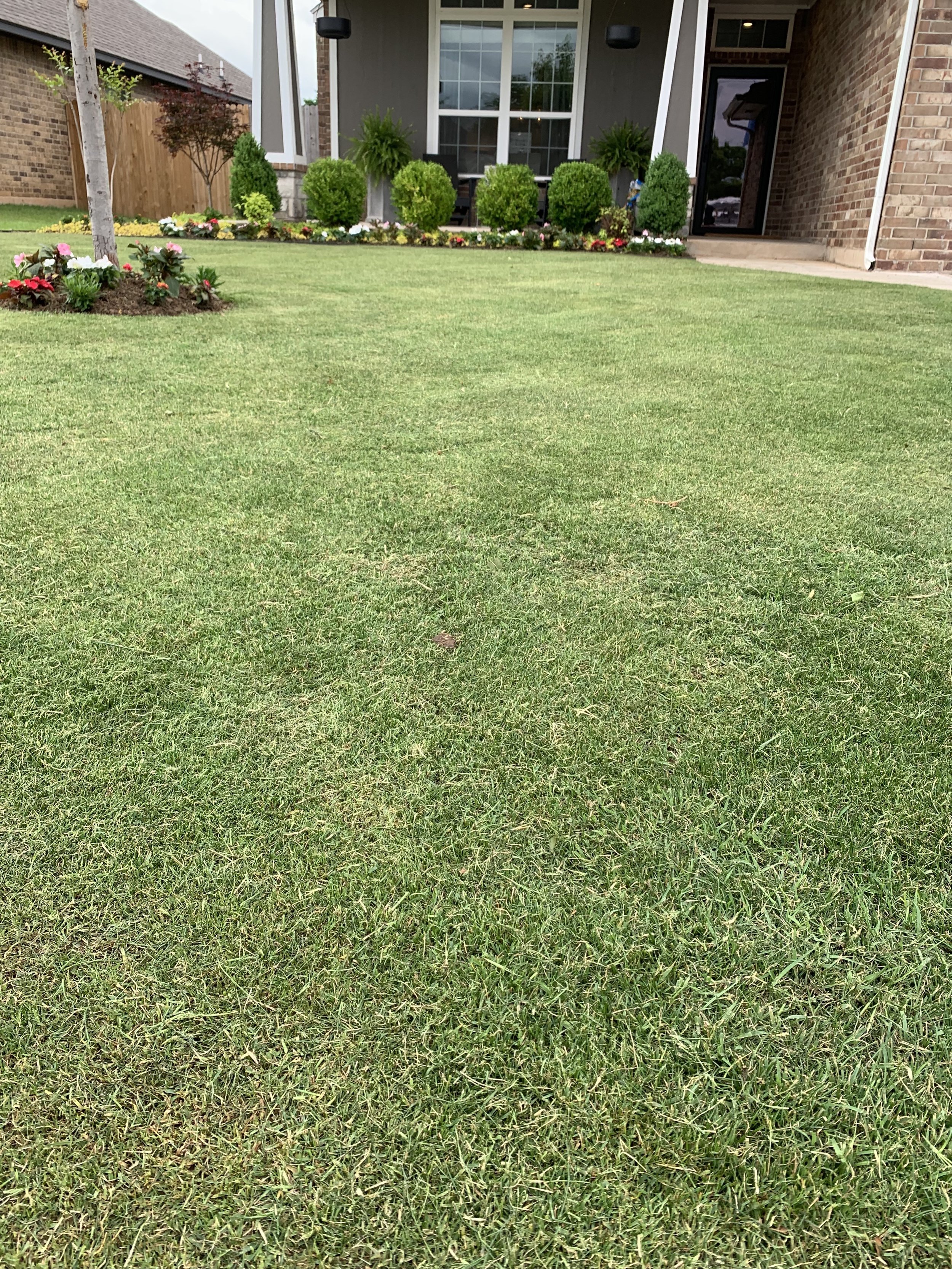
Freshly mowed Bermuda lawn cut tight with a reel. Clippings were not bagged but a blower was used to redistribute noticeable clippings.
Why Does Not Bagging Your Clippings Make Such a Big Difference?
Grass clippings are 80-90% water and nutrients, mostly nitrogen. Every time you throw away a bag of clippings you throw away moisture and valuable nutrients.
You can gain one pound of nitrogen per growing season by returning your clippings to the lawn each time you mow. This is a significant amount considering most turf grasses require 4 to 5 pounds of nitrogen for optimal growth, density and color. Research at the University of Missouri and Kansas State University confirms that 25% of your lawns needed annual nutrients are contained in your lawn clippings.

Fescue lawn immediately after the lawn was cut. 1" of growth was removed. Clippings were not bagged.
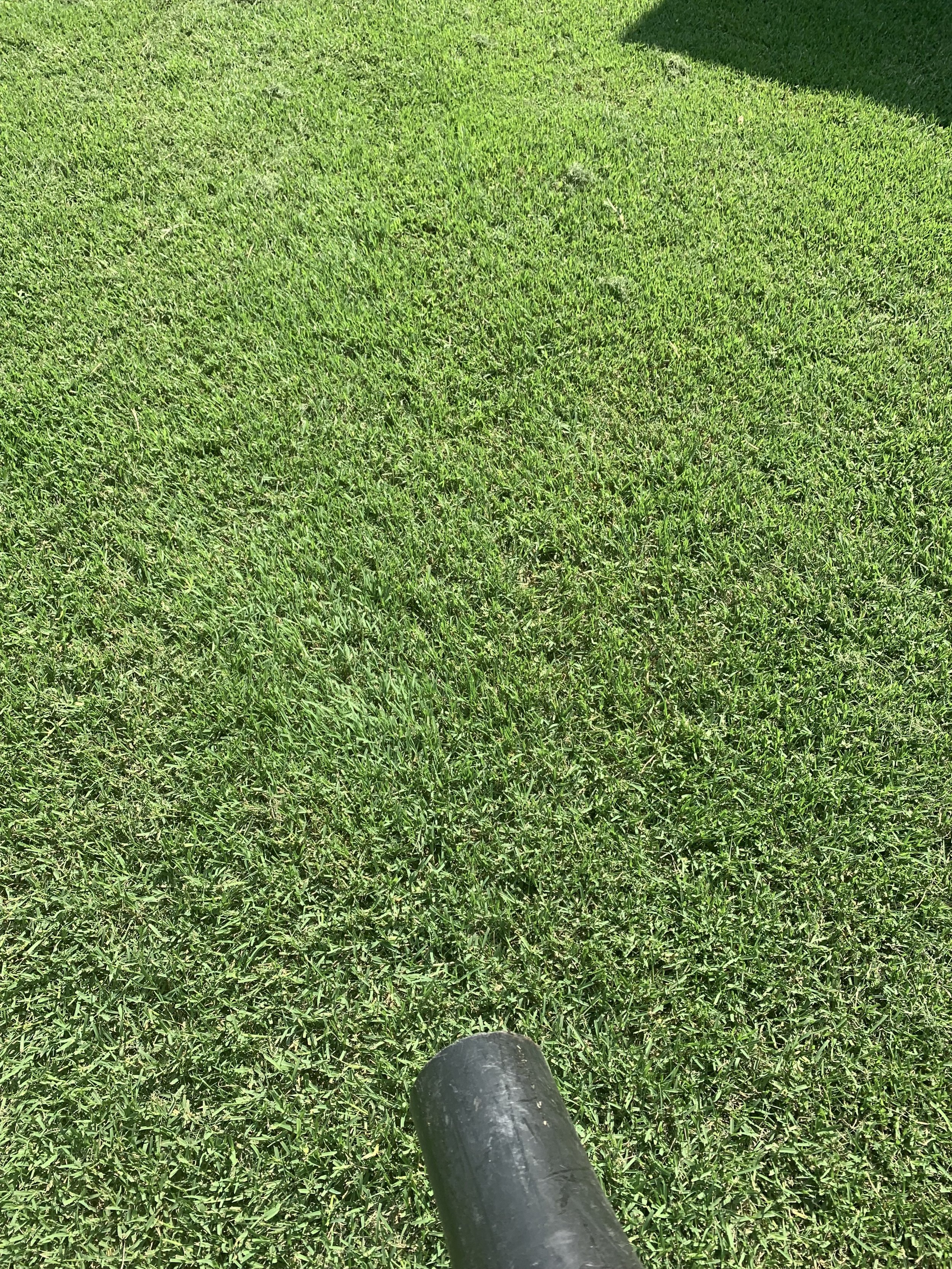
If there you have noticeable clippings after you mulch mow, simply use your blower to redistribute clippings.

Mulch mowing leaves in the fall is beneficial for your soil.
Bagging your lawn clippings is like someone offering to give you free fertilizer, and you saying, “No Thanks!”
Decaying clippings will increase organic material in the soil. As clippings break down, beneficial bacteria increases. Healthy soils contain at least 5% organic material. Most lawns contain 2-3% organic material and research shows that consistently allow your clippings to return to the soil will increase organic material by at least 1%.
Bagging your lawn clippings is like someone offering to top dress your lawn with compost for free, and you saying, “No thanks!”


Mulching mowers, also known as recyclers, will nourish the lawn by cutting the clippings into smaller clippings and return nitrogen, moisture, and organic material back to the lawn.
Keys to Successfully Mulch Mowing
Mow frequently enough that you only remove 1/3 of the grass per mowing. For example: If your goal is to maintain your lawn at 2”, mow before your lawn grows past 3”. This may require you to occasionally mow every 4-5 days instead of the traditional once per week. When only cutting 1/3 of the growth, you are only cutting off the leaves. Grass leaves break down very quickly and do not increase thatch on the soil surface.
If you get behind with your mowing, raise your mower up and gradually lower it back down over the next couple of cuttings. In the worst case, bag the clippings one time and then return to mulch mowing as you regain a more frequent mowing routine.
Don’t mulch mow when the grass is wet. Wet grass clippings clump and don’t breakdown quickly.
Mowers designed for mulch mowing work best since they cut the clippings multiple times. If you don’t have a mulching mower, most brands have mulching kits and/or mulching blades you can add to your mower. And there is nothing wrong with just mowing without the bag on with most mowers.
Keep your lawn mower blade sharp. A sharp blade will cut the clippings finer instead of tearing the grass leaf.
When you finish mowing, if there are any noticeable clippings on your lawn use your blower to clean them up or if not too many, just spread them out.
One last exception, if you have weeds with seed heads, it is best to bag your clippings and remove the weed seeds from your lawn.
If you haven’t figured it out, I’m a big believer in not catching your clippings. It will make a huge difference in the color of your turf and the health of your lawn. And, when done correctly, you won’t even notice clippings.
If you mow your own lawn, give it a try.
If you hire someone to mow your lawn, give them permission to not bag as long as they do not leave behind any noticeable clippings or debris.
I know you will like the difference it makes on your lawn.
Lorne Hall
Hall | Stewart Lawn + Landscape
(405)367-3873

Nutsedge – Possibly The World’s Worst Weed

I have called many weeds “the world’s worst weed”, but If I am asked what some of the weeds are that give all lawn enthusiast the most difficulty, there is a 100% chance I am going to respond without hesitation: “NUTSEDGE!”
Nutsedge is fast growing, has an upright growth habit and light green in color. Because it grows twice as fast as your turf and is lighter, it ruins the best maintained lawns within a couple days of mowing.
Why is it time to brush up on your nutsedge knowledge?
Because the best growing condition for nutsedge is moist soil and after the wettest April in Oklahoma City history, we have the perfect conditions for a nutsedge battle!
Like most weeds, early action is best. Procrastination only makes winning the battle more difficult. With conditions right for nutsedge to be a bigger problem this season, we want to make sure you have the information you need to get ahead of the problem.

What does nutsedge look like?
Commonly called nutgrass because it looks like grass, but it is a sedge with triangular ‘V’ shaped leaf blade arranged in groups of three at the base.
Nutsedge grows faster, has a more upright growth habit, is lighter in color and has a thicker, stiffer leaf blade than your turf grass.
What are the best growing conditions for nutsedge?
Nutsedge thrives in moist, tight soils. It is common to find it growing in areas of poor drainage, around irrigation leaks, and in lawns that are watered too frequently.
Although nutgrass starts in overwatered lawns or areas of poor drainage, once it is established it thrives with normal irrigation, in dry lawns and even through a drought leading many to believe nutgrass has more to do with the soil structure than moisture.
Nutsedge also prefers full sun and doesn’t grow well in shade and typically isn’t a problem in shady lawn areas.
Nutsedge first emerges in May and continues to thrive until the first frost.


Why is nutsedge so difficult to control?
Nutsedge is a perennial weed. Perennial weeds are always more difficult to control. But, nutsedge is one of the toughest because it spreads by underground tubers. Four to six weeks after the first blades emerge, typically in late June to early July, nutsedge begins forming new tubers (nutlets) and rhizomes (underground stems).
The tubers grow 6-12” deep and are referred to as nuts - thus the common name of nutgrass. Nutsedge spreads by growing rhizomes which produces more nuts. Weeds that propagate through tubers and rhizomes are very difficult to control because unless you get control of the rhizome and tuber, the plant will sprout new growth within a few days. Also, tubers can remain dormant in soil for up to three seasons.
Hall | Stewart’s 7-Step Lawn Care Program includes nutsedge control. One of the benefits of subscribing to our full program is we do not charge extra for nutsedge control. Because we know the presence of nutsedge can quickly tarnish a great looking lawn, we use the most advanced nutsedge control herbicides available to the industry.

In late June to early July, uncontrolled areas of nutsedge will begin to multiply and take over areas.
What is the best way to control nutsedge?
Be proactive. With the first sign of nutsedge, take action. Nutsedge is much harder to control once it has been allowed to spread and mature.
Weed killers labeled for use on nutsedge will be either a contact killer or a systemic. A contact herbicide will kill only the leaves, and the tubers and rhizomes will remain active if you make only a single application. Systemic products will translocate through the plant to the tubers and rhizomes.
Key Point - A single applications of most herbicides labeled for nutsedge will kill the plant leaves but leave the nut unaffected.
Because it is neither a grassy nor broadleaf weed, common herbicides have little to no control. For nutsedge control you must search out products specifically labeled for nutsedge.
A few herbicides available at most garden centers labeled for nutgrass include:
Basagran – A second application must be made 7-10 days after the first application.
Image Nutsedge Killer – Requires a second application 3-4 weeks later.
Sedge Hammer Plus – Must have a surfactant mixed with the herbicide to be effective and a second application will need to be made in 6 weeks.
Ortho Nutsedge Killer and Gordon’s Trimec Nutsedge Plus – Both require follow up treatments every 4 weeks.
Please read the label and follow it. You need to know your turf type. Read the label to make sure you can use the product on your lawn.

Is pulling nutsedge a good idea?
Pulling nutsedge is only recommended when the plant is very small before nuts start to develop on the rhizomes (Best if pulling only occurs in the month of May). Once nuts start to develop, you must remove the nut when pulling the weed, which is typically 6-12” below the surface.
If you pull the weed and leave the nut behind, new plants will emerge very quickly. If pulling, the best method is to dig at least 12” deep and 12” wide to get all the tubers.
Research suggests that anytime the tuber is stressed, by either pulling the top off or by killing the top without killing the tuber itself (the result of a single application of an herbicide), the tuber multiples. Therefore, many people experience more nutsedge after they have pulled or sprayed.
Cultivating nutgrass, such as in landscape beds, is ineffective. All you are doing is redistributing the tubers and rhizomes.
One of the worse infestations of nutsedge I have experienced was in a lawn where an elderly man spent hours every week, all summer long, pulling nutsedge in his lawn. He said, “Nutsedge first showed up in my lawn a few years ago and the more I pull it the more nutsedge there is. It feels like the harder I work at pulling it the more I have!” I immediately responded, “Stop pulling it! Every time you pull it, the nut in the soil is stressed and in an effort to preserve itself, the nut multiplies.”
What else can I do to be proactive in preventing nutsedge?
Aeration is a great way to reduce the chances of nutsedge starting and spreading. Aeration reduces soil compaction and reduces the best growing conditions for nutsedge.
Our experience is lawns which are aerated annually rarely have nutsedge problems.
Water only based on need and infrequently. Overwatering, keeping your lawn too wet, promotes the best growing conditions for nutsedge. Water deep. Allow the soil surface to become dry between waterings.
Correct water leaks in your sprinkler system promptly. Nutsedge will stake a claim to any areas that become waterlogged.
Along the same line of thinking, correct poor drainage areas. Often patches of nutsedge are an indicator of poor drainage.


If you find yourself struggling with nutsedge, give Hall | Stewart a call, (405) 367-3873. The good news…. the Hall | Stewart’s 7-Step Lawn Care Program includes nutsedge control.
Nutsedge is one of the more aggressive and persistent weeds you will encounter.
Control of nutsedge can be a long process.
It is a marathon, not a sprint.
Success involves both the best cultural practices (aerating, watering, and mowing) and timely use of quality herbicides labeled for the control of nutsedge.
Lorne Hall
Hall | Stewart Lawn + Landscape
(405)367-3873


Aeration… the "Then Some” of Lawn Care


A good lawn is the result of several key activities:
1. Correctly timed pre-emergent applications to prevent weeds before they germinate.
2. Applying the right amount of fertilizer to ensure you have a thick and healthy turf.
3. Regularly scheduled mowing that only removes the top 1/3 of the leaf blade each time.
4. Infrequent, deep watering based on seasonal need.
But, there is a 5th activity that too often is overlooked.
George Toma, the greatest groundskeeper in the history of sports, has a saying:
“Do the job and then some. It is the ‘then some’ that
distinguishes the mediocre from the great.”
George Toma played a part in preparing the playing field for every Super Bowl until he retired after Super Bowl LVII at the age of 95. Toma is known as “The Sodfather!”
George Toma, presenting the keynote address at a turf conference several years ago, started his talk by announcing he was going to discuss the three most important things to have a great turf.
His 1st point was Aeration.
His 2nd point was Aeration.
And, you guessed it, his 3rd point was Aeration.
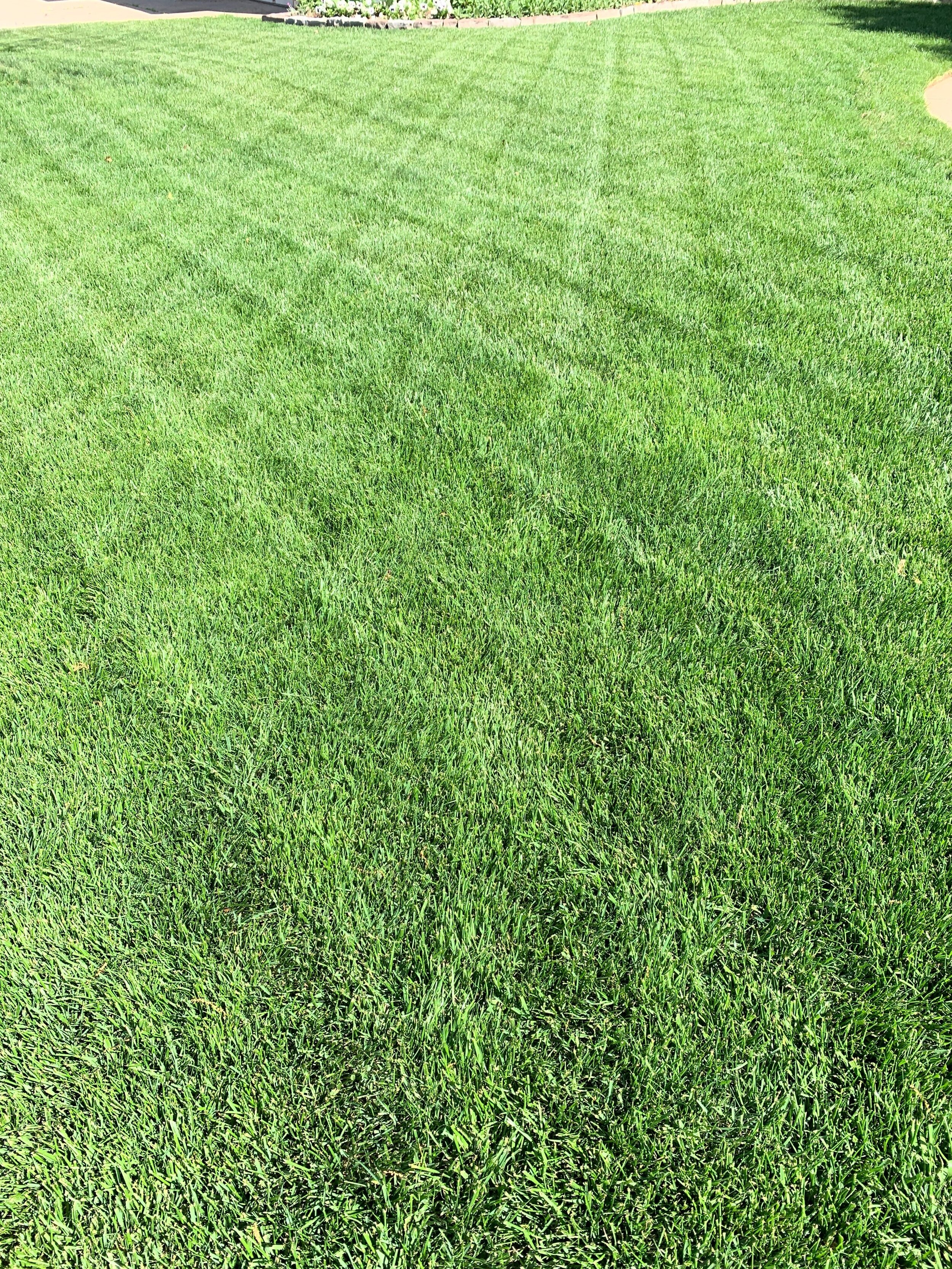

What are the benefits of aeration?
Soil compaction is reduced.
Air movement into the soil is improved.
Fertilizer can quickly reach the root zone.
Water runoff and puddling is reduced.
Roots grow stronger and deeper.
Thatch is reduced.
Reduction in weeds that thrive in compacted soils.
For George Toma, the “then some” that distinguishes the mediocre lawn from a great lawn is aeration.
Aerification is a must!
If your goal is to have your best lawn possible, aeration is a required step in your lawn care program.
What is aeration?
Aeration is the process of mechanically removing 2”-3” cores of soil, 4”-6” apart, from your lawn.

Compact soils prevent grass from establishing a healthy root system and prevent air, water, and nutrients from reaching the root zone. Walking, playing, and mowing (in other words everything you do on your lawn) increases soil compaction.
As Oklahomans, we know about tight clay, compacted soils. Our clay soils make growing a great lawn a challenge.
Too often we accept soil compaction as just the way it is and settle for the status quo of an average lawn.
Stop accepting the norm!


You don’t have to struggle with the results of growing a lawn in tight, compacted soil.
Golf courses typically aerate their turf at least two times per season. No wonder the fairways look so much better than most home lawns.
Lawns with compacted soil also are more susceptible to weed development. Most weeds thrive in tight compacted soil.
Nutsedge, one of the most difficult to control summer weeds, thrives in tight soils. Our experience has shown that annually aerated lawns have far less problems with nutsedge.

Why do golf course fairways always look so good? Turf managers know the importance of aeration. The secret to a great lawn is a great root system. Annual aeration is the ticket to a great root system.


Should the cores be removed or left on the lawn?
Leave the cores on the lawn. As they breakdown and dissolve, they will refill the holes with loose soil resulting in improved soil structure. The cores will break up and settle back into the lawn within a few weeks.
When should you aerate?
Warm season lawns (Bermuda and zoysia) should be aerated any time after spring green-up and before the end of July.
Cool season lawns (fescue) should be aerated in the fall, September through October. Aeration in conjunction with overseeding will not only improve the soil structure, but it will also improve seed soil contact resulting in better seed germination.
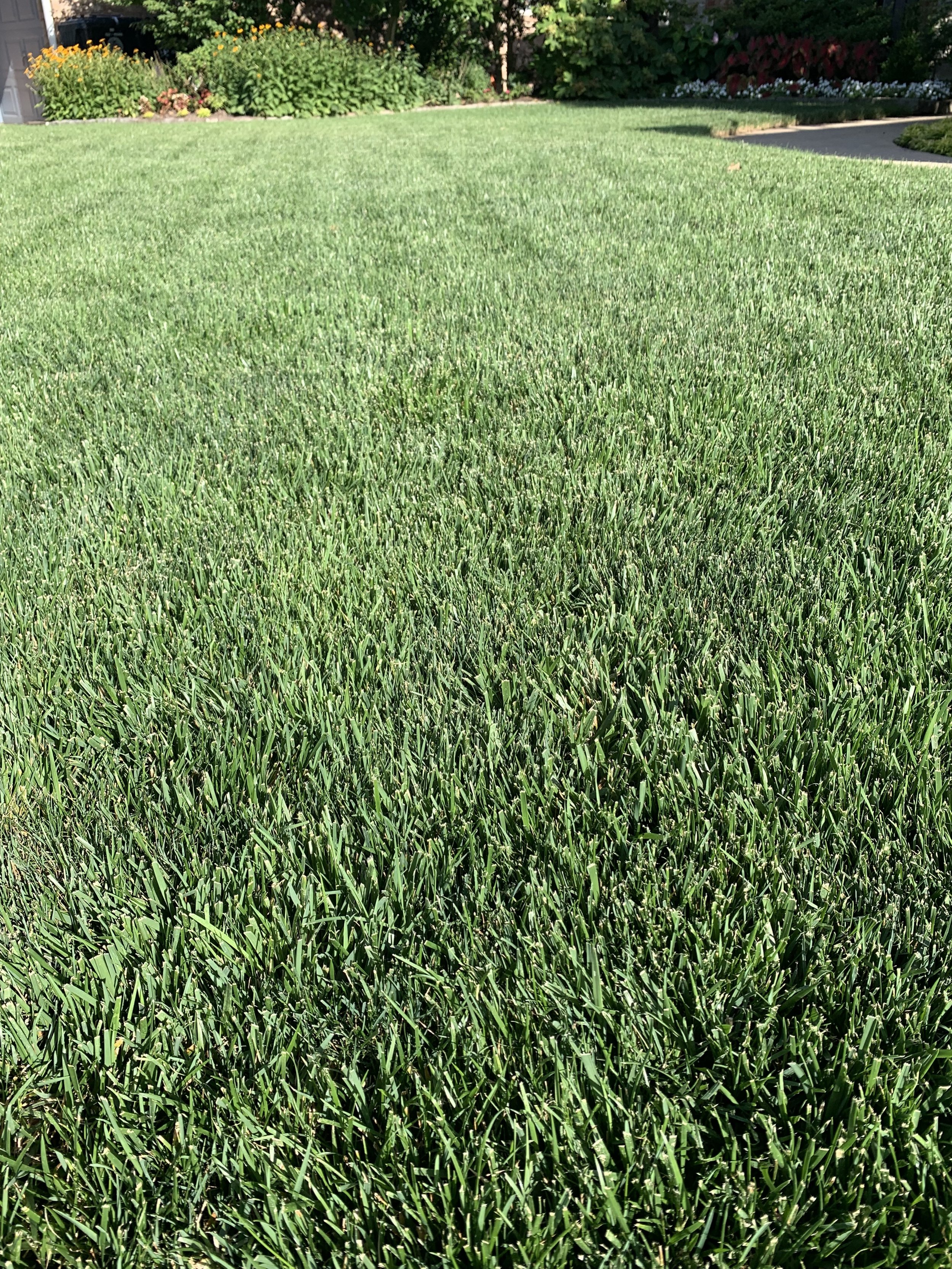

Now through the first half of the summer growing season is the best time to aerated lawn Bermuda, a warm season turf.


Nothing will take your lawn from good to great more than an annual aeration!
One more Toma saying… “The most important part of grass is the soil and the root system.”
Aeration is the best way to improve the soil structure and develop a stronger root system.
Aeration, the most overlooked lawn practice, will give you a healthier, more vigorous, less weedy lawn.
To achieve your best lawn, annual aeration is a must.
Lorne Hall
Hall | Stewart Lawn + Landscape
(405)367-3873
The Joy of Spring

What a week in the landscape!
Last weekend didn’t feel like spring. But, with one final, late cold spell in our rear-view mirror, the landscape has exploded with color this week.
The much needed rainfall has delivered us greener turf, more trees adding leaves, colorful perennials, bulbs, shrubs and trees in every pocket of the Oklahoma City metro area.
Every spring feels a little different. The timing of blooms. The length of blooms. Every spring another plant is going to captivate our attention. Every spring there is another plant that just seems a little more dynamic than it has ever been.

What are your favorite spring blooming plants?
Are you like me? Your favorite is, “All of them!”
Let’s spend a few minutes reviewing some of the tried and true spring blooming plants you can count on adding beauty and joy to our world year after year.
PERENNIALS

Creeping Phlox
Creeping Phlox. The first to welcome spring each year. Creeping phlox produces a spring-like carpet in pastel hues of white, lavender, red and pink. Creeping phlox is a moderate grower that can spread up to 2’ but only reaches 4-6” in height. It requires full sun but will tolerate a couple hours of shade each day. Borders, walls, and around boulders are where it looks best. In my garden, you will find it cascading over a rock retaining wall. It tolerates most soil if it is well drained. The plant requires little maintenance. Mites are about the only insect problem it will have.
‘May Night’ Salvia. Sage type flower spikes of deep bluish-purple that will add color in April, May, and early June. The best flower show will be in full sun, but it will tolerate a little dappled shade each day. The plant grows 12-18” tall with flower spikes reaching 24”. The plant looks great in the middle of the garden planted behind creeping phlox or dianthus, and in front of Shasta daisy or Black-eyed Susan. The leaves often become tattered later in the summer and become dormant over the winter. Keep faded blooms removed to maximize bloom period and pruning the plants after blooming may result in a few fall blooms. In the early spring, before new growth emerges, remove the dormant foliage. Salvia tolerates clay soils but will struggle with root rot if the soil stays saturated.
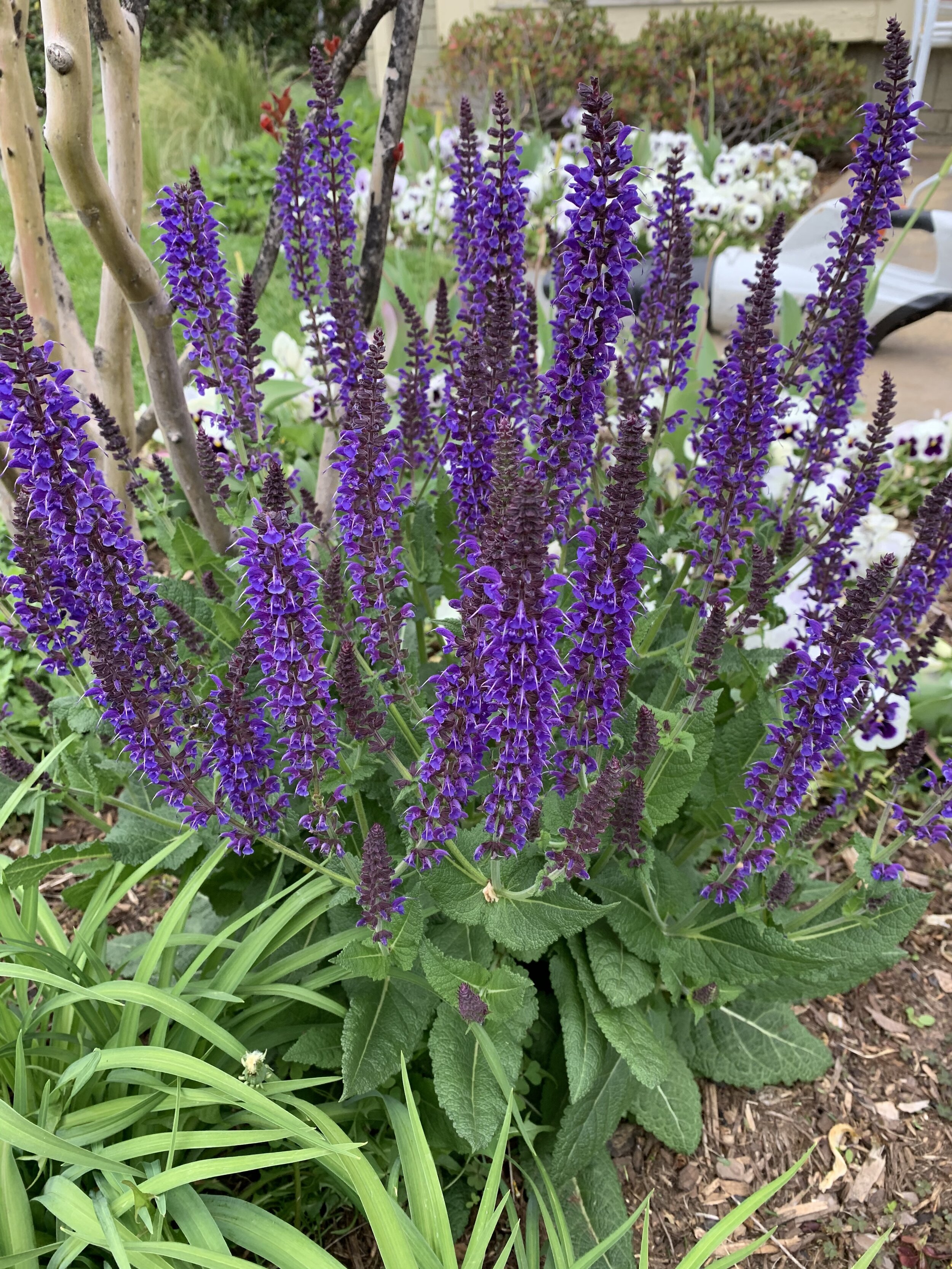
May Night Salvia
Dianthus. It works well as a border, in small groupings, around boulders or as a single plant reaching 10-15” tall with a spread of 12-24”. They bloom in late spring in rose, pink, white, and red. They like full sun but will take some dappled shade or afternoon shade. Just like creeping phlox, they are a cool season lover. They will grow in most soils, prefer alkaline soils, but waterlogged soil will cause crown and root rot. Heavy mulching near the crown of the plant can be detrimental. Late March through April and into May is the peak bloom time. Light feeding in the spring with a complete fertilizer of phosphorus, potassium and low nitrogen is recommended. Other than occasional aphid or powdery mildew issue, they do not have many problems. There are more than 300 varieties of dianthus to choose from. My all-time favorite is ‘Firewitch’. It has a silver-green foliage with a vibrant pink bloom.

Dianthus

Dianthus and May Night Salvia
SHRUBS

Forsythia.
Forsythia. Best grown as a specimen shrub where it can show off its naturally stunning shape. Forsythia’s brilliant yellow flowers are the first to welcome spring. It performs best planted in full sun and will grow in partial shade, only with less spring blooms. It is considered a fast grower. Forsythia adapts well to most soils but prefers well drained. It rarely has an insect or disease problem. Pruning should only occur after spring blooms fade. If you prune later in the year, you will reduce blooms the following spring. The best way to prune this shrub is to remove older wood all the way to the base of the shrub. Traditional forsythia will grow to 6-8’ with an 8’ spread and are well suited for large lawns. If you have a smaller yard, look for one of the newer varieties, such as Gold Tide (Forsythia ‘Courtasol’), a dwarf variety that only reaches 2’ high and spreads to 4’.
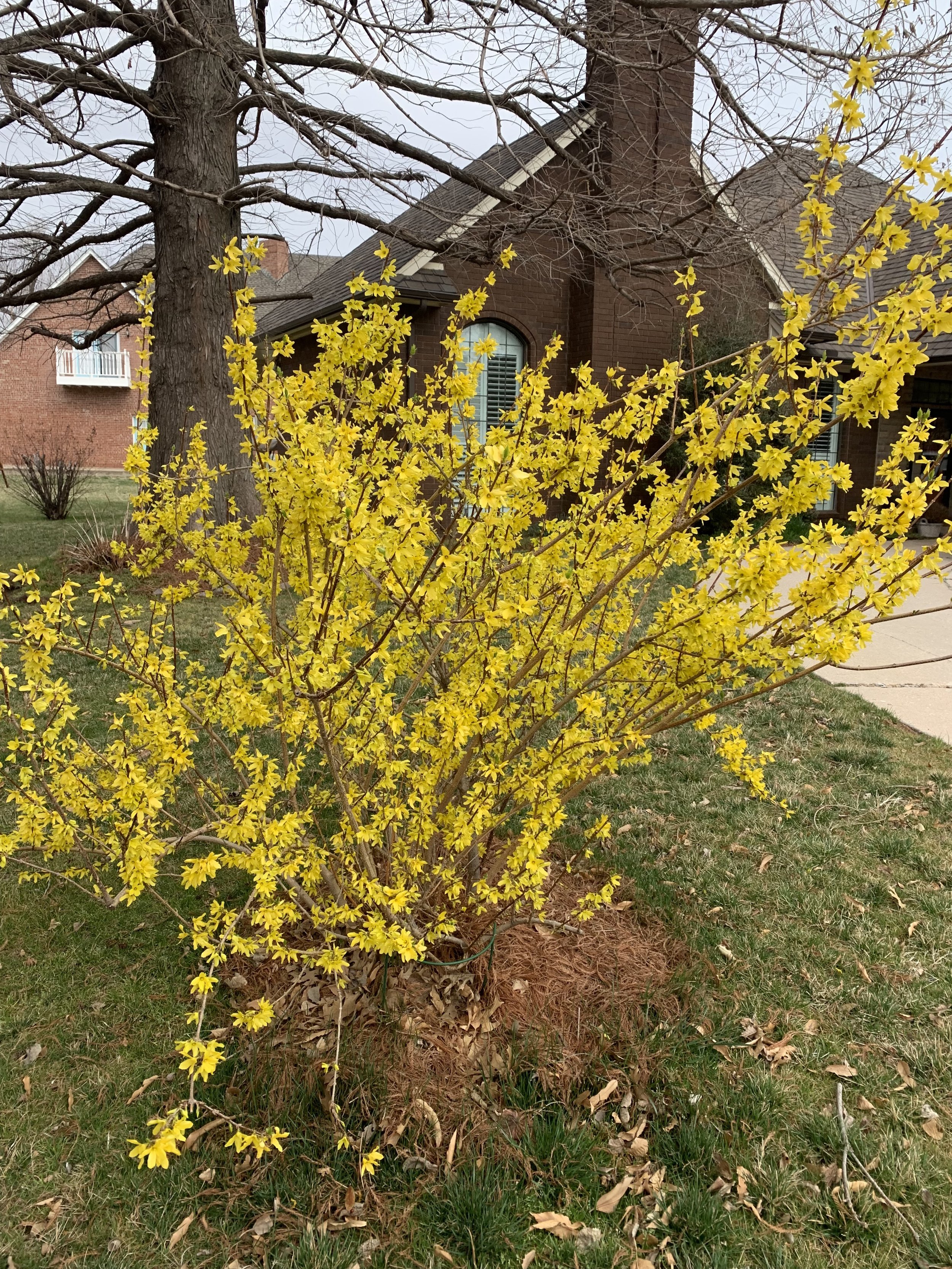
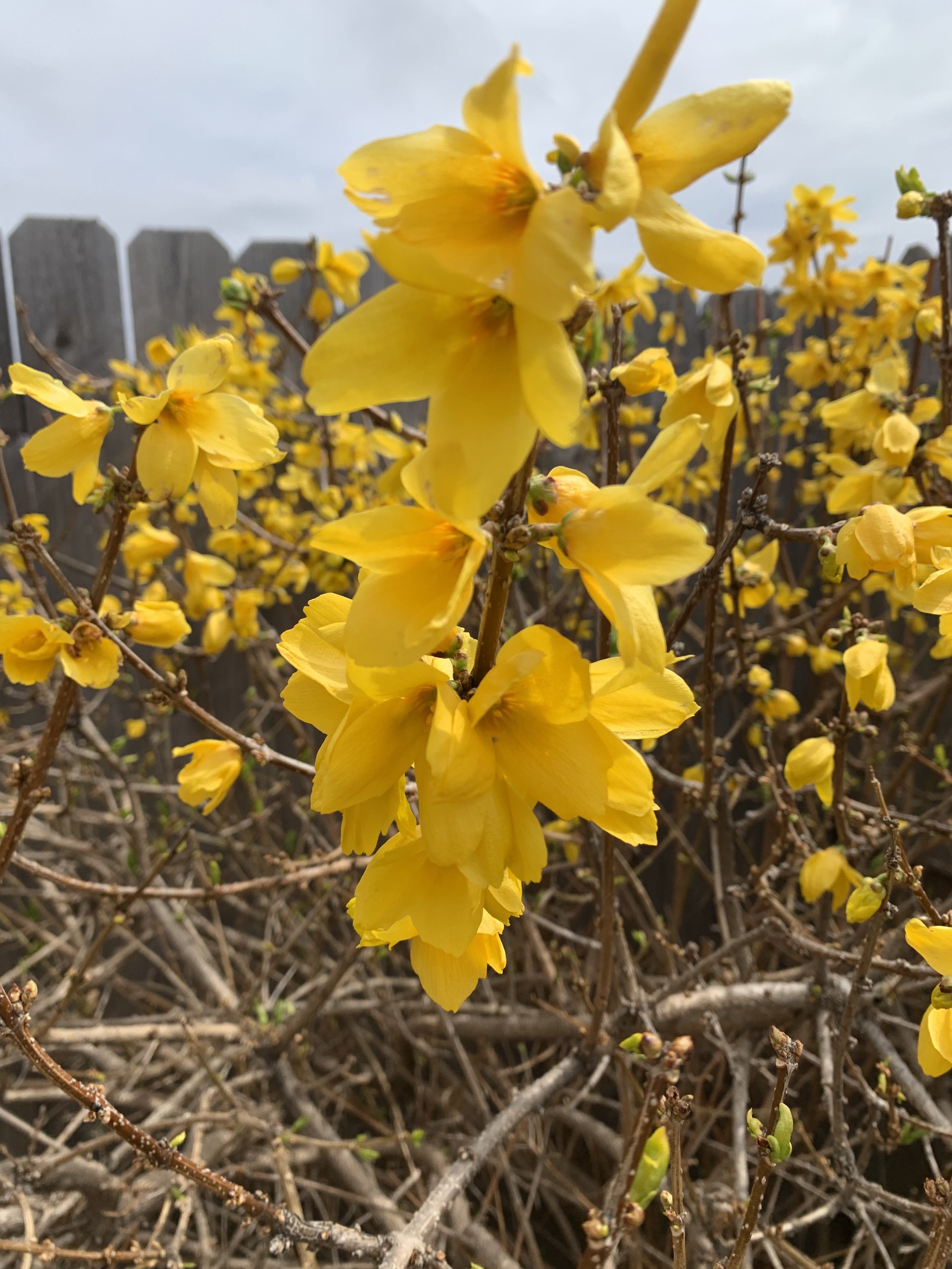
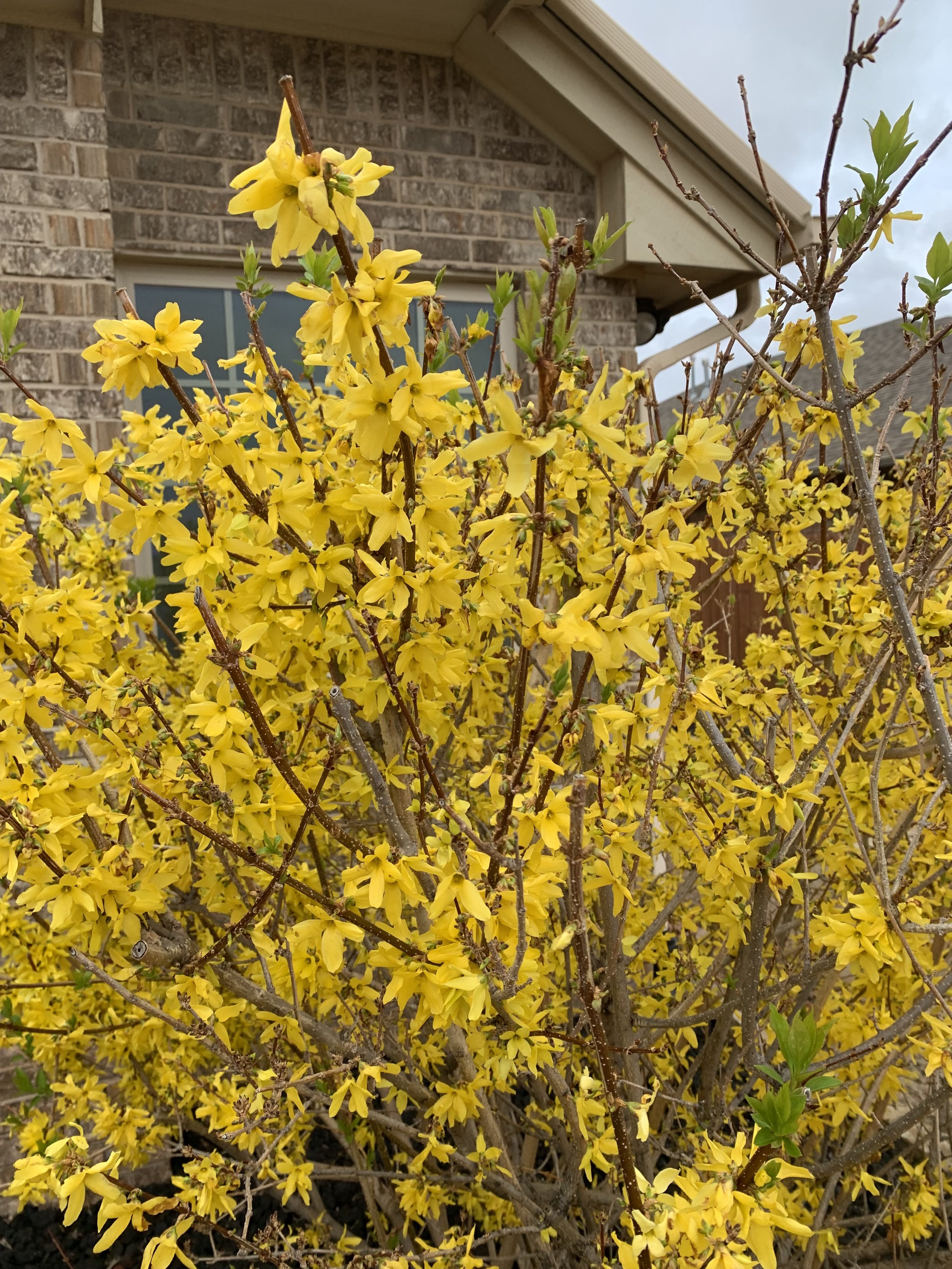
Bridal Wreath Spirea. A medium sized shrub with arching branches covered with an abundance of white cascading flowers in mid spring. It is a very hardy, heirloom shrub, with no specific pest issues that thrives in well drained soils. It attracts hummingbirds and butterflies. To preserve the natural arching shape avoid sheering but if pruning is needed, it is best done in the spring after blooms fade. It looks stunning planted in full sun to partial shade in front of darker structures or large hollies. Spiraea nipponica ‘Snow mound’ is another great variety.


Bridal Wreath Spirea.

Flowering Quince.
Flowering Quince. Another early bloomer known for adding splashes of red to the landscape. It also performs best in full sun and tolerates partial shade but with fewer blossoms. Considered a moderate grower and mid-sized shrub, most varieties reach 4-5’. It does best if planted where it can grow to its natural size and shape. If pruning is required, only prune in the spring after blooms have faded. Flowering Quince is loved by butterflies and hummingbirds. The plant is very drought tolerant once it is established and it will tolerate most soil, but like most plants would enjoy well drained areas. Another variety, Chaenomeles speciosa Double Take Series, has blooms that resemble camellias.
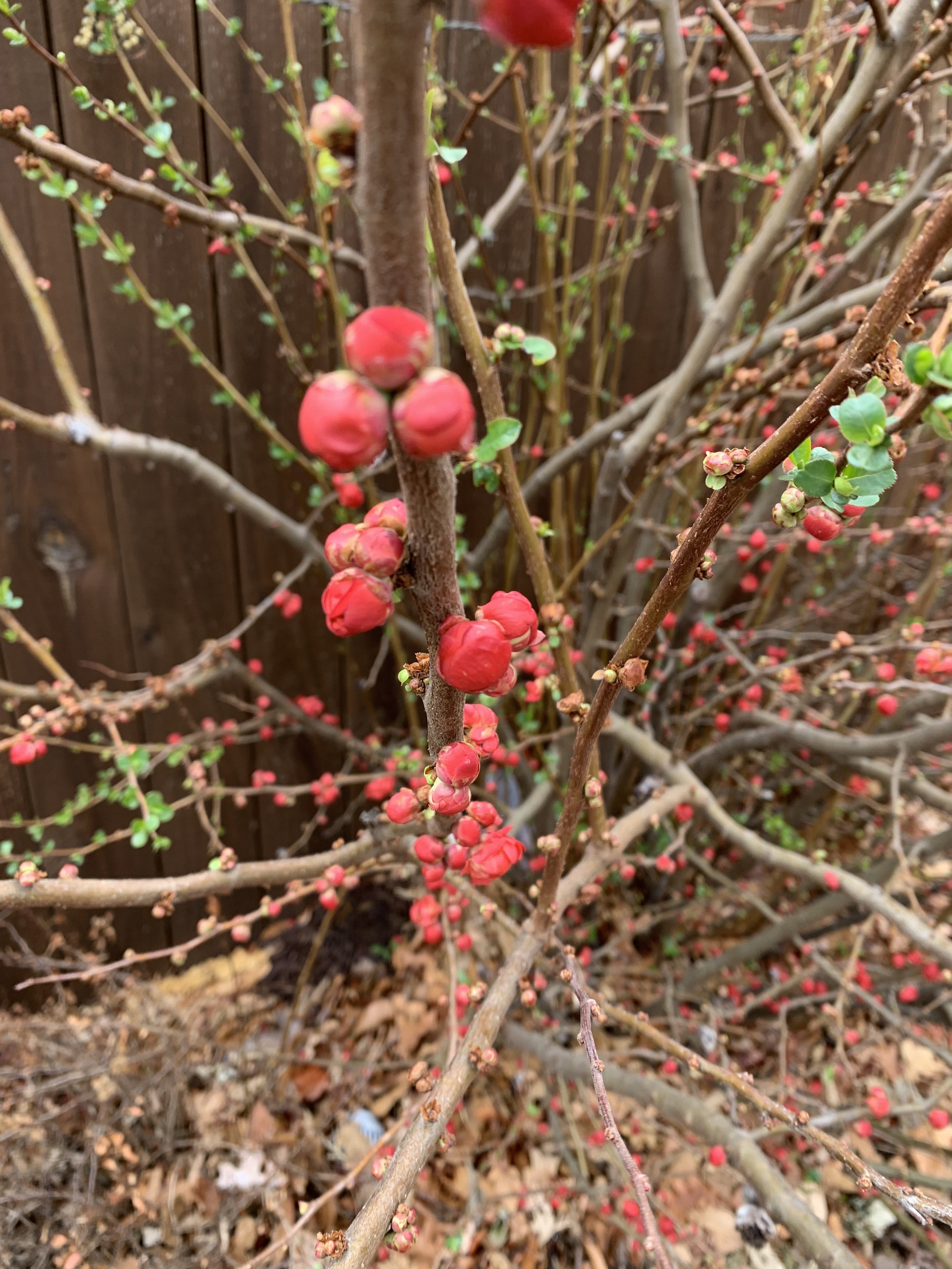
Flowering Quince buds are staring to pop.

Snowball Bush is another great spring show piece that is just starting to add interest to the landscape.
Snowball Viburnum. There are many varieties of viburnum, but the old fashion Snowball Viburnum with its masses of large, pure white, snowball sized blooms is still my favorite. Blooming from mid spring to early summer, if it wasn’t for the time of the year, it could easily be mistaken for a Limelight Hydrangea. A large shrub that can reach 10’ high and 10’ wide. Easy to care for. Tolerant of most soils but prefers well drained soils. Plant in full sun to partial shade. Oh, and it is perfect for cut flower arrangements.

Snowball Viburnum

Azaleas. There are too many varieties and nauseas to summaries in a single paragraph. But, right now, it is hard not to fall in love with azaleas. They are undeniably the most dynamic spring color plant for shady locations. And yes, you can grow them successfully in central Oklahoma, but they are not a no care, low maintenance plant. We often dedicate an entire article to growing azaleas in central Oklahoma this time of year. To learn more about azaleas, spend a few minutes reading our post from last April: https://www.hallstewart.com/hsblog/growing-azaleas-in-central-oklahoma


Shrubs such as Double Play Candy Corn Spirea add interest to the spring landscape as their new foliage emerges.
TREES

Oklahoma Redbud.
Redbud. My all-time favorite “Welcome to Spring” plant. (You can on us dedicating an entire article to Redbuds every spring.) Reddish purple blooms appear on branches before leaves appear. The ‘Oklahoma’ variety was discovered in the Arbuckle Mountains and known for its glossy, heart-shaped, green leaves in the summer. It grows to 15’-20’. Preferring full sun but does well as an understory tree in dabbled shade. For more Redbud love, visit our article from March: https://www.hallstewart.com/hsblog/the-redbud-oklahomas-state-tree

Redbud.

Oklahoma Redbud

Oklahoma Redbud
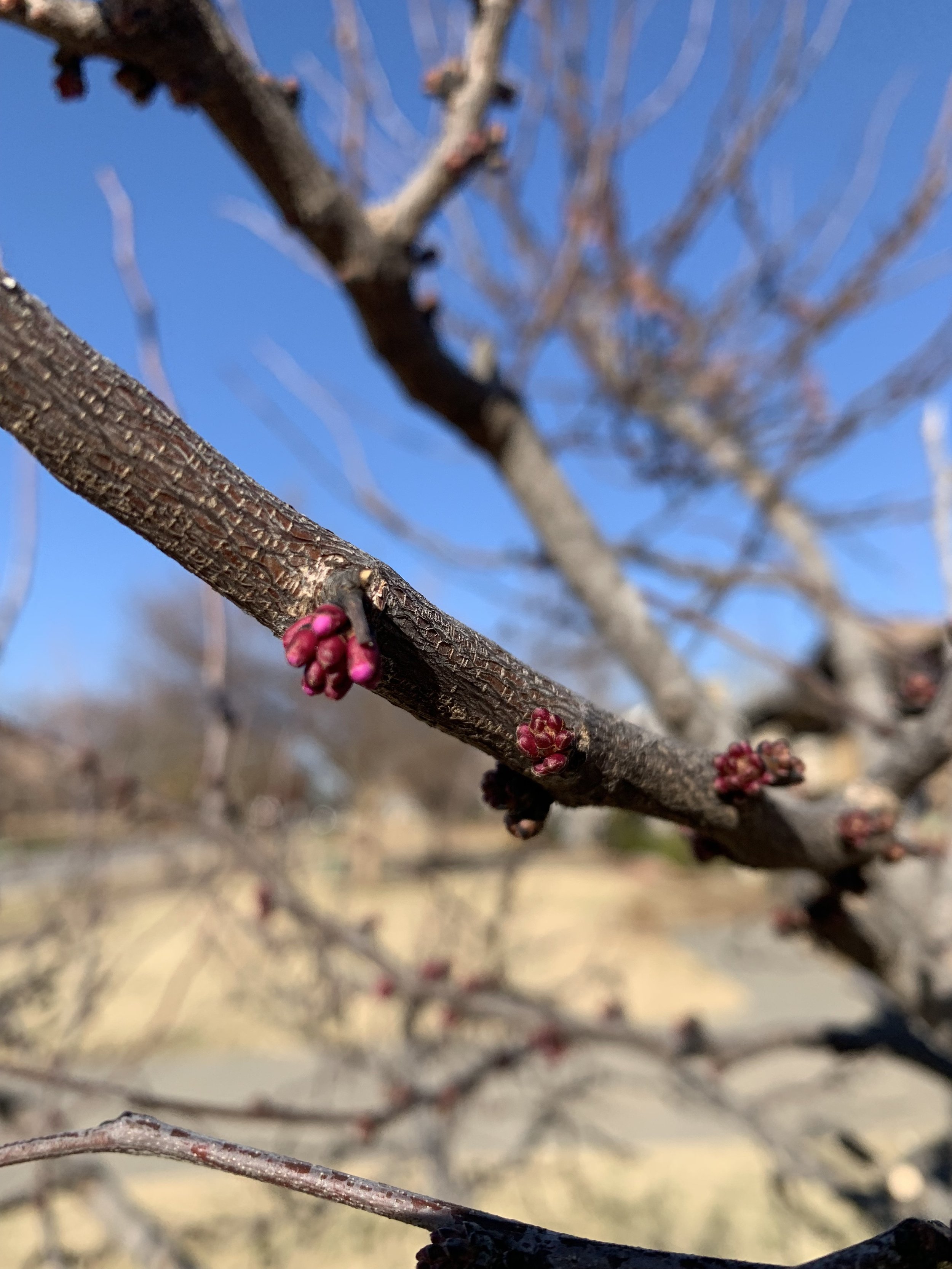
Redbud buds are swelling up!

Crabapple.
Crabapple. There are many varieties of crabapples, but ‘Prairifire’ is one of the best. It was the Oklahoma Proven tree of the year in 2007. It is disease resistant and not fazed by most of the problems with crabapples. Flowers of rose-pink cover the tree as soon as leaves emerge. Young leaves go from purple-red to dark green as they mature. Branches have red fruit in the winter. Mature, 20-25’, trees have a rounded top. Plant in full sun as a specimen tree or in a grouping. Water extra during periods of extreme heat or drought.

Saucer Magnolia.
Saucer Magnolia. A specimen type tree that reaches 15-20’. Large blooms put on a spectacular show on multi-trunk spreading branches. Blooms range from white to pink to purple. Best if planted in full sun. Plant away from radiant west or south heat where warm spring days may cause buds to develop too early only to be killed by a late freeze. They require regular deep watering in the summer months when leaves become tattered looking. It is best if their roots are protected with a layer of mulch to conserve water in the summer.

Red Baron Peach

Bonfire Patio Peach
Bonfire Patio Peach. With a mature height of 5-6’, its profuse early spring eye-level pink blooms are a real head turner. The dark red to burgundy summer foliage keeps the interest going all season long. The small tree performs best if it receives at least 6 hours of full sunlight per day.
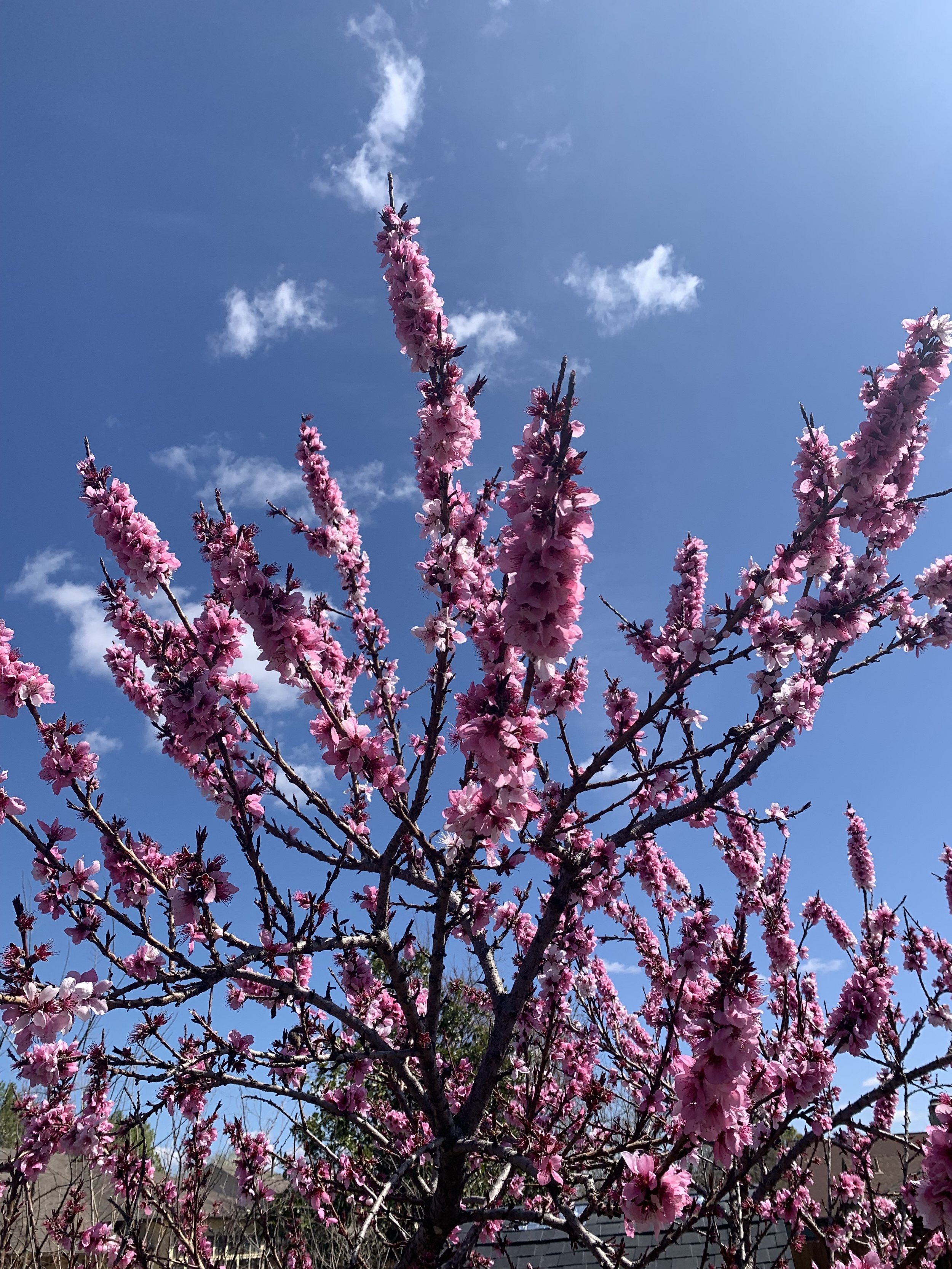
Ornamental Peach Trees add shades of pink to the March landscape.
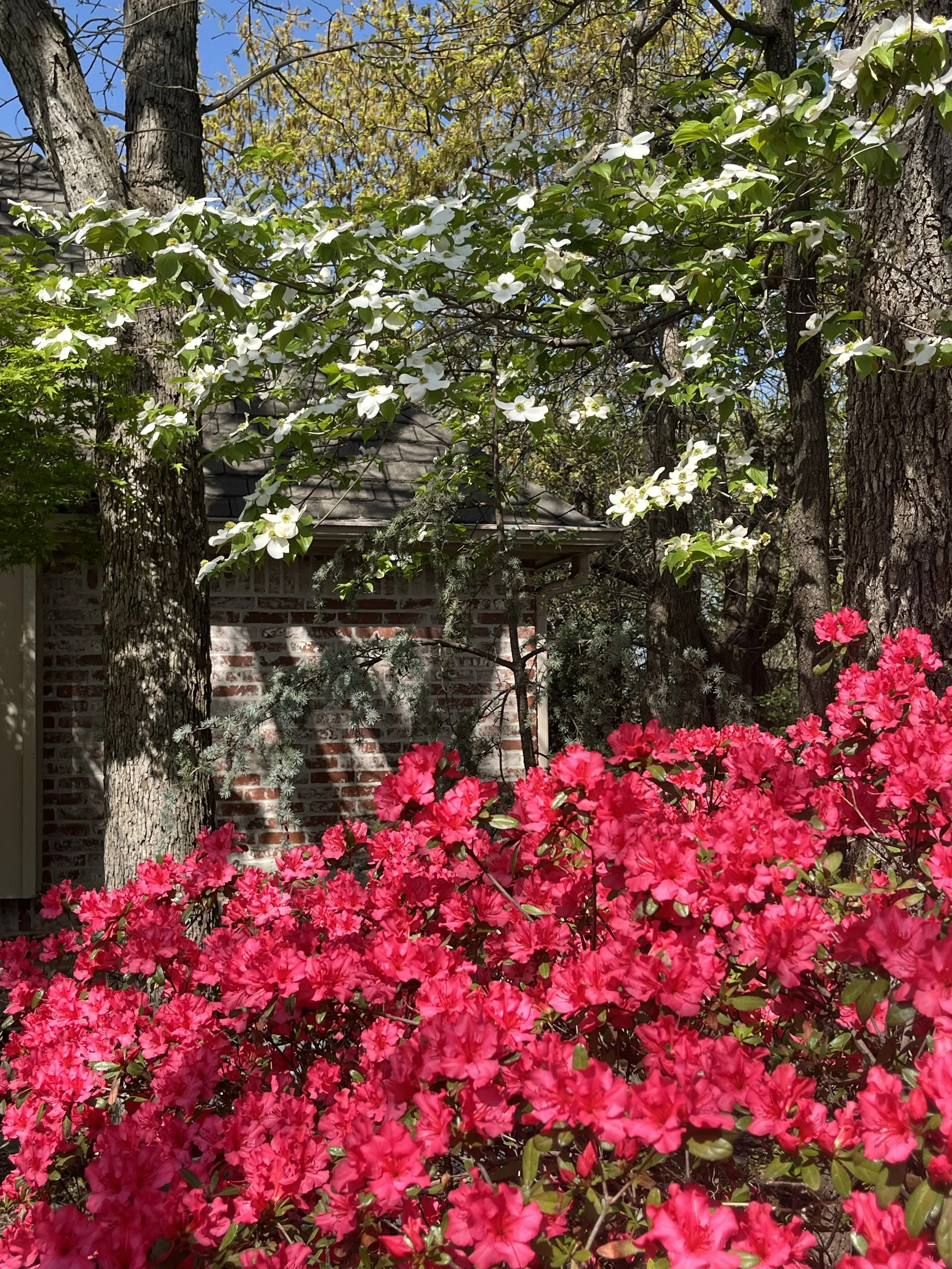
White Dogwood with Azaleas create a stunning color display in the spring in shady landscapes.
Dogwood. Great understory, slow growing, small to medium sized tree (15-20’) that is loaded with a four petaled flower in the spring. They grow well in shade to partial shade where they brighten the spring landscape with splashes of white, pink or red. Dogwoods need acidic, moist, well-drained soil, similar to azaleas.

A great understory tree, the Dogwood, adds color to shady landscapes in the spring.

The bright red spring leaves of Japanese Maples are sure to catch your attention.
Japanese Maples. Not a blooming tree, but with the bright color of their new spring leaves, it is easy to include them in a list of spring blooming trees. With so many shapes, sizes, and colors, there has to be a variety for nearly every landscape. Japanese Maples have been referred to as the “aristocratic” of the landscape. Several times we have dedicated an entire article just to the Japanese Maple. Click this link to learn more about them: https://www.hallstewart.com/hsblog/2020/4/19/japanese-maples-the-aristocrat-of-the-landscape

Japanese Blood Good Maple

Lace Leaf Weeping Japanese Maple
Spring Bulbs


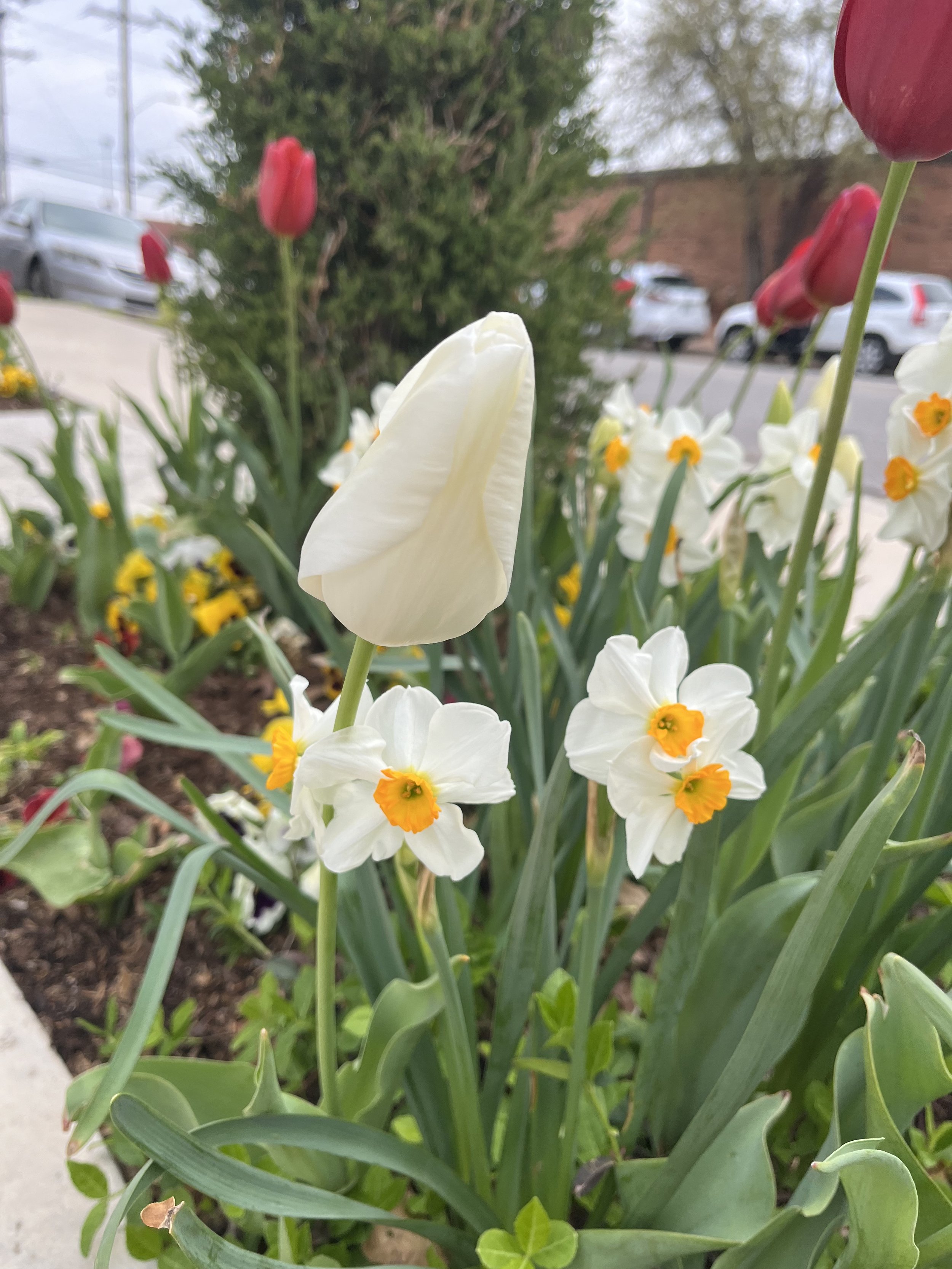
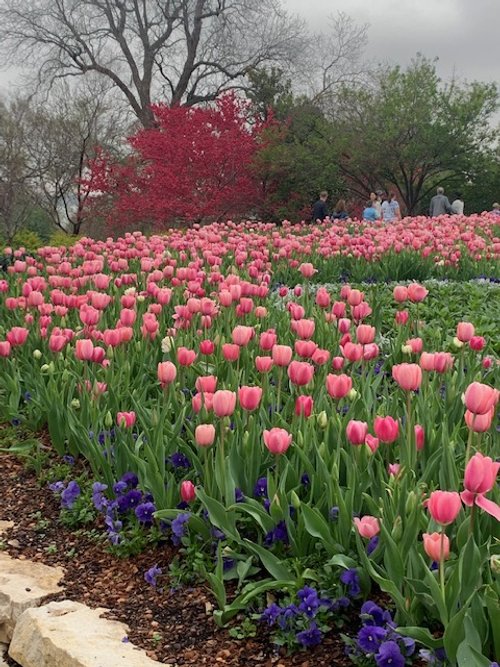
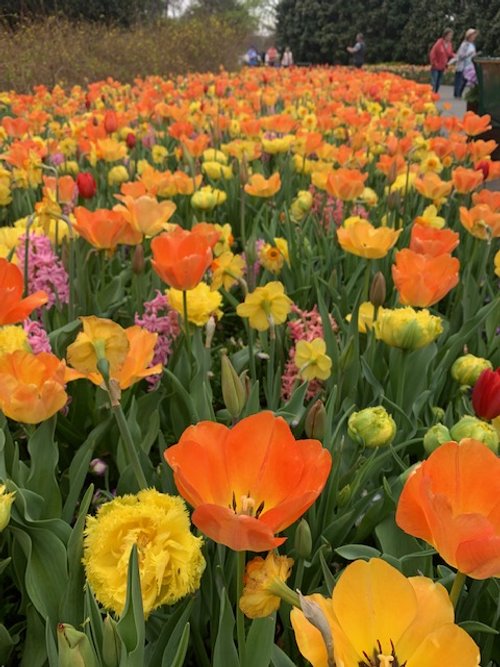
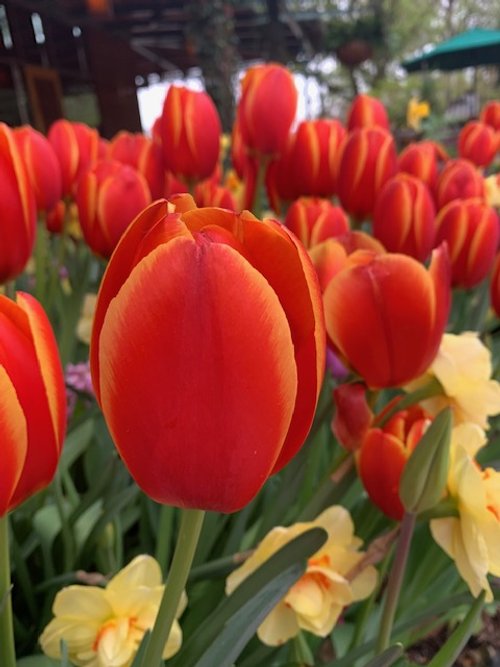
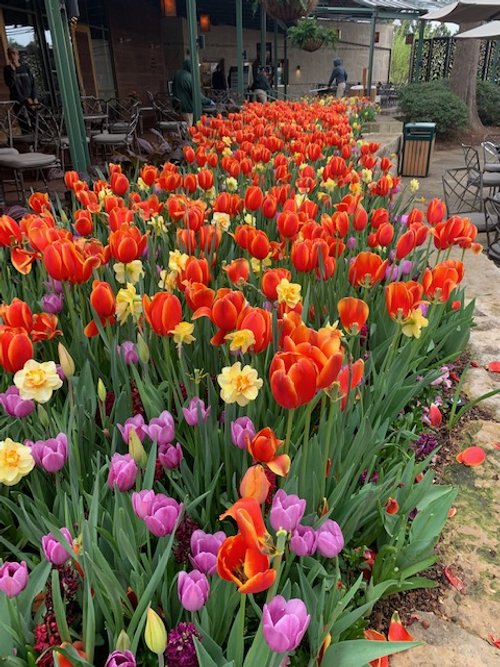
One of my favorite ways to declare spring is Hyacinths, Daffodils and Tulips!
Last October we wrote about spring flower bulbs, “Plan Now. Plant Next Month. Enjoy Next Spring.” https://www.hallstewart.com/hsblog/plant-now-plant-next-month-enjoy-next-spring
If you were inspired and added spring flowering bulbs to your landscape, you are enjoying a spring full of color.
Don’t miss out next spring! Open your calendar right now to October and write “Plan spring bulb planting!”


A friend talked about being greeted with “What has brought you joy today?” at a local business recently.
What a wonderful greeting!
We hope, as the landscape burst with new life, you find joy in the beauty God creates for us every spring, without fail.
Don’t let the busyness of life rob you of the joy of spring!
Get outside. Go on a walk. Visit a park.
Add a new plant to your landscape!
The beauty of spring is all around!
Lorne Hall
Hall | Stewart Lawn + Landscape
(405)367-3873
Hydrangeas Varieties and Care

Hydrangeas have a reputation for being difficult to grow, fussy and high maintenance. That was true of old fashion, traditional hydrangeas that only bloom on last year’s growth. It was common for a late spring freeze to damage buds resulting in little or no blooms, or a pruning mistake would also result in no blooms.
But, the world of hydrangeas keeps changing…every season the hydrangea options get better and better. New varieties just keep coming. Take a stroll through a local nursery and you will be surprised at all the hydrangea options.

First Hydrangea blooms from last May.
The introduction of the Endless Summer Hydrangea in 2004 from Bailey Nurseries with the help of Dr. Michael Dirr from the University of Georgia resulted in what many claim is the best-selling shrub of all time.

The Original Endless Summer Hydrangea

Little Lime Hydrangeas is a shorter option for smaller gardens.
Dirr had been trying to develop a re-blooming hydrangea for years with no success. Then in 1998, Dirr was visiting Bailey’s test field where he found hydrangeas in full bloom…in September! Bailey Nurseries had been propagating and testing a plant they had found in St Paul, MN for 10 years with success. The plant was unique because it bloomed in the spring on last year’s growth, like a traditional old-fashioned hydrangea, and rebloomed on the new growth during the summer and into the fall.
Dirr immediately knew it was “a game changer” for hydrangeas and quickly coined the name ‘Endless Summer’.

Endless Summer Hydrangea will continue to bloom into the fall.

The Original — big round blue or pink blooms

Blushing Bride - pure white blooms that mature to a pink blush.

Twist-n-Shout — reblooming lace-cap in pink or periwinkle blue with red stems.

Bloom Struck — purple or rose-pink flowers with red stems.

Summer Crush — a 2019 introduction with raspberry red or neon purple flowers with a compact growth.

Summer Crush Endless Summer Hydrangea

Pop Star – Introduced in 2023, Pop Star is a compact, big-leaf hydrangea that only grows 18-26” high and wide. It is the quickest Endless Summer to rebloom.

Original Endless Summer Hydrangea in the fall.
The Endless Summer Hydrangea is like traditional hydrangeas in that they prefer morning sun and afternoon shade.
Want to learn more about Endless Sumer Hydrangeas? Follow this link: https://endlesssummerhydrangeas.com/
Another hydrangea “game changer” is the Limelight. Limelight is a summer blooming hydrangea that grows in full sun!
A plant breeder in the Netherlands crossed two unidentified panicle hydrangeas and the outcome was a full sun, summer blooming show in the hydrangea family. Limelight Hydrangeas received a US Plant Patent in 2002.
I first noticed them years ago growing around a parking lot in downtown Oklahoma City in the middle of summer with vibrant white blooms planted in full sun. Of course, I circled the block, took lots of pictures, and started my search to find the name of the plant.
Limelight has become one of my favorite plants.
Limelight varieties:
Limelight (Original) – Blooms in mid to late summer on new growth. Flowers start green, turn to white and then back to green. Limelight is typically large 6-8’ tall multi-trunked shrubs or can be trained into a single-trunked tree formed large shrub.
Limelight Prime – All the characteristics of the original but a little smaller, 4-6’, and sturdier stems. Also, the flower color is more vivid than the original.
Little Lime – Great for smaller gardens and small pockets in the garden. Grows to 3-5’ tall.
Want to learn more about Limelight Hydrangea varieties? Follow this link to a Monrovia article: https://www.monrovia.com/be-inspired/best-panicle-hydrangea-varieties.html
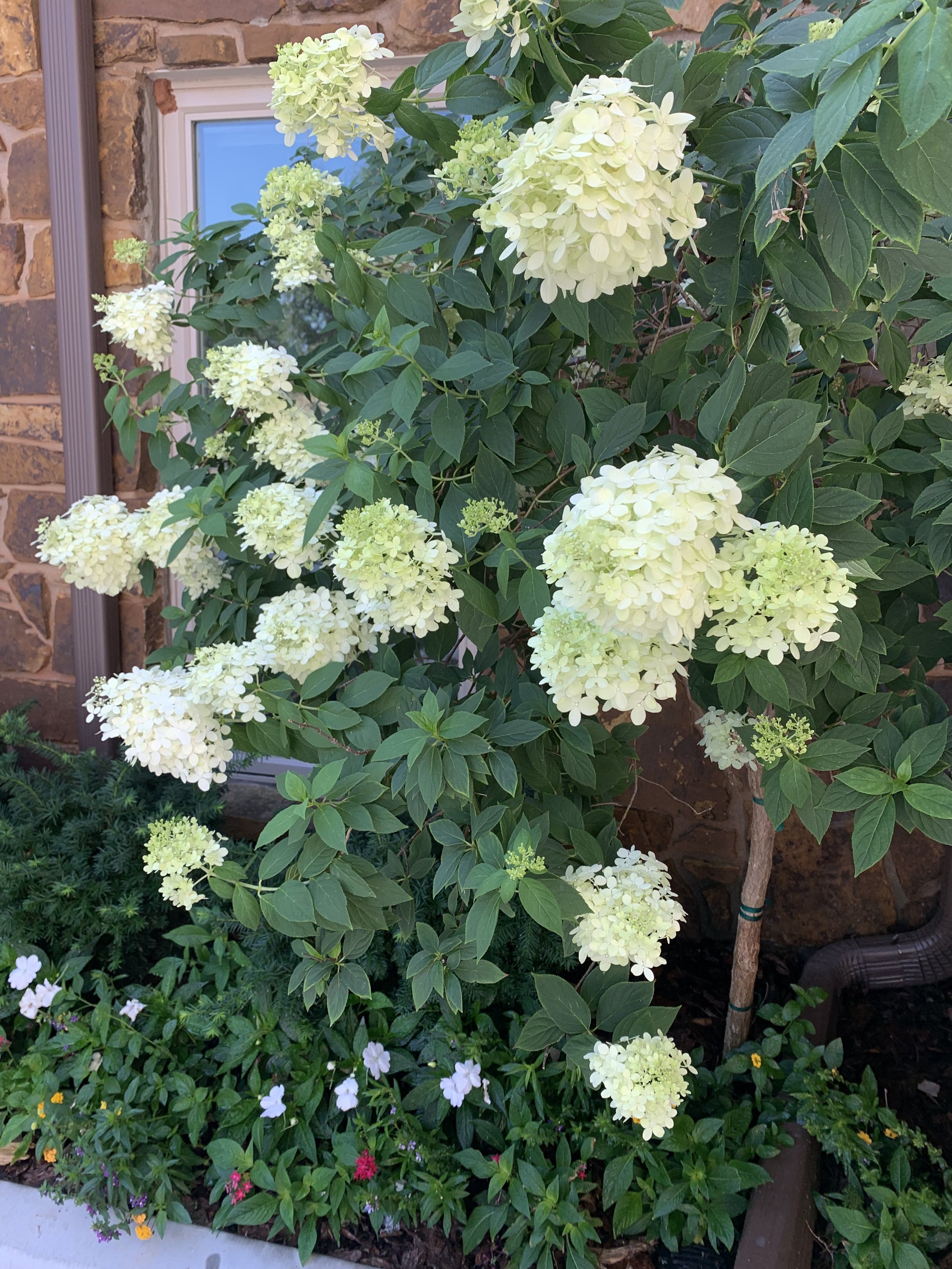
Limelight Hydrangeas make a big statement grown as a single-trunked small tree.
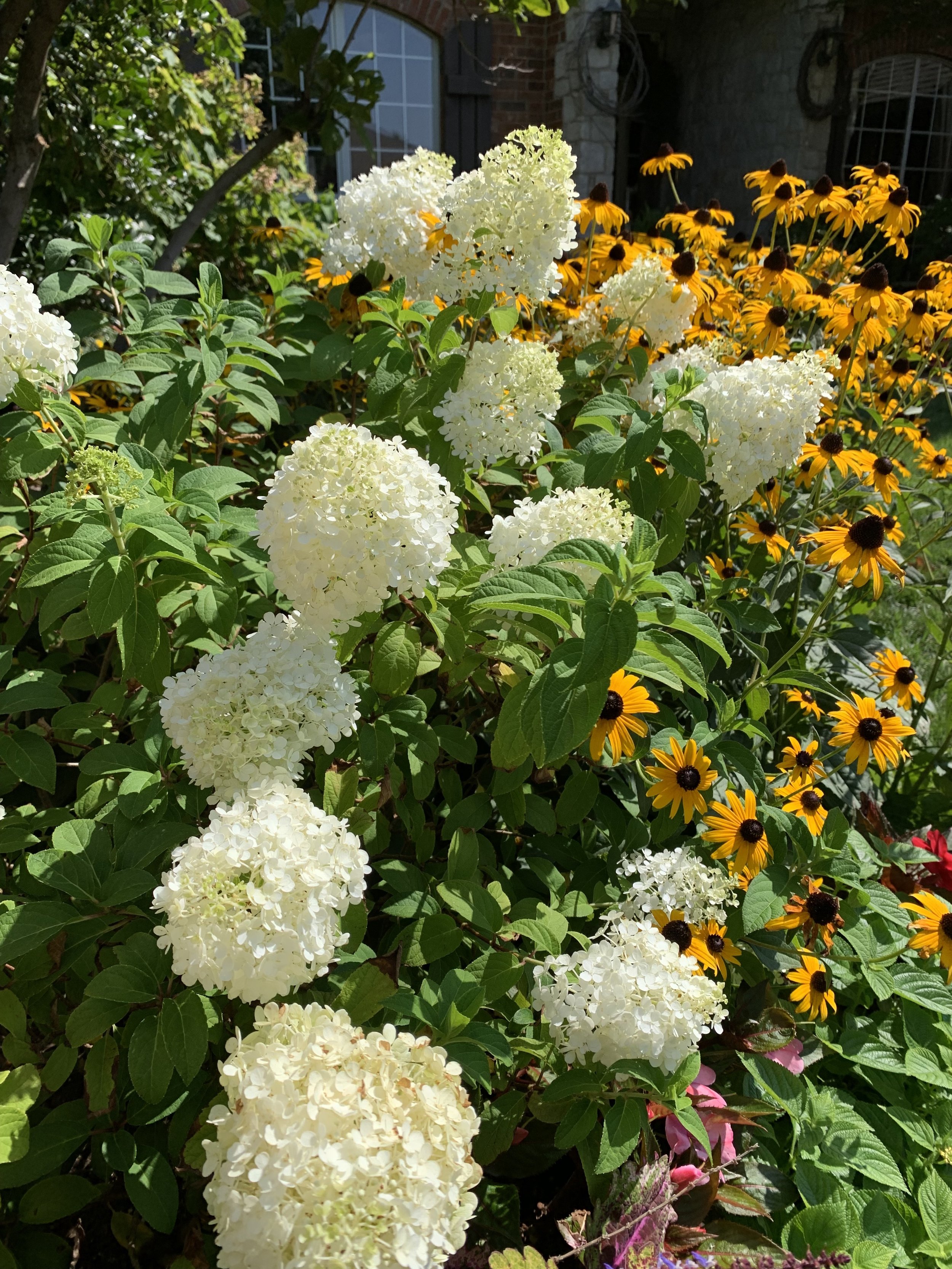
Bobo Hydrangeas are another dwarf variety of Limelight Hydrangeas. They grow in full sun to partial shade and produce large white blooms that turn pink. A characteristic of Bobo Hydrangeas is the strength of their stems. Unlike some panicle hydrangeas the blooms don’t weigh down the stems and flop over.

Limelight Hydrangea blooms gradually go from white to lime as they mature.

Limelight – Blooms in mid to late summer on new growth. Flowers start green, turn to white and then back to green. My favorite thing about Limelight is that it grows in full sun. A hydrangea game-changer: Summer blooming hydrangea in full sun! Limelights are typically large 6-8’ tall multi-trunked shrubs or can be trained into a single-trunked tree formed large shrub. For smaller areas, try the Little Lime or BoBo Hydrangeas which grow to 3’.

Limelight Hydrangea blooming in August in full sun.

Think you have to have a shady landscape to enjoy hydrangeas? Not the case with the Limelight Hydrangea. It grows in full sun with large lime to white blooms in mid-summer.

Fire Light Hydrangeas in the Myriad Garden in downtown Oklahoma City.
A late spring to early summer blooming hydrangea is the Oakleaf Hydrangea. The Oakleaf is one of only two hydrangea species native to the US in the SE from North Carolina, south to Florida and west to Louisiana.
Oakleaf Hydrangeas are named for the deeply lobed oak-like foliage. They grow 4-8’ tall and wide with a rounded habit. The white cone shaped flower clusters fade to pink in the summer and leaves turn deep red hues in the fall.
The Oakleaf prefers morning sun and evening shade. Too much shade and they become leggy, have fewer blooms and poor fall color.

Oakleaf – Instead of traditional mophead blooms, oakleaf hydrangeas have white clusters of cone shaped flowers. It is named for the large oak-like leaves that turn reddish-purple in the fall. It is a large shrub that blooms in the summer on new growth. It also requires less water than a traditional hydrangea.

Oakleaf Hydrangea

Oakleaf Hydrangeas is a large shrub that can reach 5-6’ with long, cone-shaped white flowers with large oak-like leavers that turn bright red in the fall.

Oakleaf Hydrangea in the Dallas Arboretum.

Oakleaf Hydrangea leaves in the fall turn vivid shades of red and purple.
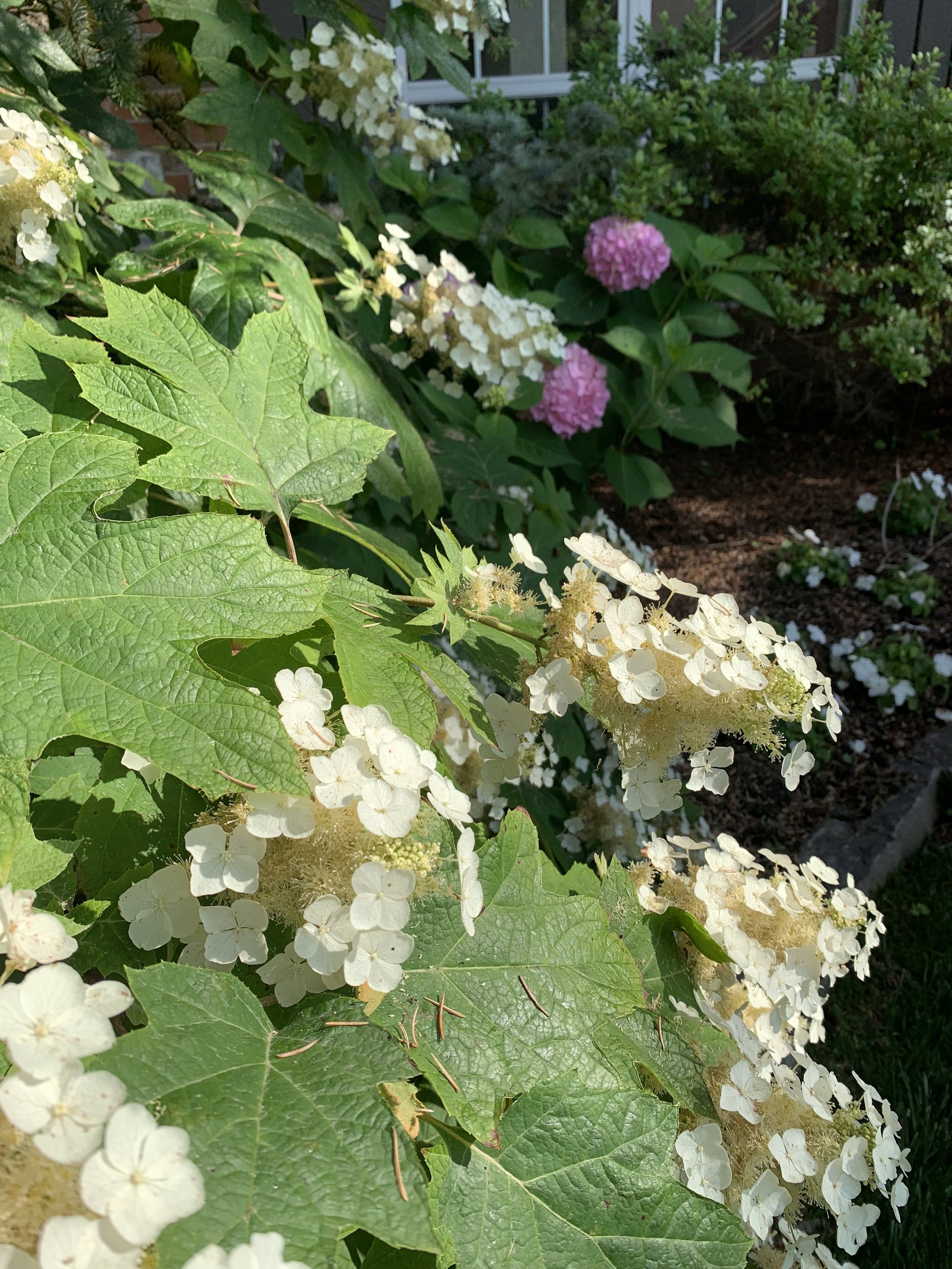
Oakleaf Hydrangea with Endless Summer in the background.
Other favorite hydrangea varieties:

Annabelle – A smooth hydrangea with white blooms on the new growth. Because it is fast growing, it is common for this hydrangea to be cut all the way to the ground each spring.

Phantom – Similar to Limelight but with color changing blooms that start in mid-summer as greenish white then gradually change to a blushing pink as summer transitions into fall. Phantom also grows in full sun.

Seaside Serenade Series by Monrovia – A more compact form of hydrangea ideal for smaller areas that blooms on both last year’s growth and new growth.
Pruning Hydrangeas
Most gardeners feel uncertain and confused about when and how much to prune hydrangeas. The truth is most hydrangeas do not need to be pruned at all. Occasionally, you may need to prune for shape or size, or remove some dead wood, but most seasons pruning can be skipped.
It is common to have some branch die back after the winter in our area. A common mistake is to get in a hurry when pruning back the winter damage. Be patient, don’t get in a hurry to remove dead branches. Wait until April before pruning off the dead branches. Pruning earlier, or pruning to the ground in the spring, could reduce or eliminate blooming this season. When it is time to prune back the dead ends, make your cuts at an angle just above the highest green bud.
When more pruning is required, it is important to know the type of hydrangea you have to know the right time to prune.
Bigleaf, Mophead, French Hydreanes. They bloom once per season in the early summer on old wood, meaning their buds are formed on last year’s growth. Pruning should be done during the summer. If they have become overgrown, remove up to ½ of the total stems by cutting them all the way to the ground. The plant will produce strong new stems that will flower next season. Nikko Blue is an example of this type of hydrangea.
Smooth Hydrangeas. They bloom on new wood, meaning buds are formed on new growth in the current season. Pruning should be done in late winter to early spring. Older smooth hydrangea varieties can become floppy and unruly. Don’t be afraid to prune this variety aggressively. Annabelle is an example of a smooth hydrangea.
Panicle Hydrangeas. They also bloom on new wood. Panicle hydrangeas rarely need to be pruned. But, if they were overgrown last season, prune up to 1/3 of the plant before they leaf out to create a more compact, rounded shape. Limelight is a panicle hydrangea.
Oakleaf Hydrangeas. Oakleafs like to be left alone. Pruning should be limited to removal of dead or broken branches. They bloom on old wood, so if there is a need to prune to improve the shape of the plant, pruning should be done in the summer after it finishes flowering.
Reblooming Hydrangeas. Hydrangeas that bloom on both old and new wood. Early in the season they bloom on the old wood from last season. During the current season they bloom on current season growth. All they really need is deadheading of spent flowers and removal of dead stems. The Endless Summer and Seaside Serenade series are examples of reblooming hydrangeas.

Reblooming hydrangeas in June at the Dallas Arboretum.

Wait until late April to early May to prune the dead from your Endless Summer Hydrangeas.

Oakleaf Hydrangeas rarely have winter die back and are best left alone.
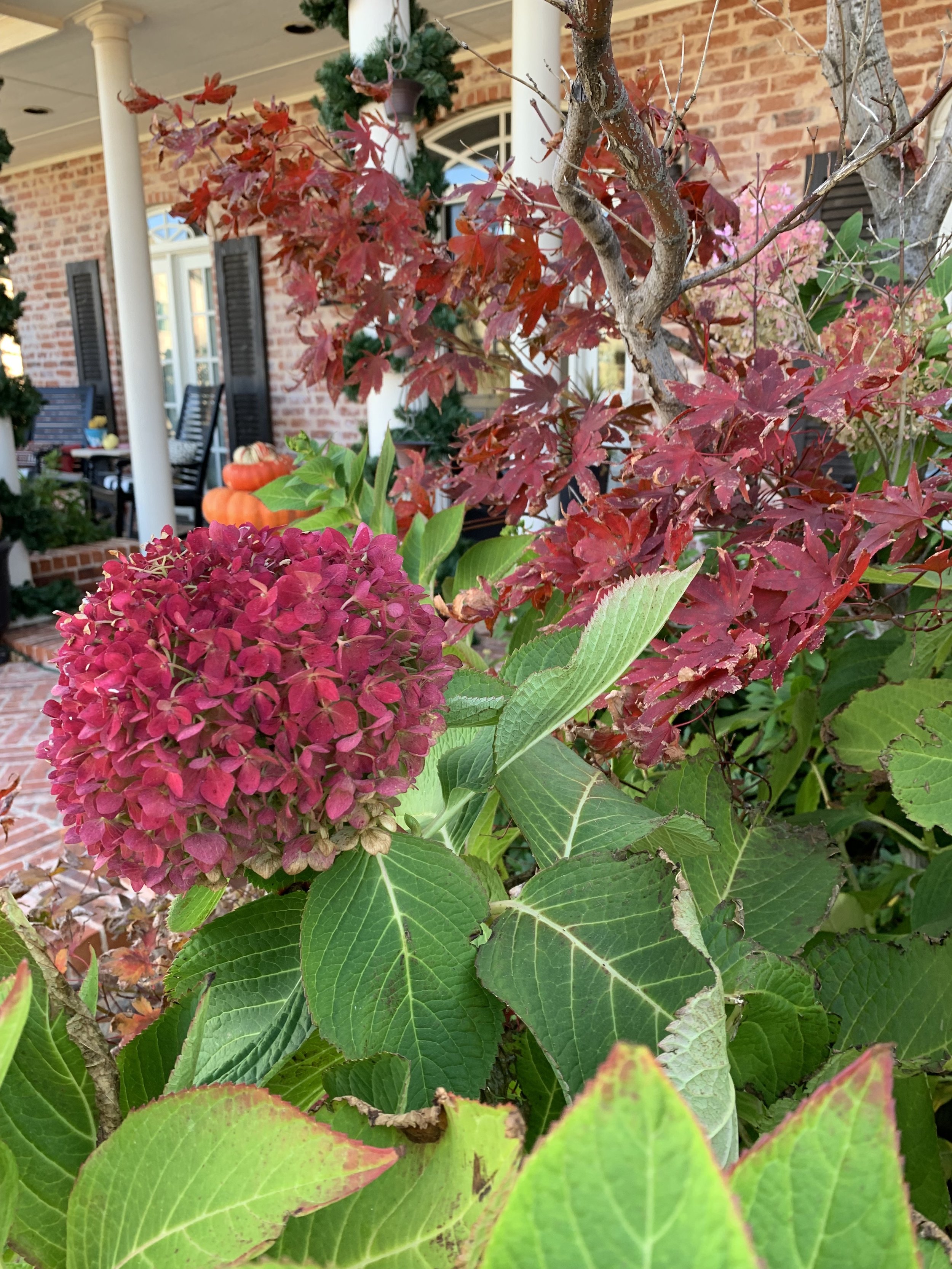
Leaving faded blooms on hydrangea will add interest changing color as they fade.

Deadheading Hydrangeas
Deadheading is the practice of removing spent blooms. You can deadhead hydrangeas, but you don’t have to. Deadheading can increase blooms but is mostly done to keep the plant looking neat. Some gardeners like to leave spent flowers on the plant for seasonal interest as they will change color as they fade. If you do deadhead, prune right above the first set of leaves below the spent flower. Cutting lower will remove emerging buds.
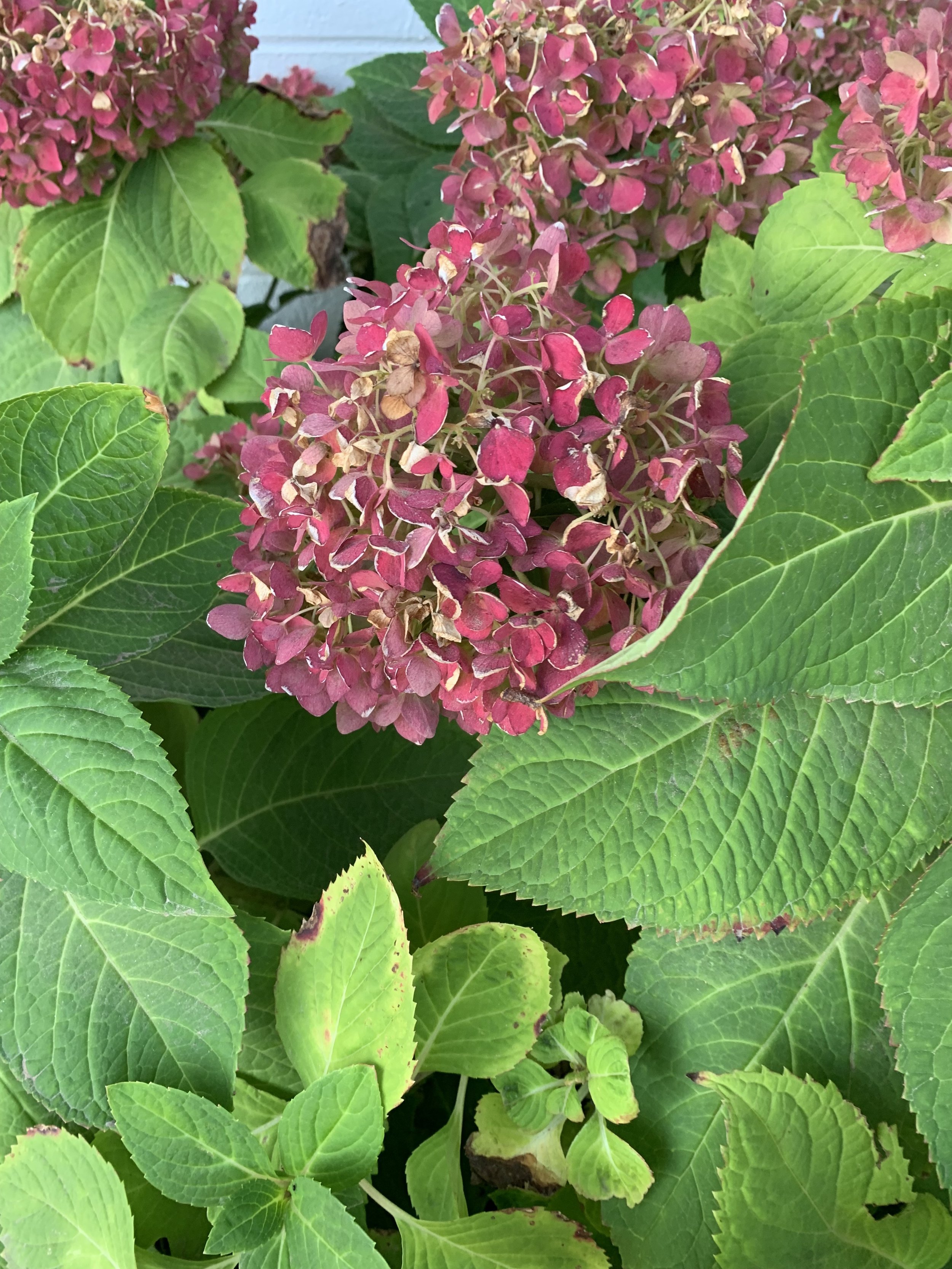
If you don’t deadhead your Endless Summer Hydrangeas the spent flowers will add color to your landscape in the fall. This is the Endless Summer Hydrangea in front of the Hall | Stewart office in October.
Planting Hydrangeas
Hydrangeas prefer rich, well drained soil in a location with morning sun and dappled to full shade in the afternoon and evening. The exception is the Limelight Hydrangea which can be planted in full sun. When planting in our tighter clay soil, start with a hole twice as big as the plant container. Incorporate compost and peat moss into the existing soil, fill the bottom of the hole with enough soil that the root ball will be slightly above the existing grade. Backfill around the root ball with the remaining mix of soil and amendments creating a ring outside the root ball creating area to retain moisture when watering.
Hydrangea Watering
Hydrangeas require more water in the heat of the summer. They perform best in soil that retains some moisture but does not stay wet. It is common for their leaves to wilt slightly on 90+ degree days and then rebound quickly when watered. A good deep soaking every other day in the summer is enough. A 2” layer of mulch will help retain moisture.

Endless Summer Hydrangeas are usually pink in our soils because of the pH being over 6. Sulfur can be used to lower the pH and turn the blooms blue.
Changing Hydrangea Flower Color
Excluding white hydrangeas and many of the new reblooming hydrangeas, soil is the greatest determinate to whether the flower blooms will be blue or pink. Soil with a pH below 6.0 (acidic) will have blue blooms. pH above 6.0 (alkaline) will produce pink flowers. Adding lime to the soil will change blue blooms to pink and adding sulfur will change pink blooms to blue. Endless Summer has a formulated product called Color Me Pink which adds lime to the soil to produce pink blooms and Color Me Blue which adds sulfur to encourage blue blooms. Similar products are avaible from Bonide.
Hydrangea Fertilizer
Hydrangeas respond well to fertilizer in the spring and early summer. Select a slow-release fertilizer that is high in phosphorus, the middle number on the fertilizer label. Phosphorus produces more blooms. If you fertilize with high nitrogen, the first number on the label, you will have more and larger leaves and less blooms.
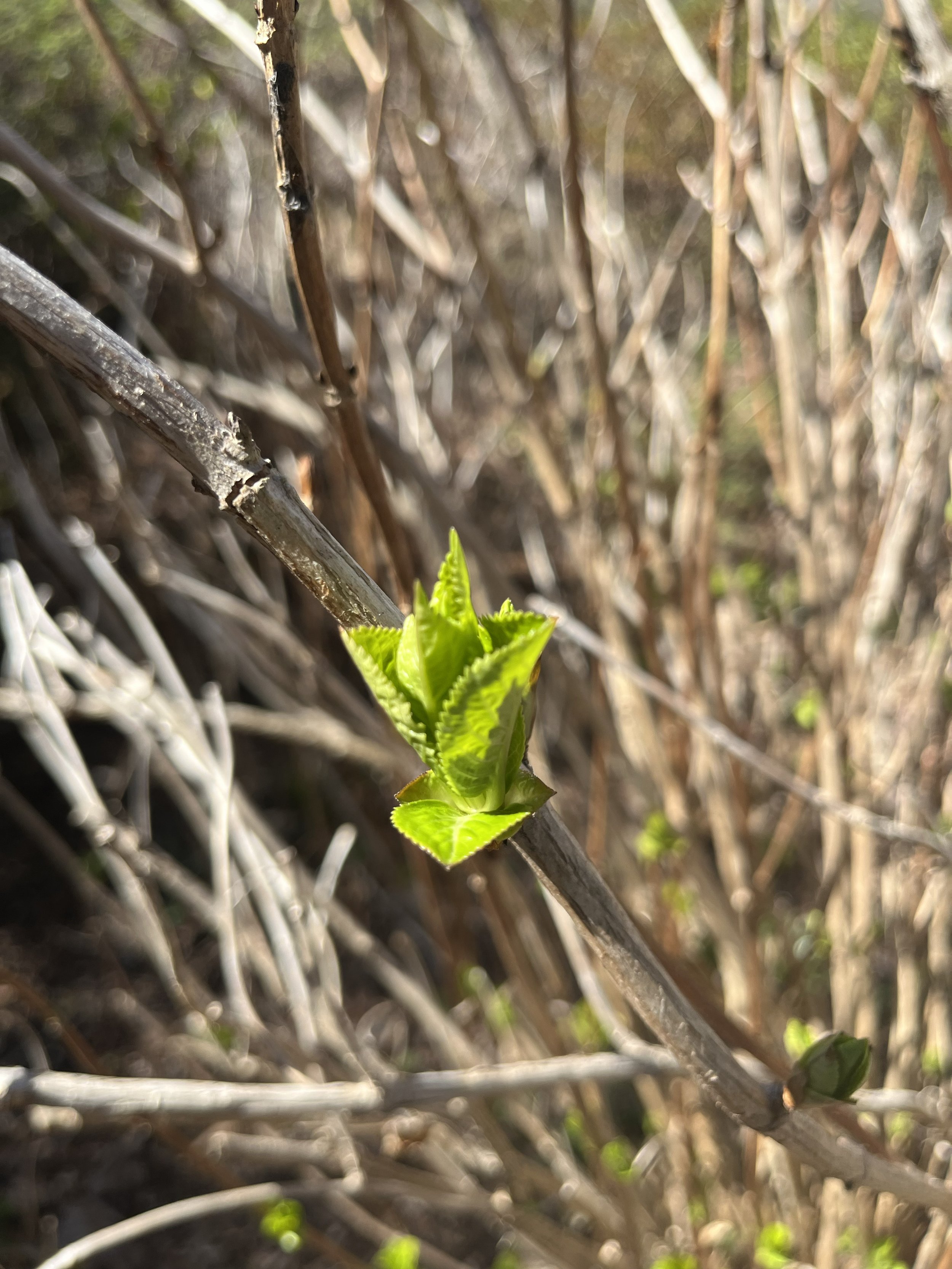
Hydrangeas are starting to bud. Wait until April to prune. Prune just above the highest bud on each branch.
Bonus Info: “Why aren’t my Endless Summer Hydrangeas blooming?”
Pruning – The most common blooming problem is a result of over pruning and pruning at the wrong time. Remember, it is best not to prune them at all. Really the only pruning recommended is at the beginning of the season to remove the brown stems left from the winter. Wait until April to prune and then only prune back to the first bud. During the summer, if you want to you can snip off spent blooms, but it is not required. Otherwise, keep the pruners and shears away from your hydrangeas. And…never prune in the fall.
Fertilizer – Hydrangeas needing fertilizer or having been fertilized wrong will always disappoint. As mentioned above they need slow-release high phosphorus fertilizer. If you are using a high nitrogen, low phosphorus fertilizer, you will have lots of pretty leaves and no blooms. Just remember – use a fertilizer with a low first number and a high second number.
Water – The right amount of water will make a difference. You don’t want the plant to be too wet or too dry. It is ok if they droop in the afternoon heat, but if they are still droopy in the morning, they need a good watering.
Sunshine – Hydrangeas bloom best planted in morning sun with dappled afternoon shade. When planted in a hot location such as on the south or west sides of a structure, they need to be protected from the scorching afternoon sun. The bottom line is you don’t want them to fry, and you don’t what them to go without some sun.
Soil Problems – What you plant your hydrangeas in will impact the results. Hydrangeas require well drained soil with a good amount of organic material. In our native soils it is best to adjust the soil when planting with ample amounts of pine bark, peat moss, and/or pecan hulls.

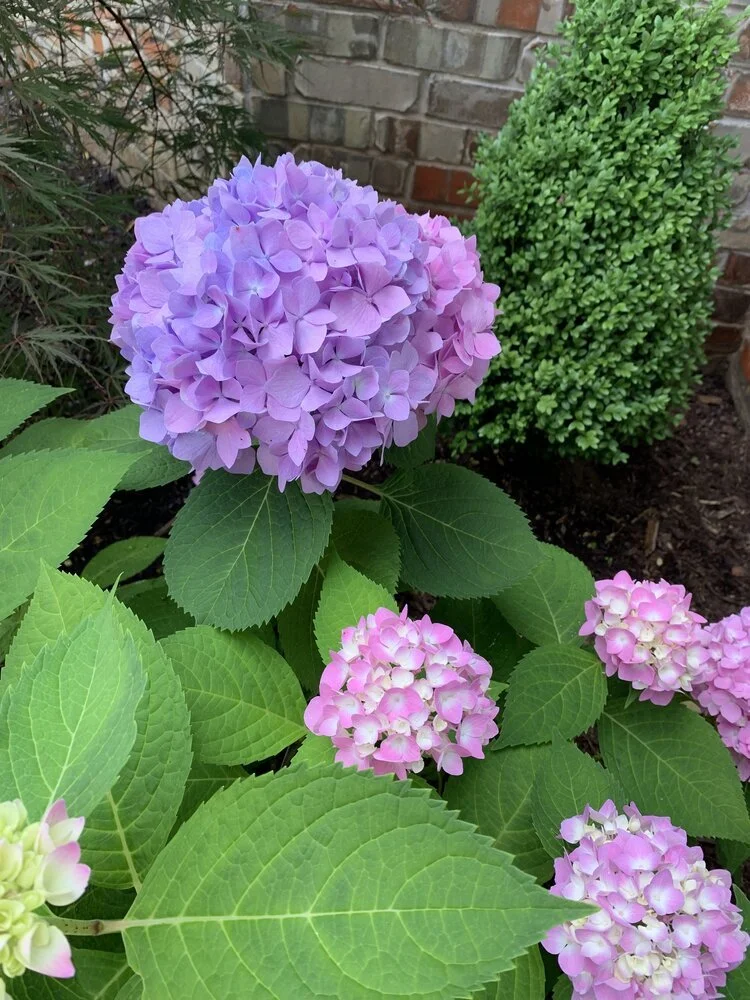
This Endless Summer Hydrangea was added to the landscape last spring and the homeowner was rewarded with extra large blooms this June.
I believe that there is a hydrangea just right for nearly every landscape.
Yes, they require a little more work when planting, and a little more attention to water, but otherwise they are not near as fussy as you would think.
Survey your landscape.
Pick a spot.
Take a trip to a landscape nursery.
Select the perfect hydrangea for your landscape.
It’s worth a try!
Lorne Hall
Hall | Stewart Lawn + Landscape
(405)367-3873